Compliance Posture Changes After Endpoint and Identity Stack Consolidation
Fragmented endpoint and identity tools can't produce continuous compliance evidence, no matter how much manual effort a team puts in. Consolidating device management, endpoint security, and identity into one platform is what turns compliance from a once-a-year scramble into something a company can prove on any given day. For a business with no dedicated security team, that shift is the difference between passing an audit by luck and passing one by design.
Compliance Verification: From Periodic Audits to Continuous Proof
Compliance used to run on a calendar. An auditor showed up once a year, asked for a folder of screenshots and policy documents, and left satisfied if the paperwork lined up. The question being asked was simple: are we covered? That question has changed. What auditors and frameworks want now is proof that holds up at any moment, not just the week before a scheduled review.
The change is sharpest at the endpoint. Securing a device used to mean one thing: is this laptop locked down, patched, and running antivirus? That's no longer the whole picture. In 2026, endpoint compliance means tracking where data comes from, where it travels, who touches it, and where it ends up. The device itself was never really the risk. The risk is what leaves it, whether that's a file copied to a personal drive, a spreadsheet uploaded to an unapproved SaaS tool, or sensitive data shared outside the company. A device can be fully patched and still leak regulated data every day.
Identity has gone through the same shift. It's now the leading way companies get breached, so identity controls can't sit in the background as a backup measure and have to work as a first-line compliance requirement, provable on demand. A company can no longer point to a policy document that says MFA is required and call that sufficient. Auditors and insurers want to see that the control is active, enforced, and logged right now, not that it was configured correctly at some point in the past.
Compliance has moved from a point-in-time assertion to a continuous state that has to be demonstrated, not just claimed.
How fragmented stacks make continuous compliance structurally impossible
Running separate tools for endpoint management and identity doesn't just add overhead. It creates gaps in coverage that no amount of manual checking can close, because the tools were never built to talk to each other.
Legacy endpoint tools were built around antivirus, patch management, device configuration, and access control. Those are real capabilities, but they stop at the edge of the device. None of them can answer what happens after a file gets downloaded. None of them can say whether that file was uploaded to a SaaS tool, copied to removable storage, or emailed to a personal account. The tools were built to secure the box, not to track what moves through it and out.
Identity has its own version of this problem. A company running multiple IAM vendors ends up with multiple sets of audit logs, each in its own format, each enforcing policy at a different boundary, each with its own blind spots. None of those logs line up cleanly. When an auditor asks for one unified record of who had access to what and when, the honest answer is that no such record exists. Someone has to build it by hand, pulling exports from three or four systems and hoping the timestamps and user IDs match up well enough to tell a coherent story.
That reconciliation work is where the real risk lives. The compliance gap grows widest exactly where device management and identity overlap. The moment a user logs in from an unmanaged device, or a dormant account gets reactivated without anyone noticing, the two systems governing that event have no shared language. One sees a device. The other sees a login. Neither sees the full picture, and stitching the two together after the fact is slow, error-prone, and often incomplete. This is why fragmentation is a structural problem rather than an effort problem: a team can work harder and still not close a gap built into the architecture itself.
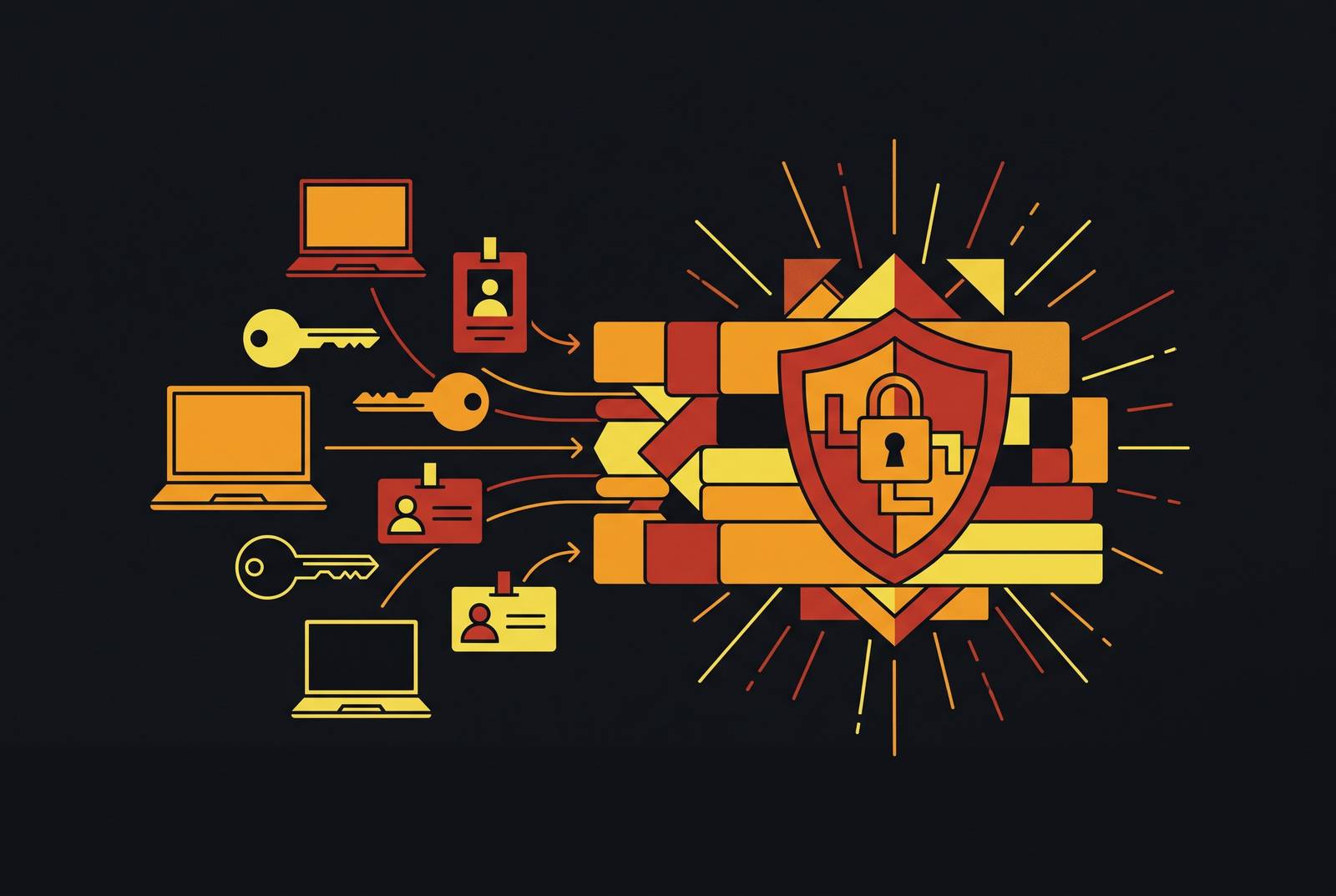
Fragmented endpoint and identity stacks create compliance blind spots that manual effort cannot close reliably. Consolidating these systems into a single platform removes the reconciliation burden by putting device state and identity context under one policy model, governed from a single control plane instead of pieced together across sources that were never designed to work together.
What a consolidated stack unifies, and what that makes enforceable
Consolidation collapses the boundary where policy gets enforced, so that device state, identity context, and data movement all answer to one control plane instead of three systems that can't see each other, rather than simply cutting down the number of vendor invoices a company pays each month.
That shared control plane changes what a company can actually enforce in real time. When device management and identity sit inside the same platform, policy can respond to live device posture. A user logging in from a device that's out of compliance, say, missing an OS update or running without disk encryption, can be blocked or limited before ever reaching a sensitive file or system. That kind of conditional access only works if both systems are reading from the same information at the same moment. Split across two platforms, that handoff either doesn't happen or happens too slowly to matter.
The same logic applies to data movement. Endpoint compliance now needs to include discovering where sensitive data sits on a device, watching that data move in real time, tracking files once they leave the endpoint, and stepping in immediately. None of that works without the endpoint agent and the identity layer sharing context about who's doing what with which file.
Identity gains a clearer picture when its tools share telemetry. Identity Security Posture Management looks for weak or missing MFA, accounts that have gone dormant, and users with more access than they need. Identity Threat Detection and Response catches session hijacking and MFA flooding as they happen. Run separately, each discipline sees only part of the picture. Run on shared telemetry with the device layer, they reinforce each other, because a posture issue and a live threat often trace back to the same underlying account.
A newer model, often called Endpoint Control and Prevention, pushes this further. Instead of waiting for a compromise and then killing the process, these platforms intervene earlier, using software governance, workflow controls, behavioral guidance, and enforcement built into the flow of normal work. Prevention taking the place of response isn't just a technical upgrade. It changes what a company can honestly claim about its compliance posture: a prevented incident never generates a remediation story.
When device management and identity live in the same platform, policy enforcement becomes conditional on both device posture and identity context at the same time, a model that blocks or scopes down access before a user ever reaches a sensitive resource.
Evidence Auditors Receive: From Detection to Prevention
A unified, prevention-first stack doesn't just produce compliance evidence faster. It produces a different category of evidence. Instead of a log assembled after the fact to satisfy an audit request, it generates a live, per-action record that ties every enforcement decision to the specific data type, the channel it moved through, and the policy rule that triggered the response.
Frameworks want proof that regulated data can't quietly walk out the door. A unified platform logs every detection and every enforcement action as it happens, which hands auditors a direct trail instead of a verbal assurance, with each record already mapped to the data categories a given framework cares about.
There's a real difference between detecting a problem and acting on it immediately. Older tools flag an issue, generate an alert, and open a ticket for someone to review later. A unified platform detects and acts in the same motion. That immediacy is what turns a compliance control from something a company hopes is working into something it can show is working.
Identity tooling adds its own layer of proof. An Identity Security dashboard gives a single view of identity-related risk and posture across the organization. Coverage and Maturity tooling points out where gaps in deployment exist and helps prioritize what to fix first. Both produce structured, searchable records that an auditor can review directly, rather than records that someone has to assemble by hand from scratch.
The audit conversation itself changes as a result. Instead of an auditor asking for evidence and a team scrambling to pull it together, the auditor reviews a record that already exists, independent of the audit cycle. That raises the next question naturally: what does it actually take to get to that point, especially for a company that has no dedicated security staff to manage the transition?
Delayed Consolidation and the Cost of the Identity Threat Landscape
The cost of staying fragmented is climbing, largely because of how fast non-human identities are multiplying. Agentic AI is the fastest-growing frontier in identity and access management, and most organizations are already experimenting with it or actively using it. Every one of those agents is an identity that needs governance, and most receive none.
These agents aren't theoretical. Right now, in production environments, AI agents are reading emails, writing code, querying databases, posting messages in Slack, filing support tickets, and making API calls across dozens of systems. Most of that activity runs through shared service accounts, long-lived API keys, and ownership that was never formally assigned. No IT department can fully account for every agent operating this way, and every agent added to that list adds to the compliance exposure.
Attacker behavior has moved in step with this. Session hijacking, MFA flooding, and admin impersonation are now the standard approach against any environment where identity governance is spread across disconnected systems. Attackers have learned exactly where the seams are, and fragmented identity stacks are full of seams.
Multifactor authentication alone doesn't close that gap anymore. Attackers get around it with adversary-in-the-middle phishing, by stealing sessions and tokens outright, and through social engineering aimed at helpdesk staff. A company that treats "MFA is enabled" as proof of a secure identity posture is measuring the wrong thing, because that single fact says nothing about whether a session can still be hijacked or a helpdesk agent tricked into resetting the wrong account.
Deployment Needs for a Lean Team Without Security Staff
For a company with no dedicated security team, the value of consolidation is that one platform keeps enforcing policy continuously, without requiring someone on staff to monitor five tools, reconcile their logs, and assemble evidence by hand every time a question comes up.
The priority order for a lean team should follow the same order as the compliance risk itself. MFA needs to be enforced consistently across every point of access, not just the obvious ones. Endpoint protection needs to include behavioral detection, not just antivirus signatures. Identity posture monitoring needs to actively surface dormant accounts and users with excess access before an attacker finds them first. And logging needs to run continuously, producing audit-ready records without anyone having to stop and build a report from scratch.
Speed of deployment matters here as a compliance factor in its own right, not just a convenience. A platform that takes days to roll out, rather than months, shrinks the window where controls are half-built and evidence trails have gaps in them. That window is visible directly in audit findings and in cyber insurance reviews, both of which increasingly expect to see controls working, not just documented. Insurance carriers now expect multifactor authentication, endpoint detection and response, tested backups, vulnerability management, and active monitoring, all demonstrable on request.
A handful of vendors address pieces of this problem. Some specialize in endpoint detection and response, a category widely used and well regarded for catching and responding to device-level threats. Others focus on identity governance alone. Few combine device management, endpoint security, identity protection, and compliance automation into one platform built specifically for a company with no in-house security staff. Zip Security is one option built around that gap: it deploys a complete security program, covering device management, endpoint protection, identity protection, and compliance automation, in about two weeks, without months of outside consulting work. That speed matters because it gives a lean team continuous enforcement and an audit-ready evidence trail from early on, rather than the patchwork a fragmented set of tools tends to produce. Zip Security is built for companies that need to pass audits, win enterprise deals, and stay protected without carrying a dedicated security team on payroll.
Continuous compliance used to require headcount most small and mid-sized companies didn't have. With endpoint and identity consolidated into a single stack, it becomes something a lean team can maintain on an ordinary workday, not just something they scramble to fake once a year.