Continuous Control Monitoring Versus Point-in-Time Evidence in Modern GRC Tools
Always-on monitoring catches control failures regulators now require you to find.
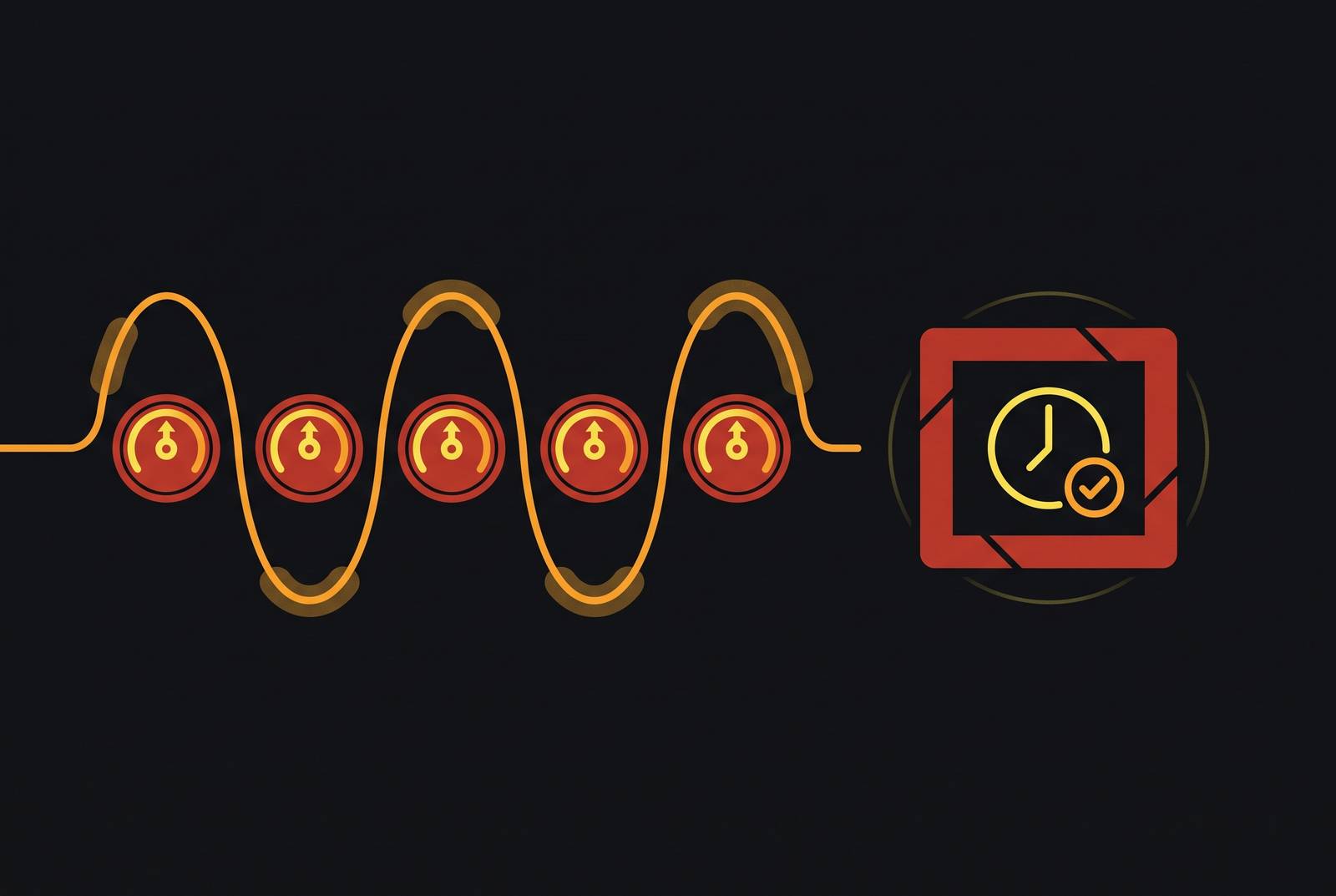
Continuous control monitoring closes that gap by turning compliance from a periodic fire drill into an always-on operational state, and modern GRC tools are increasingly built around this distinction.
Why annual audits create a structural blind spot
Point-in-time evidence collection tells you what was true on the day someone checked. It says nothing about what happened the day after. A control can pass on Monday and quietly fail on Tuesday, and nobody finds out until the next audit cycle rolls around.
Most compliance programs still run on the audit-as-event model. In the six to eight weeks before an auditor shows up, teams are scrambling: collecting screenshots, chasing engineering for configuration records, trying to reconstruct evidence for controls that may or may not have actually been running the whole time. The report gets issued, everyone exhales, and the program goes dormant again until next year's scramble starts on schedule.
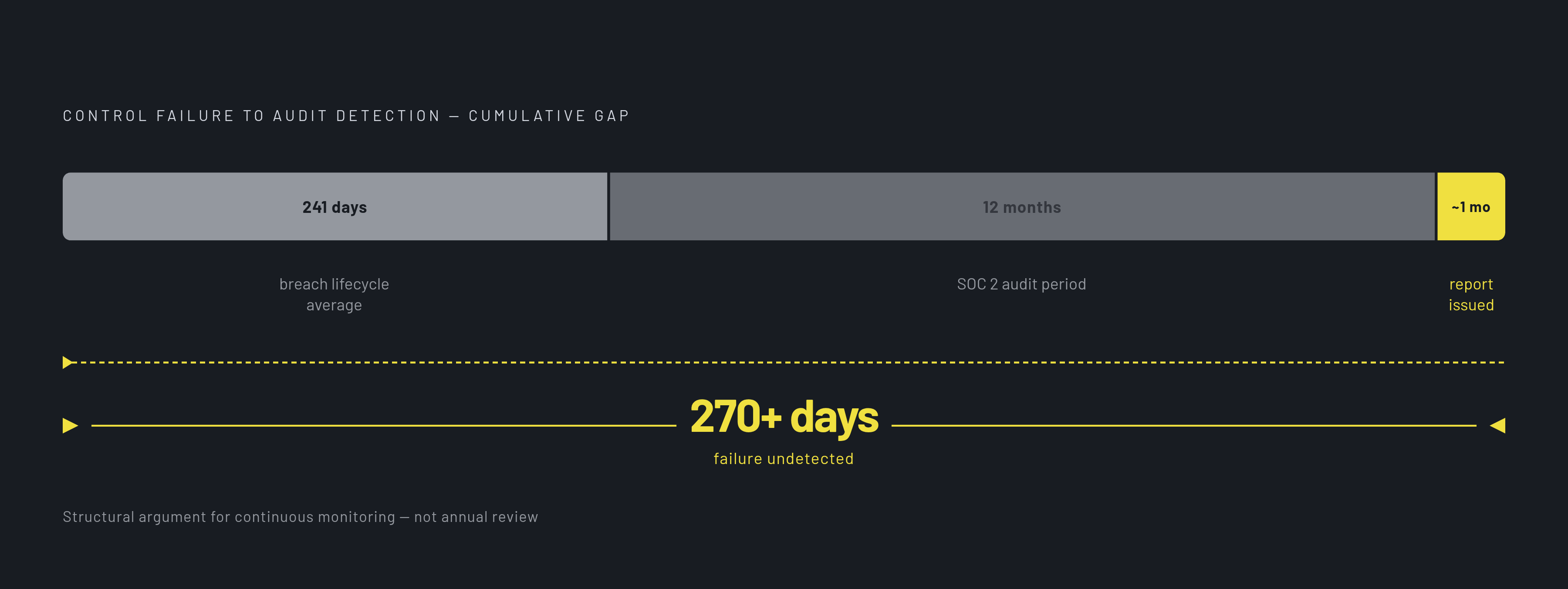
The timing gap gets this bad. The global average breach lifecycle runs about 241 days Continuous Compliance Monitoring: The Complete 2026 Guide Best GRC Platforms for Risk and Compliance in 2026 | HackerNoon. A standard SOC 2 audit covers a full 12-month window and the report itself is issued roughly a month after that period closes Continuous Compliance Monitoring: The Complete 2026 Guide Best GRC Platforms for Risk and Compliance in 2026 | HackerNoon. Do the math and a control failure can sit undetected for more than 270 days before an audit even has a chance to catch it Continuous Compliance Monitoring: The Complete 2026 Guide Best GRC Platforms for Risk and Compliance in 2026 | HackerNoon. That's not a scheduling inconvenience. It's a structural property of how point-in-time evidence works: it can only tell you about the past, never about right now.
None of this is happening in a static environment, either. Cloud infrastructure changes constantly, and engineering teams push configuration changes that shift compliance posture without anyone flagging it as a compliance event. Annual audit cadences were built for a slower-moving world, one where systems didn't change shape every sprint. Meanwhile enterprise buyers have started asking about compliance posture mid-sales-cycle, not just at renewal time, and a program built entirely around once-a-year snapshots has no real answer for that question in month six.
What continuous control monitoring means mechanically
Continuous control monitoring isn't just "auditing, but more often." An audit answers one question: what was true on the day the auditor looked. Continuous monitoring answers a different one, in real time: what's true right now, and did anything just change. That distinction is the entire point.
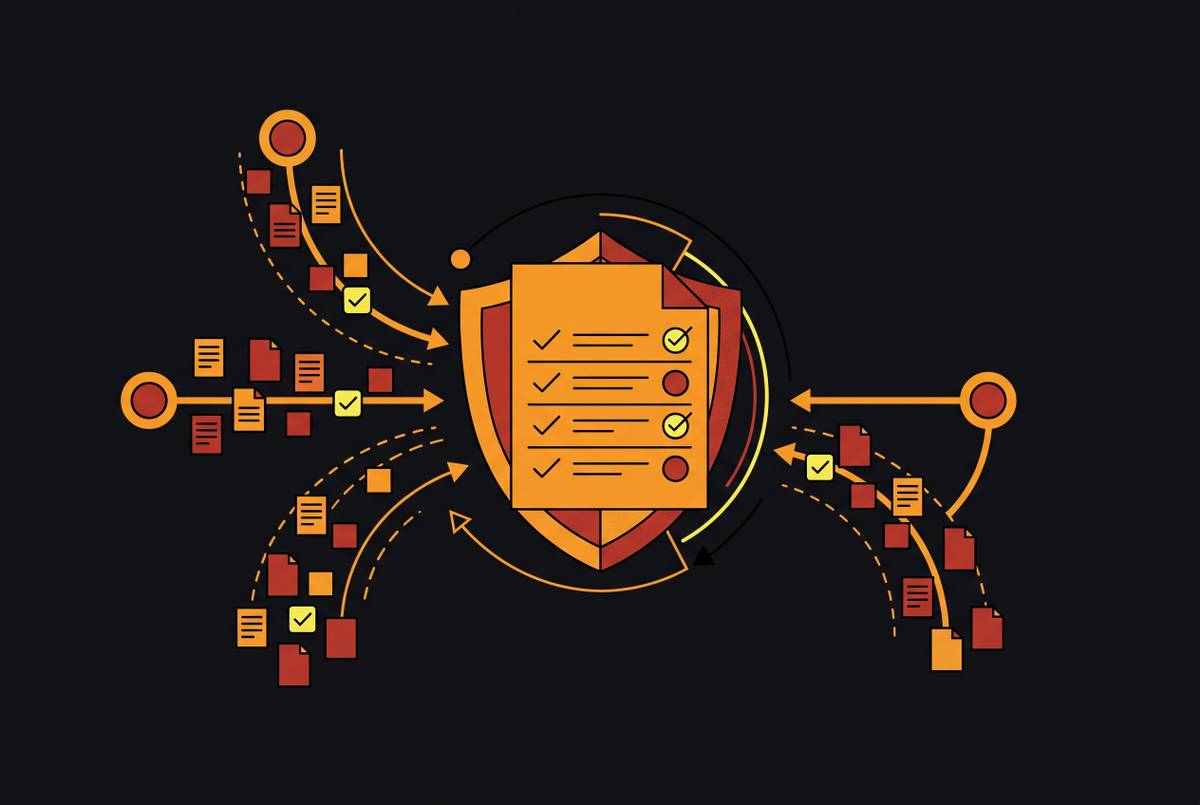
A monitoring program that actually functions, rather than one that just looks good in a sales deck, tends to have five moving parts working together. First, control mapping: a library that ties each control to the specific framework requirements it satisfies, so monitoring activity isn't happening in a vacuum disconnected from what it's supposed to prove. Second, automated control testing that runs on its own schedule, checks actual configuration against expected state, and spits out a timestamped result without a human having to kick it off. That's categorically different from a person doing a spot-check once a quarter.
Third, real-time evidence collection: automated ingestion of the evidence that systems already produce as a byproduct of running normally. When the auditor eventually shows up, the evidence is already sitting there waiting, not being assembled the week before. Fourth, alerting and remediation: a failed control triggers a notification immediately and gets fixed before it becomes an audit finding, rather than appearing months later during the next review. Fifth, multi-framework reporting: one control test can often satisfy several overlapping requirements at once. A single encryption test, for instance, can cover SOC 2's CC6.1, ISO 27001's Annex A 8.24, HIPAA's § 164.312(a)(2)(iv), and PCI DSS Requirement 3 simultaneously Best GRC Platforms for Risk and Compliance in 2026 | HackerNoon SecurityPulse.
That last point affects how easily a program scales to new frameworks. Cross-framework mapping means evidence gets collected once and reused everywhere it applies, so adding a new framework becomes incremental work instead of starting from scratch. It's rarely a missing control. It's a control that ran fine but left no traceable record behind, an evidence gap rather than a control gap.
Telemetry-driven versus evidence-scheduled is one more distinction that matters when evaluating any tool that claims to do this. Some platforms pull live telemetry directly from cloud infrastructure, EDR, SIEM, and IAM systems. Others just run scheduled evidence uploads on a timer, which is really automated periodic testing wearing continuous monitoring's clothes. The two look similar in a demo Continuous Compliance Monitoring: The Complete 2026 Guide Best GRC Platforms for Risk and Compliance in 2026 | HackerNoon. They behave very differently at 2am when a config drifts Continuous Compliance Monitoring: The Complete 2026 Guide Best GRC Platforms for Risk and Compliance in 2026 | HackerNoon.
The regulatory signal that made CCM mandatory, not optional
This shift isn't optional anymore in a lot of the frameworks that matter. PCI DSS v4.0 made continuous monitoring a mandatory requirement as of March 2025 Continuous Compliance Monitoring: The Complete 2026 Guide.
FedRAMP went further and built an entire program category around it, aptly named Continuous Monitoring. Organizations still leaning on spreadsheets to manage this report 42% higher non-conformance rates during FedRAMP and GovRAMP assessments continuumgrc.com. That's the difference between passing and failing an assessment because of a process choice, not a security gap.
The pattern across the major frameworks is consistent enough to call it a signal rather than a coincidence: point-in-time snapshots are no longer considered sufficient evidence of control effectiveness, full stop SecurityPulse. And the regulatory landscape isn't slowing down to let anyone catch up. DORA, the EU AI Act, and a growing stack of AI governance standards are adding new compliance layers on top of what already exists, and more than 76% of CISOs say fragmented regulation is seriously affecting their ability to stay compliant Best GRC Platforms for Risk and Compliance in 2026 | HackerNoon. Organizations still running manual, audit-only programs aren't just behind best practice at this point. They're increasingly out of step with the actual requirements written into the frameworks they're being assessed against. NIST SP 800-53 has required it under the CA-7 control family for over a decade; Rev 5 reinforced continuous monitoring alongside ISO 27001:2022's strengthened Annex A monitoring requirements SecurityPulse.
The adoption gap: most organizations know CCM is the answer and still haven't built it
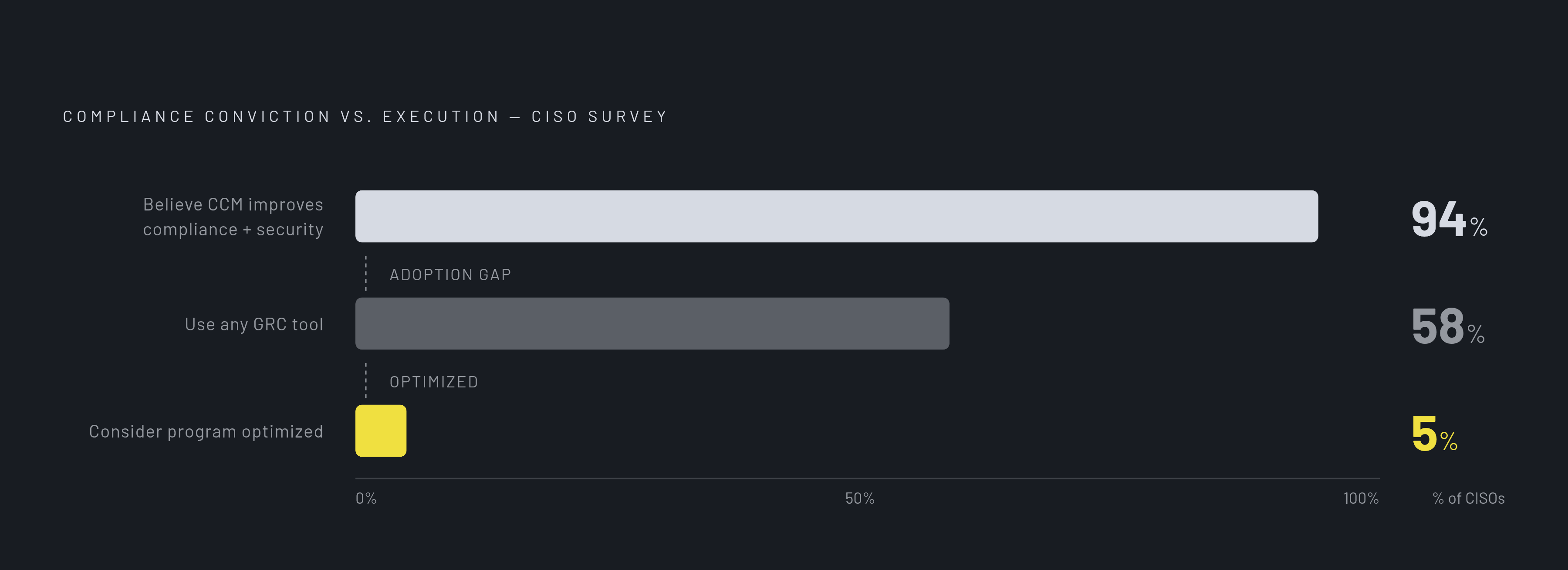
58% of organizations already use some GRC tool to manage compliance evidence, but only 5% consider their compliance program actually optimized for efficiency or continuous improvement How Can Organizations Build Better GRC Habits in 2025? | CSA. That's not a tooling gap.
It gets stranger. Of that same pool of CISOs surveyed, 94% believe continuous control monitoring will improve both compliance and security at their organization How Can Organizations Build Better GRC Habits in 2025? | CSA. So the belief is nearly universal. The execution is almost nonexistent. Compliance teams are still spending roughly 12 working weeks a year on manual tasks: gathering evidence by hand, tracking controls in spreadsheets, prepping for audits the old way Best GRC Platforms for Risk and Compliance in 2026 | HackerNoon. Twelve weeks is close to a quarter of a working year spent on activity that CCM is specifically built to eliminate.
So what's actually stopping people? Culture, mostly, more than money. 55% of CISOs point to cultural barriers inside their own organization as the main obstacle, ahead of cost concerns How Can Organizations Build Better GRC Habits in 2025? | CSA. Financial resistance is still a factor, at 31.1%, but it's clearly not the leading blocker How Can Organizations Build Better GRC Habits in 2025? | CSA. Nearly 80% admit to real duplication in their compliance efforts, doing the same work multiple times across frameworks that could have shared it Continuous Compliance Monitoring: The Complete 2026 Guide. And more than half cite a shortage of skilled staff as their single biggest challenge.
79.8% of CISOs name reduced manual processing as the biggest opportunity automation offers them, and yet the habit of manual collection just persists, year after year, survey after survey How Can Organizations Build Better GRC Habits in 2025? | CSA. Buying the tool isn't the hard part. Buying it and never actually changing how the organization operates day to day, that's the trap. CCM only works as a sustained operational shift, from compliance being something you do once a year to compliance being something that's just always running in the background. A tool sitting unused doesn't monitor anything.
Layer AI risk onto this and the gap widens further. Organizations that haven't built the monitoring muscle are trying to catch up on two fronts simultaneously, not one Continuous Compliance Monitoring: The Complete 2026 Guide Best GRC Platforms for Risk and Compliance in 2026 | HackerNoon. Over 50% report compliance is not embedded in their CI/CD pipeline How Can Organizations Build Better GRC Habits in 2025? | CSA. The gym membership trap framing from CSA holds that buying a GRC tool is necessary but not sufficient; it has to be part of a sustained operational shift from compliance-as-event to compliance-as-constant. Only 13% of organizations feel very prepared to manage generative AI risks, which matters because AI is now both an accelerant for attackers and the engine for modern CCM platforms Best GRC Platforms for Risk and Compliance in 2026 | HackerNoon.
What CCM delivers when it is working
When a monitoring program is actually running the way it's supposed to, the six-to-eight-week audit scramble collapses down to a matter of days, or by another estimate, two to three weeks, with total compliance-related costs dropping 25 to 40% on average Continuous Compliance Monitoring: The Complete 2026 Guide. That's not a marginal efficiency gain.
Evidence automation is where a lot of that time savings actually comes from. Somewhere north of 80% of evidence collection can be automated outright, replacing the frantic manual reconstruction sprint with an evidence library that's continuously populated in the background Continuous Compliance Monitoring: The Complete 2026 Guide. Posture visibility changes from a quarterly snapshot into something leadership can speak to accurately in the middle of a sales call, not just at the next scheduled review, because the evidence is continuously available rather than compiled periodically.
Remediation speed is the other half of the payoff. Controls monitored continuously and fixed promptly fail at meaningfully lower rates than controls that only get checked once a year. That math isn't close.
AI is doing real work inside this shift too, not just riding along as a buzzword. Continuum GRC reports cutting manual audit fatigue by up to 70% through real-time monitoring across NIST SP 800-171 Rev 3 and CMMC 2.0 continuumgrc.com. Hyperproof's customer Appian automated control orchestration across more than 100 frameworks at once, cut duplicative controls by 66%, and saved 350 hours a year on audit prep alone hyperproof.io.
The real payoff is a change in posture, though the metrics are genuinely good. Teams stop spending their energy proving they're secure after the fact and start actually improving security in the moment, because the feedback loop is measured in minutes instead of months. The GRC function moves from reactive to predictive, which is a different job entirely. IBM's 2025 Cost of a Data Breach Report associated extensive use of AI in security with $1.9M in breach-cost savings; AI-driven risk scoring, automated evidence evaluation, and forecasting of future compliance risks are now embedded capabilities in leading platforms Continuous Compliance Monitoring: The Complete 2026 Guide vanta.com.
How the major GRC platforms differ on CCM in practice
The single most useful question to ask any vendor claiming continuous monitoring is whether it's telemetry-driven or evidence-scheduled. Plenty of platforms market themselves as continuous while actually running on a scheduled-upload model that's closer to automated periodic testing. How often are controls actually tested, and how does the platform alert when one fails? What share of evidence collection can genuinely be automated for a given tech stack? Does the platform tie risk assessments to control effectiveness in real time, and can it show control findings automatically updating a risk score, or is that step still manual?
Vanta is recognized as a Leader in the IDC MarketScape 2025, connects to infrastructure through more than 400 integrations, and runs over 1,400 automated tests every hour across a base of more than 16,000 customers in 55-plus countries. It's positioned as an agentic trust platform with AI-native evidence evaluation and cross-framework automation. The HackerNoon piece describing it this way was written by Vanta itself, so that framing deserves the same scrutiny anyone gives vendor-authored content Continuous Compliance Monitoring: The Complete 2026 Guide 5 best GRC software solutions for enterprise teams in 2026 | Vanta.
Hyperproof offers an intuitive setup and a broad integration library, with real customer results like Appian's cross-framework orchestration to back it up. By CyberSaint's own comparison, though, its CCM isn't telemetry-driven and doesn't tie real-time risk scoring to control results, making it a strong fit for mid-market teams wanting automated evidence workflows more than for teams chasing true real-time CCM. AuditBoard, now operating as Optro, is regarded as best-in-class for internal audit and SOX work, but its continuous monitoring features are tied to audit cadence rather than live telemetry, so it's not built from the ground up as a continuous assurance engine. OneTrust covers privacy, governance, and data protection broadly, but its monitoring is event-driven rather than telemetry-based, needs heavy configuration, and fits best as a layer added onto existing privacy or governance workflows rather than a primary CCM engine.
A handful of others appear across the source material with less detail attached. Secureframe, Sprinto, Drata, and Anecdotes all appear in industry top-five lists for 2026 and get grouped among GRC-first SaaS platforms. Scrut is named specifically for SOC 2 work, while Thoropass and Tugboat Logic get filed into an enterprise-grade tier for complex multi-framework programs, though without much granular detail behind the label.
MetricStream brings a mature, scalable enterprise architecture to governance, risk, audit, and compliance work broadly, but its monitoring runs periodic rather than continuous, with limited native telemetry integration, so approximating real-time monitoring takes significant setup work. ServiceNow can pull off a form of CCM by leaning on its own ITOM, SecOps, and CMDB data, but it wasn't purpose-built as a monitoring engine. How well it actually performs depends entirely on how deeply an organization has customized its environment, and the focus leans toward process over measuring control effectiveness directly. RegScale brings strong evidence automation and regulatory mapping, particularly useful for government and compliance-heavy environments, though it leans on documentation more than technical telemetry. BitSight sits in a different category entirely: it's built for external attack surface visibility and vendor risk scoring, not internal control monitoring, so it complements an internal CCM program rather than replacing one. CyberSaint, by its own account, natively ingests telemetry from cloud, EDR, SIEM, IAM, and vulnerability systems and produces board-ready reporting reflecting current risk posture rather than historical snapshots, and that description is vendor self-assessment rather than independent evaluation.
The global average breach lifecycle is 241 days, while a standard SOC 2 audit covers a 12-month window and produces its report roughly a month after the period ends, and these two patterns together mean a control failure and its audit detection can be separated by more than 270 days Continuous Compliance Monitoring: The Complete 2026 Guide Best GRC Platforms for Risk and Compliance in 2026 | HackerNoon. Teams are increasingly consolidating onto unified platforms that handle compliance, risk, vendor oversight, and customer trust proof together, rather than stitching together a stack of point solutions. And third-party risk keeps growing as a piece of the puzzle: Verizon's 2025 DBIR found third-party involvement in breaches had doubled to 30%, so platforms extending continuous monitoring out to vendor posture, not just internal controls, are closing a gap that's getting bigger, not smaller Continuous Compliance Monitoring: The Complete 2026 Guide Best GRC Platforms for Risk and Compliance in 2026 | HackerNoon Verizon 2025 DBIR. For smaller organizations without a dedicated security team, that consolidation argument carries even more weight. A single platform covering device management, identity protection, compliance automation, and continuous monitoring together avoids the vendor sprawl that makes a real CCM program impossible to sustain without dedicated GRC staff. In that context, the platform isn't just a tool sitting next to the program. It is the program.
CCM as a maturity signal, not just a feature
Real GRC maturity isn't visible in how many frameworks a program can list on a slide. It is visible in whether the organization actually knows what's happening day to day and can respond the moment something shifts. Framework coverage demonstrates effort was spent. Continuous monitoring demonstrates that control actually exists.
Any team can check boxes once a year and produce a clean-looking audit report. Sustaining control effectiveness between audits takes real operational infrastructure, the kind described throughout this piece: mapped controls, automated testing, live evidence, immediate alerting, and reporting that spans frameworks instead of duplicating work across them. That infrastructure is what separates a program that passed an audit from a program that's actually secure.
Getting there takes more than a purchase order. The tool makes that shift possible. It doesn't make the shift happen on its own. The cultural shift required, per CSA.