Automated Evidence Collection Coverage for SOC 2 Type II in GRC Platforms
Automation covers some SOC 2 criteria cleanly, leaves others half-finished.
What the nine Common Criteria require as evidence
SOC 2 Type II asks a harder question than most people expect. It doesn't check whether a company wrote its controls down somewhere sensible. It checks whether those controls actually ran, correctly, every single day, for six to twelve months straight. That gap between paper and practice is why automated evidence collection matters so much, and why GRC platforms differ wildly in how much of an audit they can cover without a person digging through logs by hand.
Type I is a photo: it checks whether a control is designed properly at one point in time. Type II is a security camera. It checks whether that control held up across a monitoring period, usually three months to a year. Auditors want a timestamped trail, proof the control fired in January, again in March, again in June. That's a different kind of burden, and it's why the old method falls apart so fast: screenshots dropped into folders, spreadsheets updated by hand, pinging a teammate on a messaging app to ask if they turned on disk encryption. Compliance teams call it death by screenshot for a reason, and some report spending a third to half of their working hours on this kind of manual chasing. The scale keeps getting worse, too. Hybrid infrastructure, sprawling SaaS subscriptions, remote teams, and now AI tools mean evidence lives in more places, changing more often, than any manual process can track.
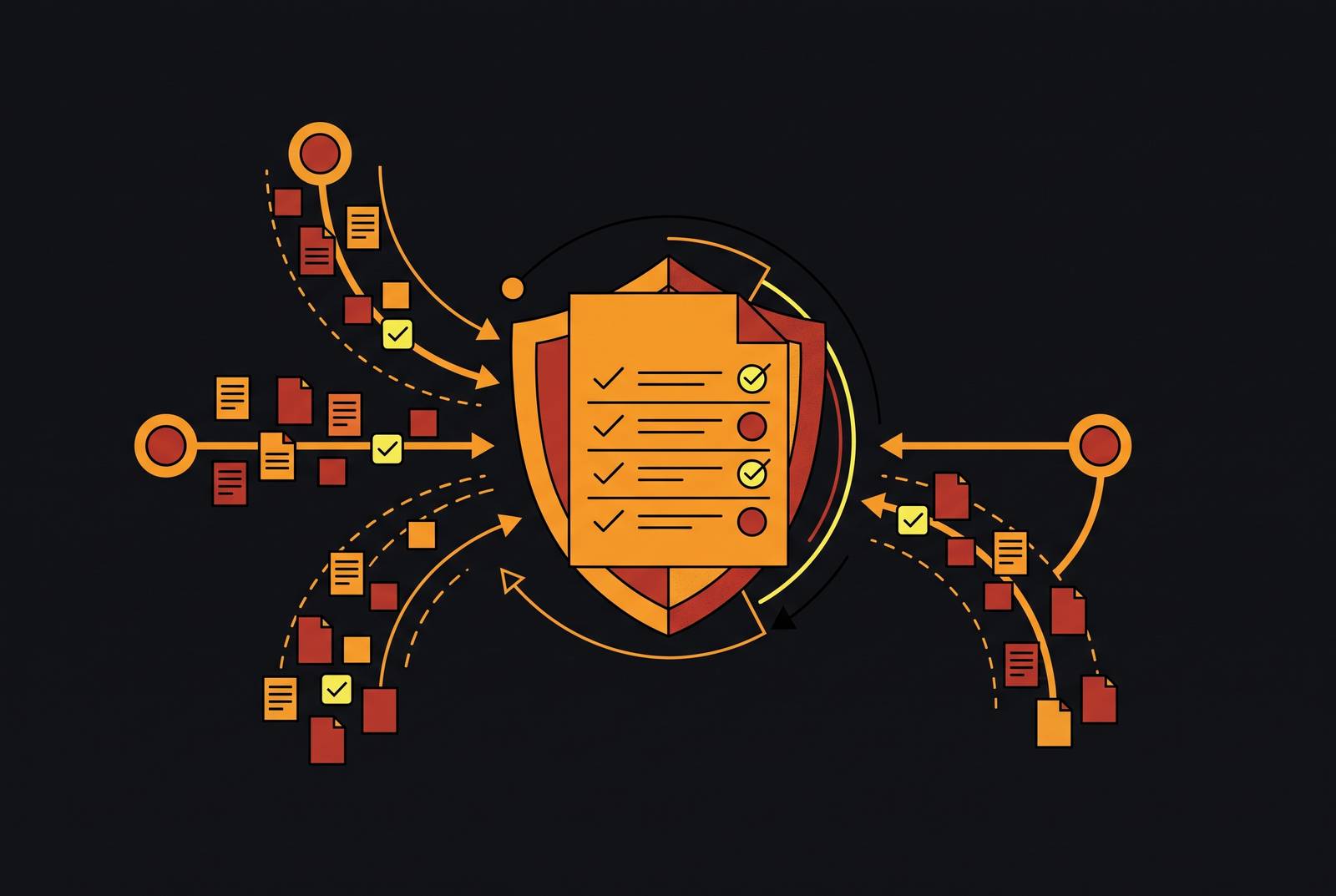
Every SOC 2 audit has to cover nine Common Criteria, no matter which extra Trust Services Categories a company bolts on. These nine are not optional, and skipping depth on any of them is how audits stall.
CC1 covers the Control Environment, which includes governance, tone at the top, and accountability resting with an actual person. CC2 is Communication and Information, how policies and security updates get shared inside and outside the company. CC3 is Risk Assessment, naming and weighing risks to the business. CC4 is Monitoring Activities, the ongoing check that controls are still doing their job. CC5 is Control Activities, the actual policies and procedures built to address known risks.
Then things get more concrete. CC6 covers Logical and Physical Access Controls: who can get into what, and how that access gets granted, reviewed, and pulled back. CC7 is System Operations, covering detection and response to security events plus vulnerability management. CC8 is Change Management, the rules for how changes to systems get approved, tested, and pushed live. CC9 is Risk Mitigation, covering vendor and third-party risk along with insurance and other backstops.
Some of these produce evidence a machine can read straight off a system: timestamps, configuration states, log entries. Others need a human to make a judgment call and write it down, a risk rating, a policy sign-off, a decision about what counts as acceptable exposure. Software can confirm a judgment call happened. It can't make the call. CC6 and CC7 also throw off more audit exceptions than any other criteria on the list, and that pattern matters later on.
GRC platforms that automate cleanly (and why those three work)
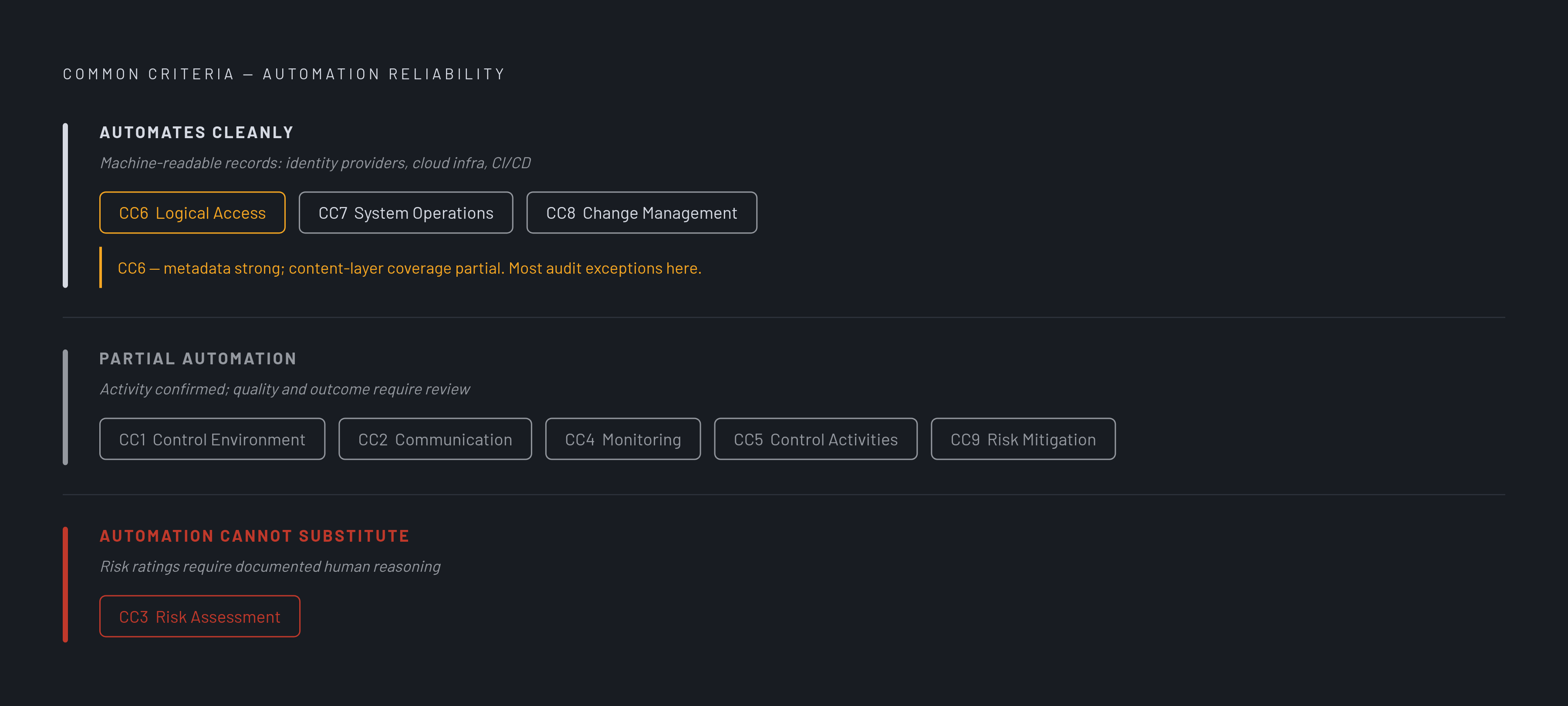
CC6, CC7, and CC8 automate the most reliably of the nine, for a reason that's almost mechanical: they pull from systems that already spit out machine-readable records just from running normally.
For CC6, that means MFA enforcement status, SSO configuration, privileged access lists, and user lifecycle events (someone joins, someone changes roles, someone leaves) read straight from the identity provider. No screenshot needed, because the identity provider already logs the event with a timestamp attached.
For CC7, platforms pull log retention settings, vulnerability scan schedules and results, and security alert history directly from cloud infrastructure and security tooling, on whatever cadence the company sets. For CC8, the evidence comes from change approval records and deployment audit trails, read directly out of CI/CD systems and project tracking tools.
That's the reason Vanta, for example, shows strong automated coverage across CC1, CC2, CC3, CC5, CC7, and CC8, including policy approvals and change records: those systems already exist, and they already log what happened. For Type II specifically, automation hands an auditor a continuous record across the whole monitoring window instead of a snapshot from the week before the audit. Instead of proving a control worked once, the evidence shows it worked in January, again in March, again in June, without anyone hunting it down.
The CC6 gap where coverage turns partial
CC6 throws off the most audit exceptions of any criteria on the list, and it's also the one where "automated" quietly means less than most buyers assume.
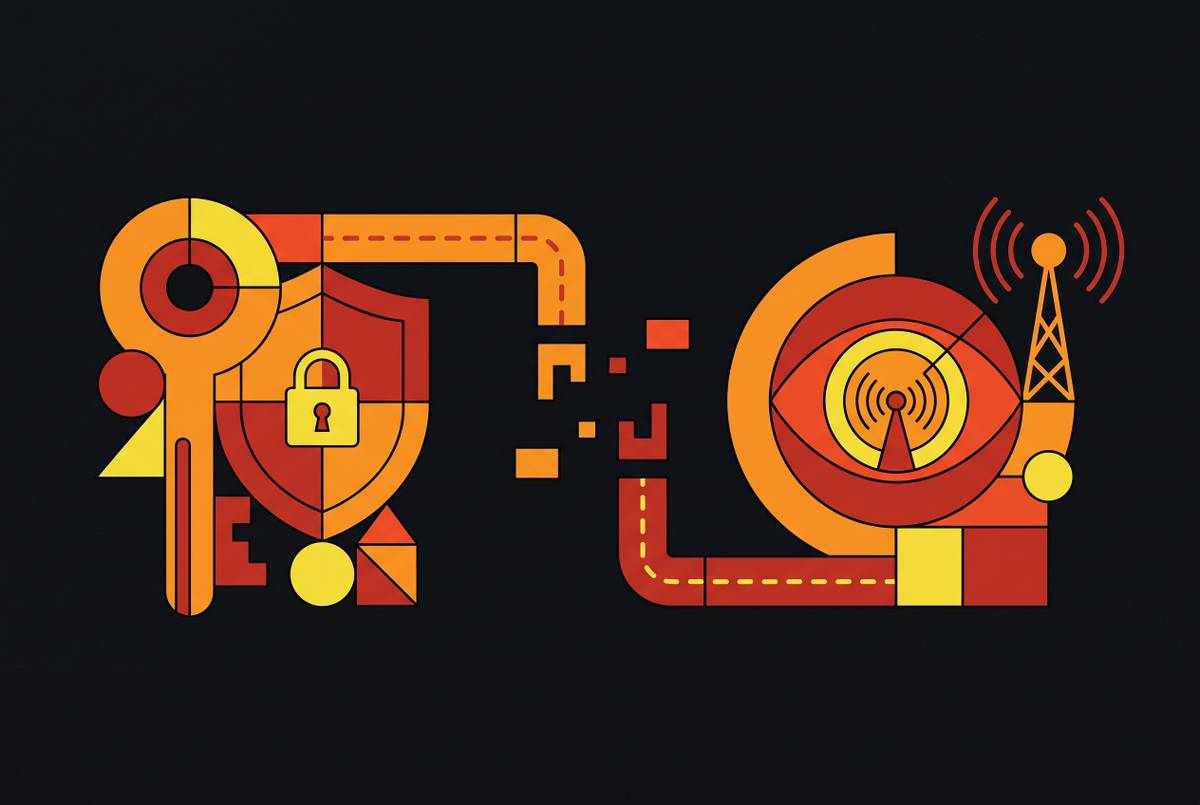
Platforms collect metadata about access: who has an account, whether MFA is on, what the access list looks like. What they generally don't do is scan the actual content moving through those systems to confirm sensitive data gets handled the way the policy says. One 2026 analysis of coverage in this space found that a leading platform's CC6 automation is partial: it can attest that an access control exists, but not that the control works correctly at the content level.
The clearest example of what slips through involves employees using external AI tools with customer data, a finding that, according to 2026 audit observations, has gone from an edge case to a recurring, expected exception because no standard GRC integration is built to catch it. The access control might be configured perfectly. The data still walks out the door through a prompt box no scanner is watching, and that's a real gap, not a hypothetical one.
The governance criteria that automation cannot fully replace
CC1 and CC5 show the limits of automation most clearly. Platforms can track that a policy document exists, that someone clicked to acknowledge reading it, that an approval workflow ran on schedule. None of that says anything about the policy's actual quality.
Unedited policies that were never tailored to the actual company are among the audit exceptions that cluster most visibly in CC1 and CC5. An auditor can spot in about thirty seconds when a document was never read by anyone who actually works there. It's a people problem wearing a compliance costume, not automation's fault. It's a people problem wearing a compliance costume.
CC3, Risk Assessment, is the hardest of the nine to automate. Risk ratings, decisions about residual risk, calls about how to treat a given exposure: these need a documented human argument behind them. A platform can prompt someone to fill out the risk register and store the answer forever. It cannot generate the reasoning behind the answer, and no amount of AI polish changes that.
CC2 and CC4 follow the same shape. Platforms can confirm a communication went out, that a monitoring dashboard existed and got checked. What they can't confirm is whether anyone acted on what the dashboard showed. That's exactly the next question an experienced auditor asks, and it's the one no dashboard screenshot answers.
CC9 and vendor risk: the criteria where enforcement is tightening in 2026
CC9.2 requires companies to review and keep evidence of their subservice providers' own SOC 2 reports across the entire audit window, on an ongoing basis rather than as a one-time check.
Enforcement here is getting stricter, and there's a clear reason why. Verizon's 2025 Data Breach Investigations Report found breaches involving a third party doubled year over year, jumping from 15% to 30%. Auditors noticed that trend, and the CC9.2 cadence expectation, ongoing review instead of a one-time glance, has tightened right along with it.
Platforms already cover a good chunk of this: vendor questionnaire workflows, storage for collected SOC 2 reports, reminders to re-check vendors on schedule, risk scoring to flag which vendors need the closest attention. One platform's vendor questionnaire workflow gets singled out specifically as a strength for CC9 coverage.
The limit here doesn't get fixed by software, and it won't. A platform can prove a questionnaire went out and came back filled in. It has no way to independently verify the vendor actually told the truth on it, and that gap sits with the company, not the tool.
The 2026 auditor question most GRC platforms aren't built to answer: AI system controls
Auditor trend reporting for 2026 points to a new line of questioning. If a service organization runs AI models in production, auditors want to know how access to those models is controlled, how outputs get watched, and how the risk gets managed day to day.
That question doesn't need a tenth criterion invented for it. It maps cleanly onto CC6 (who can access the AI system and see its outputs) and CC7 (how those outputs get monitored for anomalies). The framework isn't new here. The technology context is, and most existing integrations were never built with it in mind.
Employee use of external AI tools generates evidence in places no current GRC integration reaches. No API reports back what an employee pasted into a chatbot last quarter. AI tool usage involving customer data has gone from an edge case to a recurring, expected finding, and it sits in the same CC6 content-scanning gap described earlier. Different symptom, same root cause: nobody's watching the content layer.
How the leading GRC platforms compare on evidence coverage
All the major platforms here cover the same broad set of criteria on paper. What actually separates them is how deep the integrations run, how honestly the automation reflects reality, and how active security controls get bundled in or handed off to a partner tool.
Vanta connects with over 375 integrations and shows strong automated coverage across CC1, CC2, CC3, CC5, CC7, and CC8, with a vendor questionnaire workflow that holds up well for CC9. CC6 coverage stays partial: it collects access metadata but doesn't scan content for sensitive data. Vanta serves more than 16,000 customers, named a Leader in both the Forrester Wave for GRC Platforms (Q2 2026) and the IDC MarketScape for Worldwide GRC Software (2025). Starting price runs $7,500 a year, with a G2 rating of 4.6. It fits best for companies that want the fastest route to a first audit, backed by a wide catalog of integrations.
Drata runs on what it calls an AI-native, or Agentic, Trust Management Platform, supporting more than 30 frameworks and running over 1,000 infrastructure tests across AWS, Azure, and GCP. Technical teams tend to prefer it for cleaner CI/CD and cloud infrastructure integrations, and its continuous-monitoring interface holds up well day to day. Drata serves more than 8,500 organizations, carries a G2 rating of 4.7, and ranked No. 11 on G2's Best GRC Products list for 2026. Pricing is customized, though community estimates put it around $7,500 a year or more before audit fees. It fits best for highly automated, multi-framework programs at companies scaling fast.
Sprinto connects to over 200 systems across cloud infrastructure, identity, HR, code, devices, and security tools, with Sprinto AI handling evidence validation, control mapping, drift detection, and vendor reviews. A native device-monitoring tool tracks disk encryption, antivirus, firewall status, screen lock, and OS version, filling in useful device-level evidence for CC6. Sprinto serves more than 1,000 customers across 75 countries, ranked No. 3 on G2's Best GRC Products list for 2026, with a G2 rating of 4.8. Pricing is custom, and it fits best for early-stage SaaS companies trying to move fast toward a Type II report.
All three of these treat SOC 2 seriously, and the choice between them isn't really about which one "covers more." It comes down to where the gaps sit and how well they match what a given company already struggles with. The real differences appear in the fine print: how far the automation reaches into CC6's content layer, how much of CC9's vendor cadence gets handled without someone chasing it down manually, and how ready each platform actually is for the AI governance questions auditors are just starting to ask. Nobody has fully solved that last one yet. Any team evaluating these platforms should ask the vendor directly, point blank, how they plan to close it, and should be suspicious of anyone who claims they already have.