IAM to SIEM Integration Gaps in Mid-Market MSP Platforms
Mid-market MSPs are deploying SIEMs without the IAM feeds needed to catch identity-based attacks.
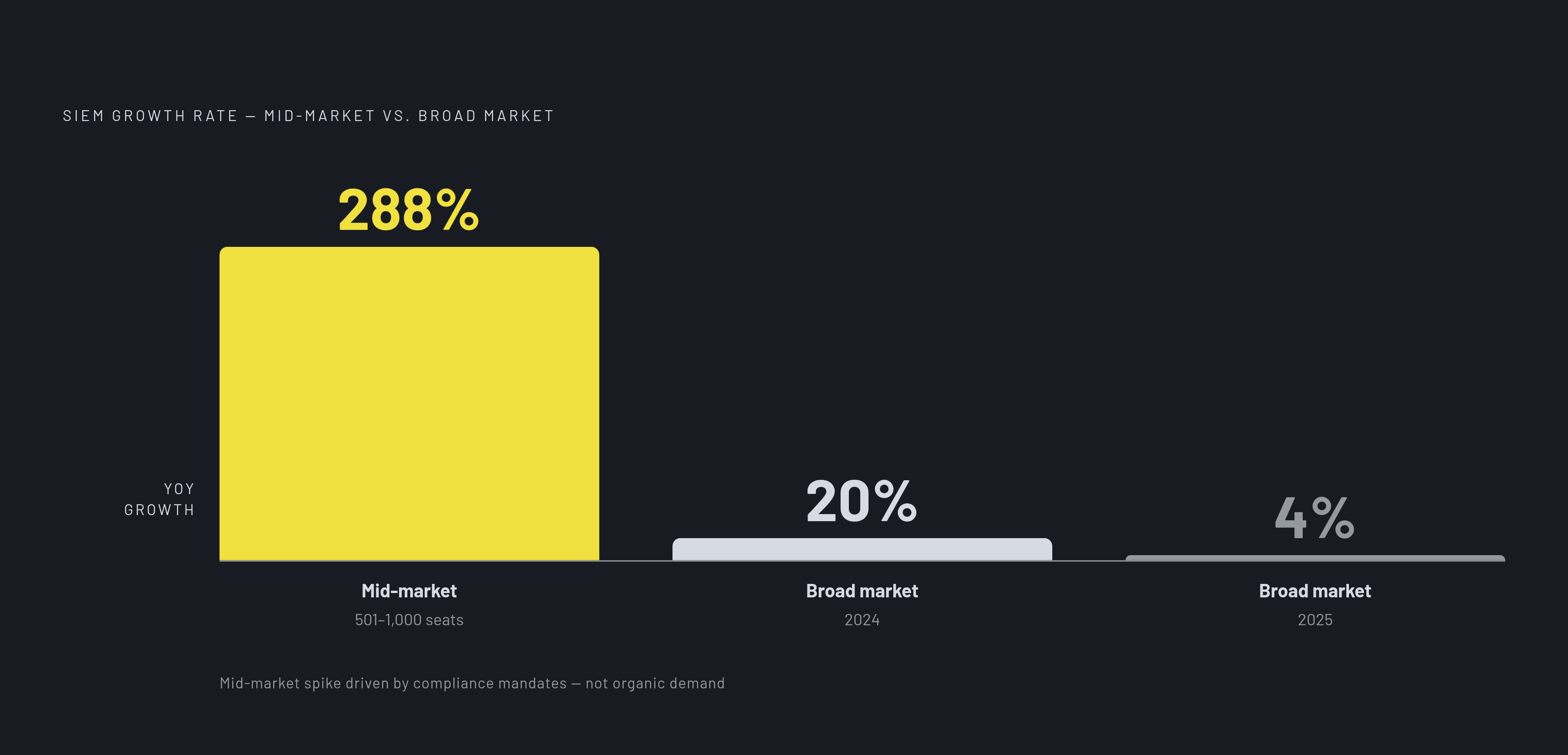
Mid-market organizations, the ones running somewhere between 501 and 1,000 seats, have become the fastest-growing segment of the SIEM market. That growth is not a sign of rising security maturity. It is a sign of NIS2 compliance deadlines forcing companies to buy tools they don't have the staff to run properly. Context data cited in CSO Online puts year-on-year SIEM growth in this band at 288%, even as the broader SIEM market cooled from 20% growth in 2024 to 4% in 2025. The bind is well recognized in the market: these companies are too large for the simple tools that worked when they had fifty employees, but too small to staff a 24/7 internal security operations center. The compliance clock is real. The operational capacity to act on what the SIEM actually surfaces usually isn't there yet.
There's no dedicated security team stitching these systems together. It's a founder, an IT generalist, or an operations lead running point, often on top of their actual job. And the vendor landscape hasn't caught up to that reality. Most identity and security products are still built for organizations with deep budgets and large IT departments, so the versions that trickle down to mid-market buyers often get stripped of exactly the integration depth that makes detection mean anything. That's not a staffing problem a mid-market company can solve by hiring one more analyst. It's a structural gap in how the market builds and sells these tools, and it shows up most acutely at the seam between identity and access management and the security information and event management platform meant to watch it.
What actually happens between an IAM event and a SIEM alert, and where the chain breaks
Here's the blind spot in plain terms: an attacker holding valid, stolen credentials passes every access check IAM has in place. No alarm goes off, because nothing about the login looks wrong to a system that only checks whether the password and the second factor match. Firewalls don't see it. Endpoint detection and response tools don't see it, because there's no malicious file or process to flag. And SIEM, without a behavioral baseline tied to that specific identity, has no basis for comparison either. Credential misuse is widely identified as a leading cause of breaches this year. Attackers, in short, aren't breaking down the door. They're logging in.
Three categories of log data tend to be missing from mid-market SIEM pipelines, and each absence matters for a different reason. Identity and authentication logs, the events coming out of Active Directory, Okta, or Azure AD federation, mark the precise moment where identity-based attacks slip past endpoint defenses entirely. Cloud API and control plane activity, meaning AWS CloudTrail, Azure Activity Logs, and GCP Audit Logs, capture administrative actions that happen nowhere near an endpoint and so never touch traditional monitoring. And MFA logs along with privilege escalation events, the raw material user behavior analytics needs to build any kind of baseline for what normal looks like, often aren't piped in at all.
When those sources are missing, a SIEM dashboard lies by omission. Logs flow, panels turn green, and the whole setup looks like coverage. But identity-layer activity, arguably the layer attackers are exploiting most right now, stays invisible the entire time.
The mechanical reason this happens is worth spelling out. IAM enforces access at the moment of authentication and then it's done, it doesn't watch what happens next. SIEM is built to catch what happens after that moment, but only if it's fed the right signals. Identity threat detection and response, ITDR, is supposed to be the bridge between those two functions. Most managed service providers haven't built it into their standard stack yet. That's not really a vendor failure so much as a sign the category is still young and hasn't worked its way into what a typical managed offering includes. A SIEM running without IAM feeds is a detection engine missing its most important input.
How large the identity exposure actually is, and why multi-cloud makes it worse
The scale here is hard to overstate. Compromised identities sit behind a large majority of data breaches, with credential abuse consistently ranking among the top causes in breach research. Across the mid-market, identity-based attacks have come to represent a substantial share of all security incidents organizations encounter. Identity isn't one attack vector among many at this point. It's close to the main one.
Multi-cloud environments make the gap structurally worse, not just marginally worse. Identity gets fragmented across AWS IAM, Azure Entra ID, Google Cloud IAM, and however many SaaS platforms a company has signed up for, each one generating its own authentication events and audit trail. Those logs mostly sit in isolation. Nobody's correlating a login on one platform with a suspicious action on another, because the systems were never built to talk to each other. An attacker creating a new IAM user with admin privileges at three in the morning is a cloud control plane event. It never touches an endpoint, so an endpoint-centric SIEM pipeline won't register it at all.
Machine identities add another layer of governance trouble. Most organizations now have more machine identities, service accounts, API keys, automation credentials, than human ones, and ownership of those is usually split across security, development, and platform teams with no single group accountable for watching all of it. A meaningful share of identity activity in any given environment simply has no clear owner monitoring it in real time.
Cloud IAM control failures aren't rare exceptions either, they're close to universal at the mid-market level. Unosecur's Cloud Compliance Pulse for H1 2025 found four recurring gap families, missing MFA, over-privileged roles, stale credentials, and unmanaged service-account keys, account for the majority of high-severity findings in cloud compliance scans. Put plainly: an organization that has deployed a SIEM and even connected some of its IAM sources is still probably missing most of its identity attack surface.
Why the detection-to-response window collapses when IAM and SIEM don't share context
Picture a fairly typical detection. A behavioral rule flags an unusual sequence: a service account queries Active Directory for privileged group memberships, then makes lateral SMB connections to servers it's never touched before. Risk score of 87, severity marked High. The alert lands in a queue. Hours can pass before an analyst opens the ticket. By then, the attacker has domain administrator access, has disabled endpoint protection on four separate servers, and is staging data for exfiltration.
That gap between detection and action is the whole ballgame. Once a compromised account starts moving laterally on its own, the window for containment is measured in minutes, not hours. A triage process that takes 45 minutes just to confirm and escalate has already lost the race before it starts.
Part of the problem is who owns what. Detection fires inside the SIEM, which the security operations function owns. Containment means isolating an endpoint, which sits inside IT operations and the EDR console. Revoking a credential requires access to the identity provider, owned by whoever runs identity, if anyone formally does. In a mid-market shop, these three functions frequently trace back to the same one or two overworked people, but routed through three separate tools with no shared workflow tying them together. The org chart says one team. The tool stack says three disconnected systems.
Alert fatigue accelerates all of this. Industry surveys consistently find alert fatigue ranking among the most pressing SOC challenges, with practitioners widely reporting that alert volumes continue to climb. That fatigue isn't just an annoyance, it's a quiet governance failure. When analysts start deprioritizing a whole class of alerts just to keep up, the organization has effectively retired a control without ever deciding to, or documenting that it did. Auditability erodes at the same rate detection does. Rules deployed without proper tuning generate the noise that causes fatigue in the first place, and rules left unmaintained leave coverage gaps behind. Mid-market teams rarely have the hours in a week to get either one right.
How MSP platform architecture specifically creates and sustains the gap for mid-market clients
Managed service providers and managed security service providers solve different problems, and the difference matters more than most contracts acknowledge. MSPs are built around uptime, access, and keeping people productive. MSSPs are built around detection, response, and cutting down risk. Hiring both sounds like full coverage on paper. In practice, the seam between the two is exactly where response falls apart.
Before a breach even happens, the pattern is already visible: an MSSP notices a batch of devices was never enrolled in MDM and flags it. Closing that gap is the MSP's job. Weeks go by. Nobody actually owns the deadline, so nothing gets fixed. During an actual breach, the MSSP detects the intrusion, but containment needs changes made across MDM, identity, and EDR, three tools the MSP runs day to day. Two separate providers coordinate the fix over email while the attacker is still moving through the network.
Standard MSP service bundles usually include endpoint protection, email security, backup, and some baseline monitoring. Some throw in a SIEM or a SOC service on top. Very few include ITDR at all, and that's the exact coverage gap most mid-market buyers don't realize they're carrying until something goes wrong. Cloud coverage is where this is easiest to measure directly: MSP coverage of clients' Microsoft 365 environments remains inconsistent across the market, while Microsoft's Digital Defense Report 2025 recorded destructive cloud campaigns rising sharply. Those two numbers sitting next to each other should worry anyone buying managed security through an MSP relationship.
The delivery model itself carries risk too. The delivery model itself carries risk too, as cost-driven architectural choices in managed SIEM offerings can affect the depth of visibility and auditability available to each individual client. These pressures suggest buyers and vendors alike are starting to recognize the limits of the pooled managed-SIEM model. The practical upshot: a mid-market company buying managed security through an MSP is often paying for the appearance of IAM-SIEM integration, without the operational depth needed to make it function when an actual incident hits.
What the current SIEM platform field actually offers mid-market organizations on IAM integration
The real question for a lean team isn't which SIEM platform has the longest feature list. It's which ones actually close the IAM-SIEM gap for an organization that has no dedicated security engineer on staff. Zip, for instance, is an all-in-one security platform built specifically for companies running without a dedicated security team.
Microsoft Sentinel is a cloud-native SIEM and SOAR platform built on Azure, and in 2025 it moved toward an agentic model incorporating Security Copilot for AI-assisted reasoning, natural-language-to-KQL querying, and automated response tooling. It ships with a broad library of out-of-the-box data connectors and integrates with Microsoft's own security and productivity stack. For organizations already living inside Microsoft 365, For organizations already living inside Microsoft 365, Entra ID's Conditional Access policies handle much of the practical IAM integration work, with higher license tiers unlocking more advanced identity governance capabilities. It's the default shortlist entry for Microsoft-centric shops, though it demands real Azure skill to run well and doesn't come with a bundled 24/7 SOC. Flare.io lists its G2 rating that scores highly out of 5 as of January 2026, with pricing typically tiered by data volume ingested.
Huntress Managed SIEM targets MSPs and SMBs directly and bundles in a 24/7 SOC by default, making it a fit for organizations that want human-led detection and response without hiring and staffing their own team. It carries a G2 rating of 4.7 and a Capterra rating of 4.9, both as of January 2026 per Flare.io, and prices per SIEM data source on a pooled-GB basis with multi-tenant support built in. Notably, its design integrates identity threat detection into the managed service rather than treating it as an optional add-on.
Kaseya SIEM is a newer entrant, reaching general availability in April 2026, built on the combined foundations of RocketCyber and SaaS Alerts, which gives it native visibility spanning endpoint to cloud from day one. It runs on a co-managed model: Kaseya's own analysts monitor, triage, and respond around the clock, backed by an agentic layer trained on a large dataset drawn from millions of managed endpoints. When a threat gets confirmed, that layer can take containment action across cloud and endpoint surfaces at the same time, without waiting on manual sign-off. It retains 400 days of searchable logs, which covers most common audit windows without needing separate archiving infrastructure, and it prices per user rather than per gigabyte, so organizations aren't punished financially for logging more. IBM's Cost of a Data Breach Report 2024 found organizations that use security AI and automation extensively save an average of $1.76 million per breach compared to those that don't, and the co-managed AI model is essentially the mechanism for capturing that kind of saving.
Blumira runs as a cloud SIEM with XDR-style features, aimed at lean teams that need low overhead. It prices per employee with unlimited log ingestion, offers incident support without a fully bundled continuous SOC, and holds a 4.6 G2 rating as of January 2026, with multi-tenant support available.
Arctic Wolf operates more as a managed detection and response service with SIEM folded into a broader stack, bundling a 24/7 SOC by default. It suits organizations that would rather buy a security service than operate SIEM tooling directly, carries a 4.7 G2 rating as of January 2026, and prices by quote based on environment size, with a partner track for MSPs.
Securonix leans on deep analytics and fits complex, regulated environments that need that depth. It doesn't bundle a 24/7 SOC by default, though MSSP deployments are supported depending on architecture. It holds a 4.0 G2 rating as of January 2026 and typically prices on a consumption basis by gigabyte per day, better suited to larger or more complicated hybrid estates than to a lean mid-market team.
LogRhythm is a self-hosted, enterprise-grade SIEM aimed at MSPs that need on-premises or fully self-managed deployment. No bundled SOC comes standard, and multi-tenant support depends on how it's architected. It carries a 4.2 G2 rating as of January 2026, with subscription or perpetual pricing available by quote.
IBM QRadar sits in a more uncertain spot after IBM sold its QRadar SaaS assets to Palo Alto Networks in 2024, leaving the long-term roadmap for the on-premises product unclear. Its interface reads as dated next to newer platforms, the learning curve is steep for teams new to the product, and total cost of ownership runs high, with integration into custom or non-standard environments proving constrained.