API Rate Limits and Polling Lag in Multi-Tool Security Stacks
Polling delays and rate limits silently blind security tools when attackers move fastest.
Rate limiting caps how many requests a client can send to an API within a set window of time. The purpose is defensive: protect the source system from getting overwhelmed, and keep any single consumer from hogging the pipe. Different systems implement this with different algorithms, token bucket, sliding window, fixed window counters, and each produces a slightly different throttling curve. The end result is the same across all of them, though. Once a client crosses the threshold, requests get rejected or queued.
The rejection shows up as an HTTP 429 response. Some APIs include a Retry-After header telling the client when it's safe to ask again; plenty don't bother.
A 429 doesn't look like an outage, and that's what makes this a security-specific problem rather than a generic engineering annoyance. Uptime monitors stay green. Status pages show nothing wrong. Error budgets look fine on a dashboard. Meanwhile the integration has silently stopped delivering data. A SOAR playbook stalls mid-run. A SIEM enrichment feed goes quiet. A threat intel source stops updating. No one gets paged, because the absence of new events reads as the absence of new threats, which is exactly backward.
Rate limits get sized for ordinary, day-to-day traffic, and they break under load. The load that matters most is a major incident, when multiple playbooks fire at once and all of them hit the same upstream API within seconds of each other. Vendors clearly take throttling seriously as infrastructure; the depth of engineering behind token buckets and backoff logic makes that plain. That investment is aimed at keeping the source system healthy, full stop. It does little for the consuming integration that needs an unbroken feed of data to do its job, and mistaking one kind of protection for the other is the first error worth naming here.
How polling intervals layer a second timing gap on top of rate limits
Most tool-to-tool connections in a security stack don't push data as it happens. They poll: the downstream system asks the upstream system, on a fixed schedule, whether anything new has shown up. Real-world polling intervals in security tooling typically fall somewhere between five and fifteen minutes, and some connectors default to even longer windows for high-volume log sources.
Run the math on a five-minute interval and the average delay works out to roughly half the interval, about two and a half minutes. That's the average case, not the worst case, though. An event that fires one second after a poll completes sits there for nearly the full five minutes before the next poll picks it up. Stretch the interval and the delay grows right along with it.
A few documented examples make this concrete. CrowdStrike feeding into Microsoft Sentinel in GCC-High environments typically takes thirty to forty-five minutes before the first data shows up, a lag driven by backend scheduling, and after that initial delay it refreshes every five to seven minutes; the default API rate cap on that connection often needs manual tuning once 429 errors start appearing. Splunk SOAR polling Microsoft Sentinel uses an On Poll action that pulls incidents modified since the last successful poll, and the interval itself is entirely user-configured, so the lag varies with incident volume and how the operator set things up. CrowdStrike feeding Splunk through the Falcon Data Replicator starts ingesting within the first few minutes of connecting, but the feed is still bounded by its polling interval regardless of how fast that initial connection happens.
Polling also burns rate-limit quota whether or not there's anything new to report. Every empty poll counts against the upstream tool's request cap the same as a poll that returns real data, leaving less headroom exactly when a real event finally does show up and needs to move fast.
The two mechanisms don't operate independently; they feed each other. A poll that gets hit with a 429 doesn't just retry instantly. It waits, per whatever backoff logic the client has built in, and that wait stretches the effective polling interval well past its configured value. The visibility gap widens right when the system is already under strain.
Why adding more tools multiplies the delay rather than distributing it
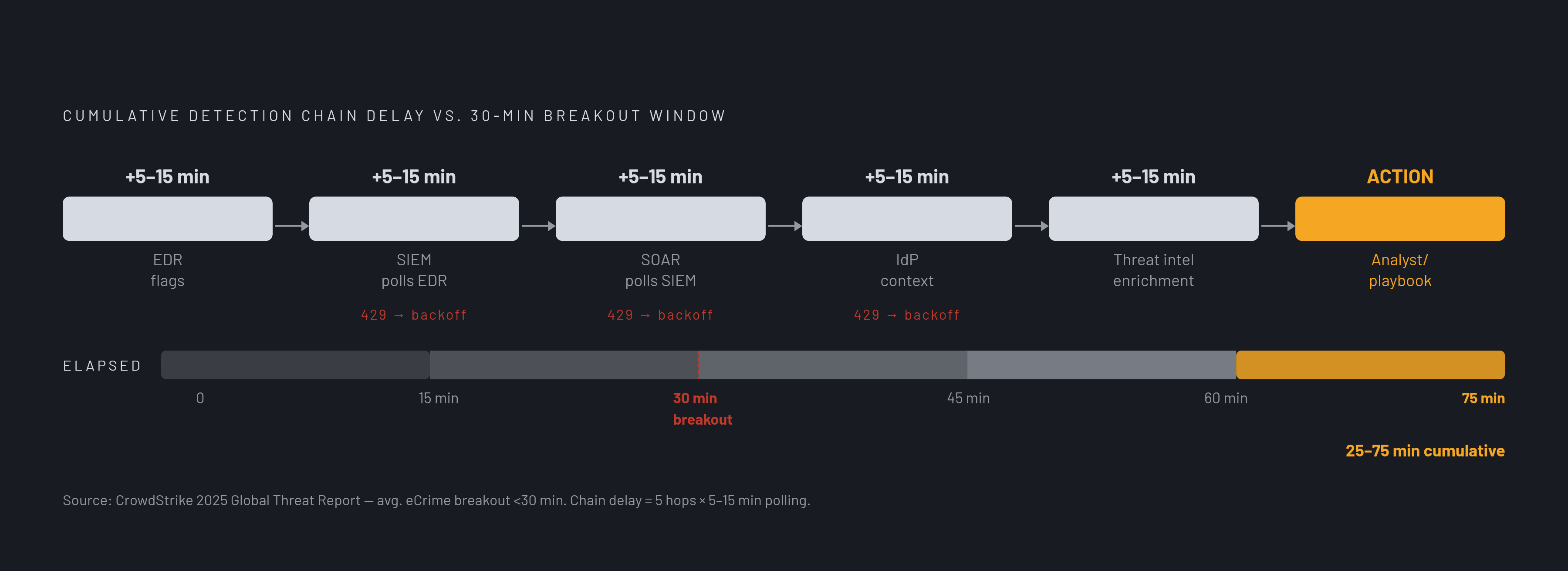
A single polling gap, on its own, is a manageable inconvenience. The real damage shows up in a detection chain that has to cross several tools in sequence. Take a representative path: an EDR agent flags anomalous behavior, a SIEM polls the EDR for new events, a SOAR platform polls the SIEM for new alerts, the SOAR queries an identity provider for user context, then queries a threat intel feed for indicator enrichment, and only then does an analyst or automated playbook act.
Every hop in that chain carries its own polling interval and its own exposure to rate limiting. These delays don't average out or cancel each other. They stack, plainly and without mercy for whichever hop happens to be slowest that day.
API sprawl makes the exposure worse in ways that are often invisible to the people trying to manage it. Organizations regularly discover they're running far more active APIs than their gateway configurations account for: shadow APIs, abandoned endpoints nobody decommissioned, microservice connections that never got routed through centralized rate-limit management. Many organizations also lack a full inventory of where sensitive data actually flows across their API surface, meaning some of the integration paths causing delay are paths nobody's even looking at.
Running multiple API gateways at once adds a coordination failure on top of all this. If rate-limit counters get tracked separately per gateway, the same upstream API can get over-consumed before either gateway registers that a limit has been breached.
The pattern worth taking away is this: each tool adds a variable delay, and the worst-case size of that variable depends on coincidental timing, on how many other playbooks happen to be running concurrently, and on hidden upstream quota consumption that no single team can see in full. Treating that variable as if it were fixed, as most capacity planning does, is the mistake.
The attacker-speed problem that makes these delays operationally dangerous
None of this matters in the abstract; it matters because attackers have gotten faster. Breakout time, the interval between initial access and lateral movement, has compressed sharply. CrowdStrike's 2026 Global Threat Report puts the average eCrime breakout time at under thirty minutes in 2025, with the fastest observed case measured in seconds, a steep drop from prior years. Some of the intrusions tracked in that report show data exfiltration beginning within minutes of initial access.
Set that against a five-to-seven-minute polling window and the mismatch is stark. A SIEM or SOAR platform may still be sitting on its next scheduled pull at the exact moment an attacker has already finished moving laterally to a second system. A fragmented stack compounds the problem further: if the EDR-to-SIEM hop, the SIEM-to-SOAR hop, and the SOAR enrichment queries each eat up several minutes on their own, a response that should wrap up in under half an hour can stretch into hours. By then the blast radius has already grown well beyond what a faster response would have contained.
There's an added layer of difficulty. Per CrowdStrike's report, the majority of detections in 2025 involved no malware at all; adversaries used valid credentials, trusted identity flows, and approved SaaS integrations to move around. Catching that kind of activity requires correlating behavior across multiple tools at once, in something close to real time. Polling lag and rate-limit gaps are precisely what stand in the way of that correlation happening fast enough to matter.
None of this looks dramatic in the moment. Teams check their dashboards, see everything green, and assume they have near-real-time visibility. Meanwhile, the attacker is operating inside the gap between polls, a gap that's structural, not accidental, and no amount of dashboard-watching closes it.
What MTTD and MTTR data reveal about where time actually goes
IBM's 2025 Cost of a Data Breach Report measured how long organizations take, combined, to identify and contain a breach. That figure sits at a nine-year low, and it still spans many months on average. The report's cost finding is the part worth sitting with: breaches identified faster cost meaningfully less than ones that linger, with the gap between fast and slow detection translating into a cost difference of over a million dollars per breach.
A long mean time to detect is rarely a mystery once someone goes looking. It usually points to specific blind spots: workloads with no runtime monitoring, cloud APIs that never got configured to forward logs to the SIEM, detection rules that were never tuned to the actual environment. These are integration failures more than analyst failures, and the distinction matters because it changes where the fix belongs. Blaming the analyst for a gap the architecture created is a common instinct worth resisting.
IBM's report also found that breaches involving stolen credentials take substantially longer to resolve than the average. Part of the reason is structural: identity events are some of the most fragmented data in a typical stack, scattered across directory services, SSO platforms, and endpoint telemetry, each polling on its own independent schedule. Pulling those threads together into a single coherent picture takes time precisely because the underlying data was never unified to begin with.
One more finding from the same report deserves attention. Organizations with heavy AI and automation usage detected breaches substantially faster and paid meaningfully lower costs when breaches did happen. Automation, though, only moves as fast as the data reaching it, and that's the catch nobody markets. A SOAR platform that can close an investigation in under two minutes once it has what it needs still has to wait on the slowest upstream poll before that two-minute clock even starts.
Why SOAR platforms are especially exposed to rate-limit compounding during incidents
SOAR platforms exist to orchestrate across a lot of downstream APIs at once: EDR, identity, threat intel, email security, firewalls, often all within a single playbook. Under normal, quiet-day conditions, playbooks run one after another and API usage spreads out over time without much friction.
Incidents change that entirely. Multiple playbooks fire in parallel, and all of them hit the same upstream APIs at nearly the same moment. That's also exactly when those upstream APIs are most likely to start throttling, because incident conditions generate more telemetry volume overall, and other consumers, analysts running manual queries, dashboards auto-refreshing, scheduled reports kicking off, are drawing on the same quota at the same time.
The failure mode that results is a particular kind of frustrating: a playbook that runs perfectly clean in testing stalls or silently drops enrichment steps once it's live, because a 429 hits mid-execution and the retry logic wasn't built with concurrent playbooks in mind. Rate-limit tolerance and retry behavior have become explicit line items when organizations evaluate SOAR platforms now, which tells you the industry recognizes the problem. It also tells you the burden of solving it still falls mostly on the buyer's configuration choices rather than on defaults the platform ships with, and that split is worth calling out plainly rather than treating as a minor footnote.
There's a secondary drag worth naming. Building, maintaining, and troubleshooting SOAR playbooks takes real engineering skill. When a rate-limit failure causes a playbook to return incomplete or wrong results, figuring out why requires the kind of deep, cross-system integration knowledge that most security teams simply don't have in surplus.
Webhooks reduce polling lag but introduce their own reliability tradeoffs
Webhooks flip the model: instead of the consumer asking on a schedule, the source pushes data the moment an event happens. Latency drops from interval-bounded to close to instant. Webhooks also use far less API quota, since a polling client burns requests continuously no matter what, while a webhook client only receives traffic when there's something real to send, which can cut API call volume by an order of magnitude.
That doesn't make webhooks a clean fix, and treating them as one is a mistake worth flagging directly, especially in security contexts. Acknowledgment and retry is the first snag: if the receiving endpoint happens to be down when an event gets pushed, the source will retry a limited number of times and then drop it. Polling, for all its lag, at least guarantees the consumer can go ask for the data once it's ready to receive it.
Ordering is a second problem, and arguably the more dangerous one. Webhooks can arrive out of sequence under heavy load, and a threat intel event that lands out of order can produce a false correlation inside a SIEM. That can make a harmless sequence of events look like an attack, or worse, bury a real one in noise. Idempotency rounds out the list: duplicate delivery is a known webhook failure mode, and without dedup logic on the receiving end, the same event gets processed twice, sometimes triggering a response action twice.
Not every security API even offers webhooks. Plenty of audit log and compliance APIs are built strictly as batch exports, meaning polling isn't a legacy choice there, it's the only option on the table.
The ordering risk deserves a second look before moving on. An alert correlation engine that receives events out of sequence might clear an alert that should have kept firing, or stitch unrelated events together into what looks like a real incident. Both outcomes chip away at how much analysts trust the system, and trust, once eroded, is slow to rebuild.
Architectural approaches that reduce compounding delay without requiring a full rebuild
A hybrid ingestion setup, webhooks where sources support them, a message broker sitting in between as a buffer, fallback polling for sources that don't do webhooks, active monitoring of the ingestion pipeline itself, addresses a meaningful share of the problem without a full rebuild.
That last piece gets skipped constantly, and it shouldn't be. Most teams monitor their security tools closely, but almost nobody monitors the pipes connecting them. An integration silently eating 429s for twenty minutes straight is invisible unless the pipeline itself emits metrics on successful deliveries, not just on whether the source system is technically up. Any team that hasn't instrumented that layer is flying blind on exactly the failure mode described above.
Rate-limit budget allocation helps too. During active incident response, some portion of upstream API quota should be walled off for SOAR enrichment queries specifically, kept away from scheduled reports, dashboard refreshes, and lower-priority polling jobs. That takes explicit coordination across teams that often own different tools independently and rarely talk to each other about quota.
Cutting the number of hops in the detection chain matters more than any single tuning fix, and this is the part organizations underinvest in because it's harder than adjusting a config value. Every tool boundary is a potential polling gap and a rate-limit exposure point on its own. Platforms like Zip, which unify device management, endpoint security, and identity protection under one roof, are built around reducing exactly that kind of surface. Consolidating functions that currently live in separate tools, device management, identity context, endpoint telemetry, into fewer integration surfaces reduces the number of gaps an event has to cross before triggering a response.
Dynamic polling helps at the margins: some SOAR and SIEM connectors support shortening the interval during an active investigation and reverting to a longer default once things quiet down, buying responsiveness without permanently inflating API traffic.
Here's the honest limit on all of it. Each of these measures shaves delay off a specific hop. None of them removes the underlying property of a fragmented stack, that delays accumulate across hops no matter how well each individual hop is tuned. Reducing the number of integration seams in the first place is the deeper fix, and that's an architectural decision, not a configuration setting, no matter how much a well-tuned retry policy might feel like progress in the short term.
What integrated platforms change about the polling-lag equation
Compounding delay is a property of the architecture, not of any single tool doing its job badly. It exists specifically because data has to cross API boundaries between systems that are operated, maintained, and rate-limited independently of each other. Tuning around that fact treats a structural problem as a configuration problem.
When device management, endpoint telemetry, identity context, and response orchestration sit on a shared data layer instead of trading data over external APIs, the polling gap at those particular seams stops existing. The change isn't that anything got faster in a raw technical sense, token buckets and sliding windows still govern any external connection that remains, but the hand-off itself is gone. There's no API call to rate-limit and no schedule to poll when two functions already live inside the same system. The delay is structurally removed at that seam, a different and more durable kind of fix than tuning an interval or adding a retry policy will ever be.