Network Segmentation Architecture in MSP-Managed Multi-Tenant Environments
MSPs must architect tenant isolation across data, control, and management planes simultaneously.
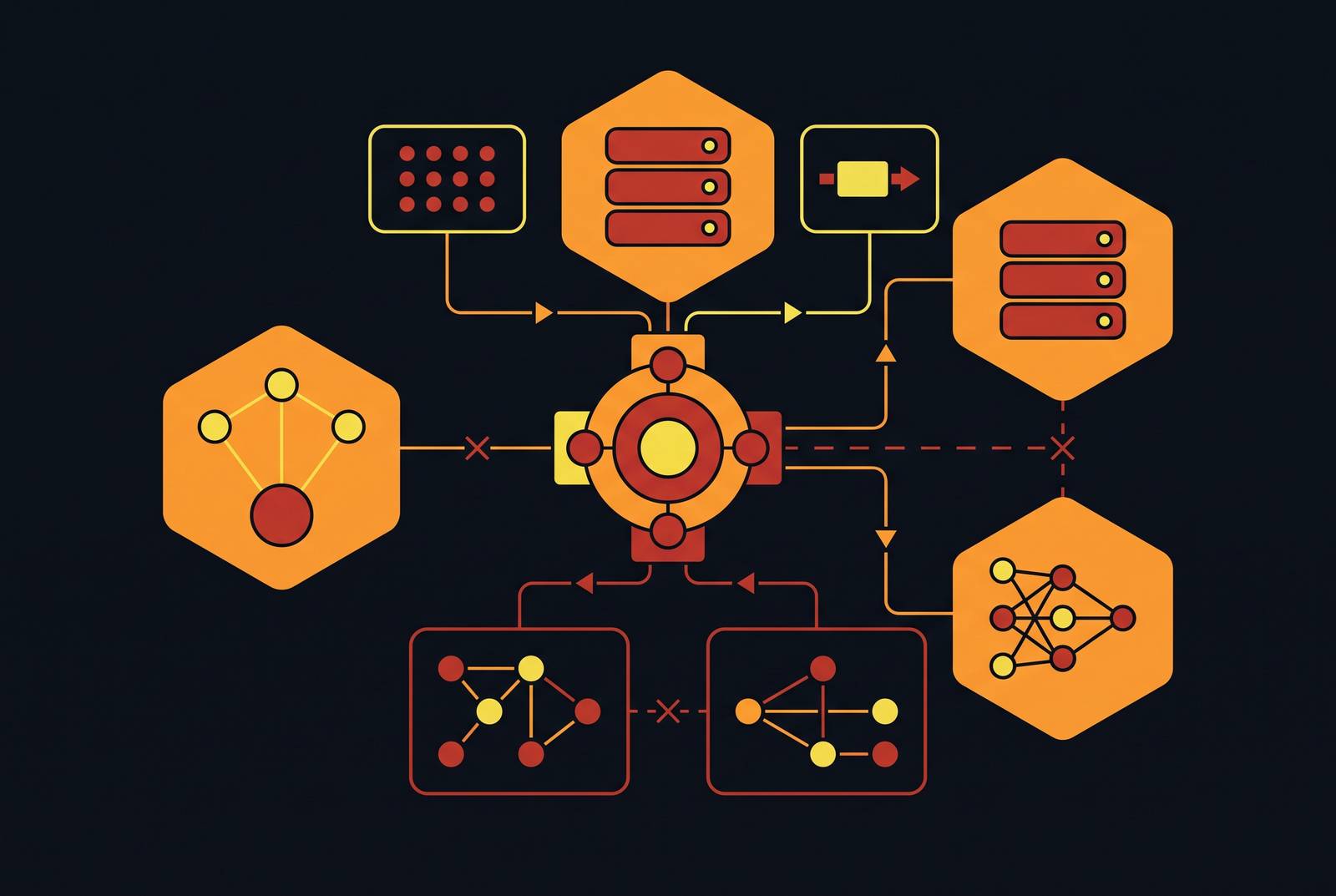
Network segmentation in a managed services context is one layered system that has to hold hermetic boundaries between clients while still letting one technician, one dashboard, and one policy engine run all of them at once. Most MSPs treat that tension, shared efficiency against strict isolation, as something to balance. That instinct deserves pushback: the tension is a structural problem to solve outright, and a market this size only raises the cost of getting it wrong.
The managed services market was valued at $441 billion in 2025 and is projected to reach $1.27 trillion by 2035, growing at roughly 11.18% annually. In 2024, 68% of global enterprises outsourced at least one IT function to an MSP, with cloud management and network monitoring the two most requested services. North America alone held a 43.20% share of that market in 2025. The concentration matters more than the sizing: at this scale, an architectural mistake at one MSP doesn't stay contained to one client. It spreads across every downstream business on that platform, at once, the moment something in the shared infrastructure breaks.
That's the structural difference between enterprise segmentation and MSP segmentation. A single enterprise builds its network around one regulatory regime, one risk tolerance, one industry's threat model. An MSP doesn't get that luxury. The same switch fabric, the same monitoring stack, and often the same firewall policy engine may serve a PCI DSS merchant, a HIPAA-covered clinic, and an unregulated ten-person law firm, all at once. The efficiency that makes multi-tenancy commercially attractive, shared infrastructure, centralized management, pooled tooling, sits in direct tension with the isolation each of those clients is contractually and legally owed. A segmentation architecture exists to resolve that tension.
What multi-tenant architecture actually means in an MSP context — and where isolation is expected to hold
Multi-tenancy, stated plainly, is a single software platform or infrastructure layer supporting multiple customers at once, where each customer works inside an environment that's logically separated from every other customer's data, configuration, and access rights. The tenants aren't on separate hardware. They share the same underlying physical or virtual substrate, and separation between them gets enforced through access controls, encryption, and virtualization rather than walls and cabling.
Enforcement has to hold across three distinct planes, and each one fails differently. The data plane is the most intuitive: tenant traffic must never cross into another tenant's segment. The control plane is less visible but just as critical; routing tables, policy configurations, and orchestration logic all need to be scoped to a single tenant, so a routing change made for Client A can't silently touch Client B's path. The management plane is where most real-world failures actually happen: MSP administrator access into one client's environment has to be walled off from every other client's environment, even though the same technician, using the same credential set, may be responsible for both.
Most segmentation writing treats these three planes as equally weighted risks. That's wrong, and the hierarchy matters. Should any one plane bleed across, through a shared device, a misconfigured policy, or a reused credential, isolation on the other two stops mattering. The management plane fails most often, because it's built for convenience rather than defense. A hardened data plane sitting behind a compromised management plane offers isolation only until someone with the right access decides otherwise.
There's also a contractual dimension that gets less attention than the security one, but it binds just as tightly. Genuine multi-tenancy means keeping individual SLAs for every customer even though they share infrastructure. Isolation, in other words, is more than a security posture. It's the mechanism by which an MSP can promise one client's uptime and performance without that promise depending on another client's behavior.
None of this is a reason to avoid multi-tenancy. The scalability benefits are real: flexible resource allocation, faster onboarding, and the ability to push patches and updates across the entire client base without touching any single environment. A single management interface, with subtenants representing each client's assets, is the operational prize that makes running dozens or hundreds of clients viable for one team. That interface is only as safe as the isolation architecture underneath it, though, and that architecture gets built as a stack of complementary technologies.
The layered toolkit: how macrosegmentation, logical isolation, and microsegmentation fit together
Segmentation isn't a single technology choice. It's a family of approaches that differ by scope, granularity, and implementation method, and most production environments run several at once, layered rather than swapped in and out. Anyone selling segmentation as one product has already misdescribed the problem.
Macrosegmentation sits at the outer ring. It splits a network into broad functional zones, corporate, guest, IoT, payment, management, typically using VLANs, subnets, and firewall zones. It does useful work: it limits blast radius at the zone level. But it treats every device inside a given zone as mutually trusted, which leaves a large internal attack surface untouched. A compromised IoT sensor and a point-of-sale terminal sharing a zone can, in principle, reach each other.
Physical segmentation sits at the other end of the spectrum: separate switches, separate cabling, sometimes separate firewalls per tenant. Nothing is shared, so there's nothing to misconfigure across tenant lines. It's also the least practical option for an MSP running shared infrastructure across many clients, because cost and hardware overhead scale linearly with every new client added. Few MSPs can justify a dedicated switch stack per customer, and the ones that try rarely survive the margin pressure.
Logical segmentation is the practical middle ground, and it's what most modern MSP networks build on. VLANs, virtual routing and forwarding instances, and software-defined networking create virtual boundaries on top of shared physical hardware. Different departments, client environments, or application tiers get their own segments, their own access controls, their own security policies, without the cost of physically separate infrastructure. It's far more flexible than physical isolation and far cheaper at scale.
VxLAN extends that logical isolation further, and it's widely used in data centers specifically for tenant isolation and for connecting virtual machines within a given tenant's environment. Paired with Group-Based Policy, VxLAN lets policy follow an endpoint wherever it physically sits on the network, rather than tying it to a particular switch port or subnet. Both macrosegmentation and microsegmentation can run through GBP layered on a VxLAN fabric, which is part of why VxLAN has become a common foundation rather than a niche data center feature.
Microsegmentation is the inner ring, and it runs on a different design philosophy entirely: shrink the segment as small as possible so a single compromised endpoint can't reach far. Traditional flat design puts every server in a data center on one segment, meaning a single compromise can reach any other server on that segment. Microsegmentation gives each workload, device, or user its own micro-perimeter with its own policy, turning one large network into many small ones, each of which has to be separately breached. CISA's Zero Trust Maturity Model treats microsegmentation as a core control within the network pillar. Any MSP still calling it optional is behind where the guidance already sits, and that gap shows up eventually as a client question the MSP can't answer well.
The layers are additive, and this is where most vendor pitches get it wrong: they present the layers as alternatives to pick between rather than pieces meant to combine. Macrosegmentation narrows scope. Logical isolation draws the tenant boundary. Microsegmentation limits how far an intruder can move once already inside one tenant's boundary. An MSP architecture missing any one of these layers has a gap, no matter how well the other two are built, and no amount of spending on the remaining two closes it.
How a working MSP segmentation architecture is actually structured across client sites
The canonical MSP problem looks like this: dozens of client sites, each needing consistent monitoring, none of them able to see or touch another's traffic. The first boundary sits at the site level. Each client environment gets its own segment, and site-to-site VPNs back to the MSP's central monitoring infrastructure create encrypted, isolated tunnels per client. No client's monitoring traffic shares a path with another's, even though all of it lands at the same central point.
Inside each client environment, the segmentation stack keeps going. VLANs or VRF instances separate functional zones, end-user, server, IoT, management, and firewall rules enforce policy between those zones on a default-deny basis: nothing crosses a zone boundary unless something has explicitly permitted it. Microsegmentation policies then get layered onto the highest-value workloads and the most sensitive data zones within that client's environment specifically.
The management plane is where the architecture earns or loses its credibility. A centralized dashboard with subtenants representing individual client assets gives the MSP a single-pane view across the whole customer base, which is the entire operational point of running a platform this way. Access controls have to guarantee, though, that a technician scoped to Client A can't reach into Client B's configuration or data, even by accident, even under time pressure during an incident. Role-based access control at the subtenant level is the floor here, not the ceiling. Privileged access management for MSP credentials themselves is essential, because a technician's own login is the single highest-value target in the entire system, worth more to an attacker than any one client's firewall rule. Each client also needs an audit trail that stands on its own, one that can survive a compliance review independently of every other client's log data.
SD-WAN plays a specific role in this structure. It lets an MSP apply tenant-specific compliance controls, PCI DSS, HIPAA, GDPR, without a performance penalty, and it lets policy enforcement happen automatically per tenant instead of getting hand-configured site by site. Empirical analysis of multi-tenant SD-WAN deployments has found roughly a 47% improvement in resource utilization while tenant isolation stayed intact, a meaningful number given how often isolation and efficiency get framed as opposing forces instead of something that can move together.
One more layer is worth naming, because at first glance it looks like it should be a liability rather than a capability: cross-tenant threat intelligence. Advanced platforms let an indicator seen during one client's incident inform detection across the rest of the customer base, and anomaly baselining built across the whole base tends to catch more than baselining done client by client in isolation. The design requirement that keeps this from becoming its own breach vector is strict: the correlation has to be privacy-aware. Signals get shared. Data doesn't.
Why lateral movement through the MSP management plane is the attack pattern the architecture must defeat
Here's the exposure in plain terms: one compromised MSP credential can open the door to dozens of downstream client environments at once. The same architecture that makes centralized management efficient is the exact surface an attacker wants, because compromising one point of entry buys access to many victims instead of one.
The data backs up what that exposure looks like in practice. Third-party involvement in breaches roughly doubled in a single year, according to the Verizon 2025 Data Breach Investigations Report, the largest single-year shift that report has recorded for any attack vector. MSPs specifically face attack frequencies meaningfully higher than comparable technology organizations, and that's not a coincidence. It reflects a straightforward calculation on the attacker's side: one compromise, many victims, a return on investment that a single-target breach simply can't match.
The Kaseya VSA incident in 2021 is the case study that made this pattern impossible to ignore. Attackers exploited a remote monitoring and management platform, a tool MSPs trusted specifically because it let them push updates through legitimate management channels, and used that trust to distribute ransomware instead. Dozens of MSPs and hundreds of downstream businesses got hit through a single point of entry. The multimillion-dollar ransom demand that followed was a direct reflection of how much downstream compromise that one entry point had produced. The lesson for architecture, not just for incident response, is that the management plane itself got weaponized. Trusted administrative channels bypassed every client-level segmentation boundary that existed, because those channels were never meant to be walled off from each other in the first place.
Exploitation attempts against ConnectWise's remote management tooling reinforce the same pattern from a different angle: when a remote management platform gets abused, it enables lateral movement directly into customer environments through a channel the client explicitly trusted and had no reason to monitor.
Lateral movement is the mechanic underneath both cases. Most successful breaches involve some pivot from the initial point of entry to a more valuable target elsewhere on the network. Inside an MSP's world, lateral movement means something broader than moving between machines on one network; it can mean crossing tenant boundaries entirely. Flat or under-segmented client networks are exactly the condition that makes that pivot productive once the management plane itself has already been breached. Supply chain compromises also carry some of the highest costs and longest dwell times of any breach category, per IBM's 2025 Cost of a Data Breach Report, and that combination, wide blast radius paired with slow detection, is precisely what makes MSP-targeted attacks so disproportionately damaging compared to a breach confined to one organization.
Segmentation that only stops lateral movement inside a single client's network is necessary, but it isn't sufficient, and that gap is the whole argument for treating the management plane as its own hardened layer rather than an appendage of client-side security. The same isolation discipline applied to client environments has to apply to the administrators managing them. Most MSPs get this backward: they harden the perimeter around each client and leave the technician's own access path as the one thing nobody segmented.
How zero trust principles and SASE reshape the segmentation architecture for identity-aware control
Zero Trust starts from a specific rejection: implicit trust based on network location, the assumption that anything sitting inside a given segment must be safe, is exactly what lateral movement depends on to work. Every access request, under a Zero Trust model, has to get authenticated, authorized, and validated at the moment it happens, regardless of where on the network it starts. CISA's Zero Trust Maturity Model places microsegmentation inside the network pillar as a baseline expectation.
This produces a real shift in how segmentation policy gets written. Traditional VLAN-based segmentation ties policy to network location; a device sitting on VLAN 20 inherits VLAN 20's permissions, full stop. Identity-based microsegmentation follows a different model: policy follows the user, the workload, or the device wherever it connects, independent of network location. For an MSP, this matters in a concrete way. A contractor accessing a client environment remotely gets the same access policy that contractor would get sitting on-site. Physical presence stops working as an implicit credential.
Moving a small or midsize client from a flat network architecture to granular, identity-enforced access controls under a ZTNA model is not a weekend project, and any vendor pitching it as one is setting up the client for a bad renewal conversation. It typically takes roughly a year to do right, because the work isn't just deploying software. It means mapping existing data flows, classifying assets by sensitivity, and retraining client staff used to a much looser access model. That timeline is a cost worth stating plainly, because clients who expect a quick fix underestimate it consistently, and that mismatch shows up later as frustration the MSP could have headed off with an honest scoping conversation.
SASE is the architectural layer that ties this together in practice. It folds SD-WAN, secure web gateway, CASB, next-generation firewall, and ZTNA into one policy framework, which lets an MSP apply unified segmentation and access control aligned with Zero Trust principles across every distributed client site from a single console. The compliance payoff is direct: CMMC, HIPAA, and PCI DSS all expect segmentation, identity-tied access control, and logging as baseline requirements, and producing all three from one policy engine is architecturally cleaner than stitching them together from separate point solutions. Cyber insurance underwriting questionnaires now ask explicitly about MFA coverage, remote access controls, and network segmentation; a SASE deployment answers each of those questions from one architecture rather than three disconnected ones.
The consolidation argument follows from that directly. An MSP running separate tools for VLAN management, firewall policy, ZTNA, and compliance logging across dozens of clients carries more than extra vendor relationships. It carries compounding operational overhead and compounding misconfiguration risk, because every additional tool is another place a policy can drift out of sync with the others. Fewer tools, tied to one identity plane, is the only version of this that scales past a handful of clients; anything else is a bet that nobody will ever have to reconcile four different policy engines during an incident at 2 a.m.
Operational considerations that determine whether a segmentation architecture actually holds at scale
A technically sound design still fails if it can't survive growth. A segmentation architecture that needs a manual policy update per client, per site, can't hold as the client base expands, because complexity compounds faster than any MSP's headcount will. This is the point most architecture discussions skip past, treating automation as a nice-to-have rather than the thing that decides whether the design survives past twenty clients.
Policy automation is a structural requirement, not a convenience feature. That means automated enforcement per tenant rather than manual per-site configuration, template-based policy frameworks that can be spun up the moment a new client signs on, and change detection that flags drift before it becomes a gap. Segmentation policies rarely fail all at once. They erode gradually, through routine changes nobody flagged as significant at the time, which is exactly why drift alerting matters as much as the initial policy design.
Onboarding is its own test of the architecture. Bringing on a new client should never require touching the segmentation boundaries of an existing one; if it does, the design has a coupling problem that will eventually show up as a mistake made under time pressure. Capacity and resource allocation ought to flex on their own, with segment provisioning built directly into the onboarding workflow rather than handled as a separate manual step afterward.
Audit trails round out the picture, and they need to be treated as part of the architecture itself, not a report generated after the fact. Every client needs an access log that stands on its own and survives an independent compliance review. Every action an MSP technician takes inside a client's environment needs logging at the subtenant level, both for that client's own audit needs and for the MSP's ability to show, after the fact, exactly where a boundary held and where it didn't. An architecture that can't answer that question when asked hasn't solved the isolation problem. It has only put off the moment the gap becomes visible.