MDM and EDR Data Pipeline Fidelity in Managed Stacks
Data pipeline breaks between MDM and EDR leave attackers undetected.

MDM and EDR get sold as a matching set, but the pipeline connecting them is where most managed security stacks actually fail, and the reason is almost always mundane. Data doesn't move between the two automatically just because a vendor's brochure implies it does. The gap that opens when it doesn't is rarely the product of a sophisticated attack; more often it's a default setting nobody changed, a sequencing error, or an enrollment record that fell through six months ago. A lean IT team without a security analyst on staff can learn to find these gaps, and that's what this piece walks through.
What MDM and EDR each actually capture, and where their coverage stops by design
MDM answers one question: is this device configured the way policy says it should be? It tracks enrollment status, encryption state, and configuration compliance, and it can remotely wipe a device that falls out of line. That data is declarative. It describes what a device is set up to do, checked against a schedule, rather than what's happening on it right now.
EDR answers a different question entirely. It watches process creation, file system changes, registry edits, memory access, and network connections, continuously, feeding all of it into a detection engine built to recognize attack patterns. That telemetry is behavioral: it says what's happening on the endpoint at a given moment, but nothing about whether the device is supposed to be there in the first place, or whether it's configured correctly.
Neither tool fills the other's gap, and neither was built to, since MDM doesn't do threat detection and EDR doesn't manage enrollment or push configuration policy. Some MDM platforms have moved toward SOC integration in recent years, but that takes deliberate setup, not just both tools sitting in the same admin console.
BYOD makes the split worse on both sides, and this is where most IT teams get the tradeoff backwards. The instinct is to treat an EDR agent as the fix for an unmanaged personal phone. Installing EDR on a personal device raises real privacy objections and can eat noticeable battery and CPU on lower-spec hardware, while MDM on an unenrolled personal device typically can't report a full compliance picture at all. BYOD will always carry a coverage hole. Policy needs to be written around that fact, rather than around the hope that an agent quietly closes it.
The structural blind spots built into EDR that MDM data cannot compensate for
EDR needs an agent, and an agent needs a supported operating system, but firewalls, VPN concentrators, routers, and load balancers running proprietary firmware accept no such agent. That's a structural limit, not a gap somebody forgot to patch, and those devices generate zero EDR telemetry, under any configuration, ever.
Attackers have noticed, and this is the point most vendors skip past. The overlap between edge hardware and exploited vulnerabilities shows why it makes such an efficient target: network-edge devices sit outside every endpoint agent's reach and often go unpatched longest, which is also the equipment EDR was never going to see. That overlap isn't coincidence; it's attackers picking the blind spot on purpose, because network-edge devices sit outside every endpoint agent's reach by construction.
Identity-layer attacks sit in the same dead zone, and this is the one worth naming plainly: it is the biggest blind spot in most managed stacks, bigger than the firmware problem, because it covers more of what attackers actually do all day. Credential stuffing, session token hijacking, OAuth abuse, adversary-in-the-middle phishing: none of it touches the endpoint in a way EDR can watch, because it happens at the identity provider. No amount of tuning the endpoint agent changes that.
Cloud infrastructure abuse follows the same logic. AWS API misuse, Azure AD token theft, SaaS misconfiguration: all invisible to an endpoint agent, all handled at a layer EDR was never architected to reach. Linux adds another layer of exposure, since session tracking, cron job monitoring, and service-creation events, all common persistence mechanisms, have historically carried weaker EDR coverage than their Windows equivalents. Autonomous AI agents running on corporate devices with local permissions are the newest version of this problem, operating in a space legacy EDR agents weren't built to watch at all.
None of this diminishes EDR's value; it's a description of the category's edges. A managed stack that doesn't supplement EDR with identity and network telemetry has blind spots that no amount of MDM tuning closes, because MDM was never positioned to see into those spaces either.
How living-off-the-land attacks exploit the gap between MDM policy and EDR detection
Living-off-the-land attacks use tools already sitting on the machine: PowerShell, WMI, certutil. No malware signature gets dropped, so antivirus flags nothing, and the process events look routine unless a behavioral baseline has been tuned tightly enough to catch the deviation. This is the dominant style of attack now, and it's precisely the style built to slide underneath MDM's compliance checks and past EDR's signature logic at the same time.
Here's where MDM and EDR talk past each other. MDM can confirm a device is enrolled, encrypted, and fully compliant with policy, and that same device can still be the pivot point for an attack running entirely inside tools the organization sanctioned. EDR is supposed to catch the behavior anyway, through anomaly detection, but only if three things hold at once: the agent has to be on the affected device, the telemetry has to be collected at real fidelity, and the detection logic has to be tuned for that specific environment.
When one of those slips, the pipeline fails in a particular, predictable way. MDM reports the device as compliant, because nothing in its policy checks caught anything wrong, while EDR has an agent running and even fires an alert, but that alert arrives without any correlation to the device's posture state. Whoever reads it has no context for how urgent it is or what else might be true about that machine.
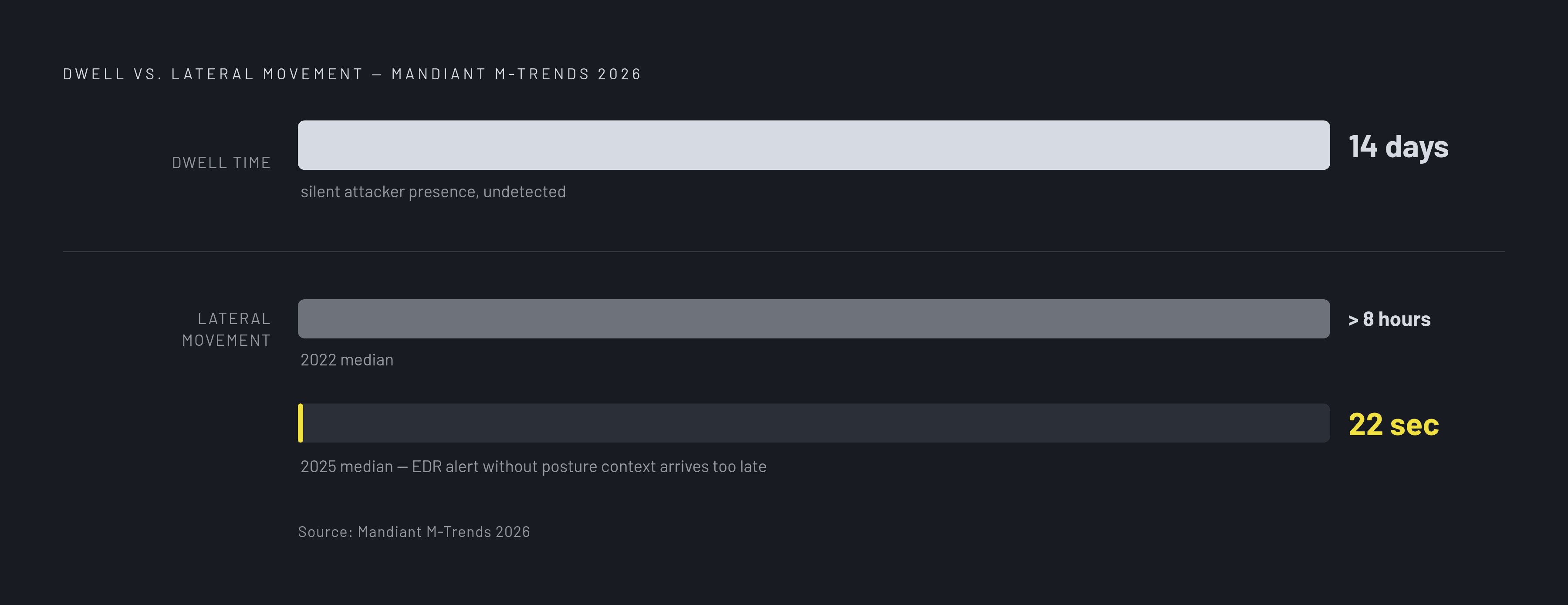
Speed compounds this. Mandiant's M-Trends 2026 report tracked the median gap between initial compromise and lateral movement collapsing from more than eight hours in 2022 to 22 seconds in 2025. Global median dwell time, meanwhile, rose to 14 days over the same period: attackers sit inside networks for two weeks on average before anyone notices, then move in under half a minute once they decide to. An EDR alert without posture context forces a responder to reconstruct that context by hand, and at 22 seconds, there's no time left for reconstruction. The signal was real; the response arrived too late to matter.
Where MDM enrollment gaps and compliance drift silently shrink the managed fleet
A device never enrolled in MDM produces no MDM telemetry, and in most configurations, no EDR telemetry either, since EDR agents are commonly pushed out through MDM policy. That device disappears from both layers at once, not gradually, and it stays invisible until something forces a manual check.
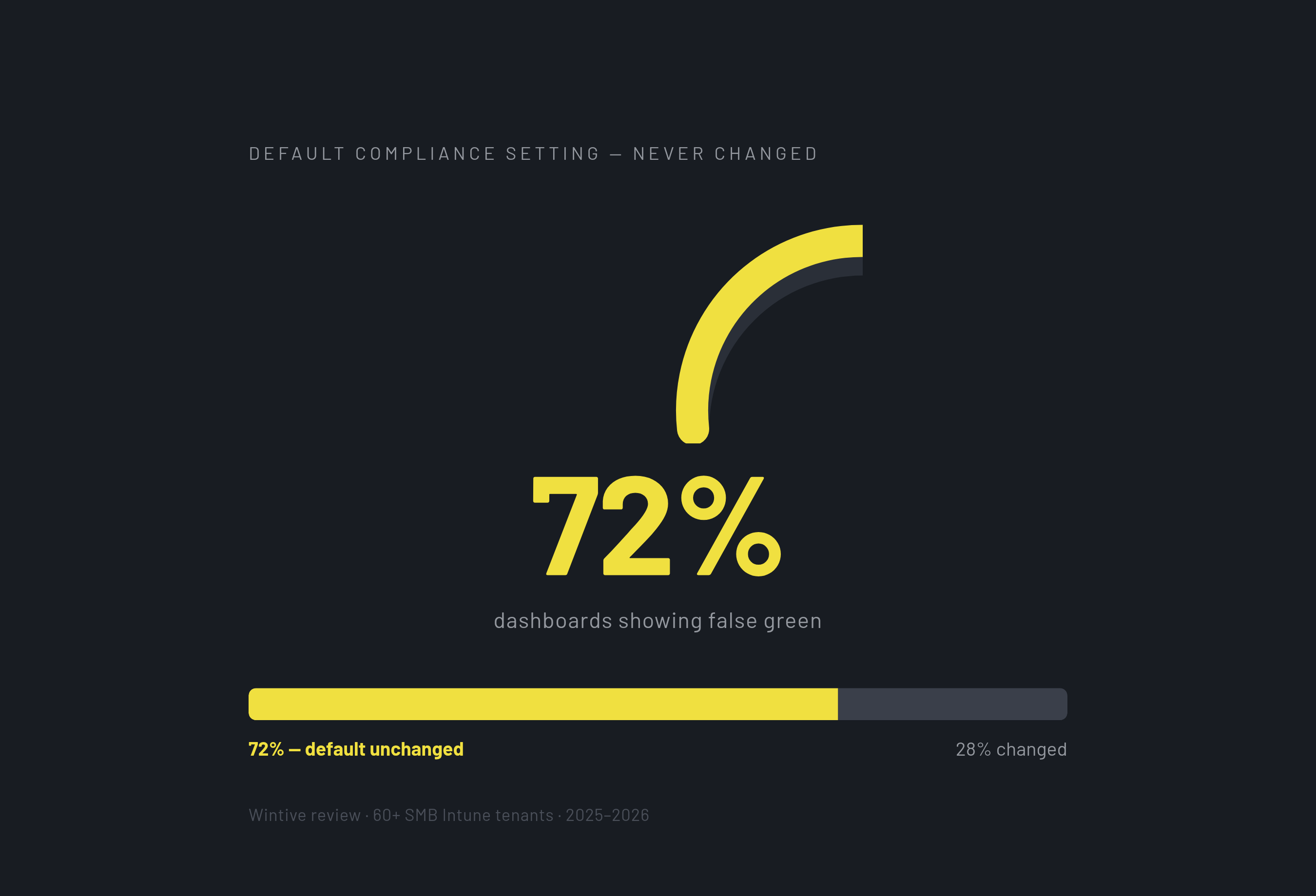
Enrollment is a snapshot, not a permanent state, and that distinction is where compliance drift comes in. A device enrolls today and drifts out of compliance next month, quietly, between audit cycles, and nothing surfaces the drift until it causes a problem downstream. Wintive's review of more than 60 SMB Intune tenants between 2025 and 2026 found that 72% had left the default "mark no-policy as compliant" setting untouched. Practically, that means devices that were never even evaluated got marked compliant in the console by default. The dashboard says the fleet is healthy, but the fleet includes machines nobody ever checked. A false green is worse than a red flag nobody looked at twice; at least the red flag gets a second look.
IoT compounds the problem from another angle: printers, cameras, smart building sensors, almost none of it visible to MDM or EDR, all of it sitting on the same network segment as managed endpoints. BYOD stacks a policy-versus-enforcement mismatch on top of everything else. A written BYOD policy can say whatever it wants about acceptable use, but if the device isn't enrolled, Conditional Access has no compliance state to evaluate, and the paper policy has no technical control standing behind it.
Standard security frameworks assume an organization can identify its assets before it protects them. Compliance drift breaks that assumption before any downstream control gets a chance to matter. For a non-practitioner, the test is straightforward: pull the MDM device list, pull HR onboarding records, and see where they don't match. Every mismatch is a gap in enrollment and EDR coverage simultaneously.
The specific integration configurations that cause pipeline data to arrive incomplete or out of sync
MDM and EDR don't sync just because they came from adjacent vendors, or even the same one. Getting telemetry to flow between them takes deliberate API connections, forwarding rules, and field normalization, set up on purpose and checked on a schedule.
A handful of misconfigurations show up over and over, and of these, enrollment trust conflation is the one worth fixing first, because it's both the most common and the easiest to miss: treating enrollment itself as proof of trust inside Conditional Access rules, with no continuous posture evaluation layered on top. Enrolled is not the same as currently compliant, though plenty of access policies are written as if it were.
Stale compliance state runs a close second. MDM checks run on a schedule, and if that interval is too wide, EDR ends up acting on a compliance verdict that's hours or days old. A device can pass its last MDM check, get compromised an hour later, and any EDR alert that fires afterward carries no signal that posture has changed since.
Agent deployment gaps follow from enrollment gaps directly. If EDR agents get pushed out through MDM policy, and a device was never enrolled, the agent was never deployed either, and that device vanishes from both layers at once, not one after the other.
Telemetry volume throttling is quieter, and buyers often don't know it's happening. Managed stack providers sometimes dial down EDR verbosity to control SIEM ingestion costs or data fees. That's a fidelity tradeoff made on the vendor's economics, not the client's risk tolerance, and it's rarely disclosed as such.
Field normalization failures round out the list. When MDM and EDR use different identifiers for the same device, hostname on one side, serial number on the other, correlation queries fail silently. An alert in EDR can't be matched to a posture record in MDM, and nobody gets notified the match failed; it just doesn't happen, and the gap sits there until someone goes looking.
Revocation latency deserves its own mention. When EDR flags a device as compromised, the time between that detection and MDM actually cutting off access is a live window of exposure. Organizations without an automated revocation workflow leave that window open until a human closes it by hand.
A non-practitioner evaluating a provider can ask direct questions here. How often does MDM re-check compliance, and does EDR get that update in real time or on a lag? What field correlates MDM and EDR records for the same device? If EDR flags a compromise, what does MDM do automatically, and how long does it take? Is any EDR telemetry filtered or throttled before it reaches detection logic?
What SMBs are most exposed to when these gaps go unexamined
SMBs aren't targeted by accident; they're targeted because the math favors it. Smaller IT teams, slower patch cycles, and thinner incident response capacity all point the same direction: toward organizations carrying exactly the kind of MDM-EDR gaps described above, and carrying them for longer before anyone notices.
The workforce shortage makes this worse from the outside in, since the people who'd normally catch a stale compliance interval or a broken device-identifier match often don't exist inside these organizations at all. The gap sits unexamined not by choice but by staffing arithmetic, a different problem than negligence and a harder one to fix with a memo.
None of this is theoretical when it comes to cost. Dwell time compounds the risk directly: a stack with pipeline gaps is exposed not just to the initial break-in, but to the full 14-day median window an attacker gets to move laterally, dig in, and stage data for exfiltration while every dashboard in the office reads green. Credentials sit at the center of it, an attack path that lives entirely outside EDR's field of view and one that MDM policy rarely accounts for directly.
For a lean team, the real cost isn't the missed alert; it's the false confidence. When the pipeline has gaps, the alerts that do fire arrive stripped of context, and a non-expert responder is left holding a signal they can't act on with any certainty.
How to pressure-test a managed stack's pipeline fidelity without a security team on staff
Start with the inventory question, since it's the cheapest one to answer. Pull the MDM device list, compare it against HR records and DHCP logs from the network, and flag anything that appears on one list but not the others. Every mismatch is a coverage gap, full stop.
Then check enrollment completeness on its own terms, not as a proxy for total device count. What percentage of known corporate devices are actively enrolled and reporting a current compliance state, versus just appearing on a list from the last time someone checked in? A device that hasn't reported in weeks is unaccounted for, a different problem requiring a different fix than a device that's simply out of compliance.
Audit the default compliance setting directly, and do it before anything else on this list, because it's the single highest-leverage fix available. In Intune and comparable platforms, confirm that devices without a policy assignment aren't marked compliant by default; that's the exact misconfiguration found in 72% of the SMB tenants Wintive reviewed. It's a two-minute check in the console, and nothing else here costs so little and closes so much at once.
Finally, verify that MDM and EDR records can actually be correlated. Pick a device at random, find its record in MDM, find its record in EDR, and confirm both systems use the same identifier to refer to it. If they don't, neither system's alerts will carry the other's context, no matter how well each tool performs on its own. That correlation is the whole point of running both products. Without it, the organization is paying twice and getting the coverage of neither.