Compliance Control Automation Versus Manual Evidence Collection in GRC Platforms
Automation cuts manual compliance work, but only for tasks already defined and integrated.
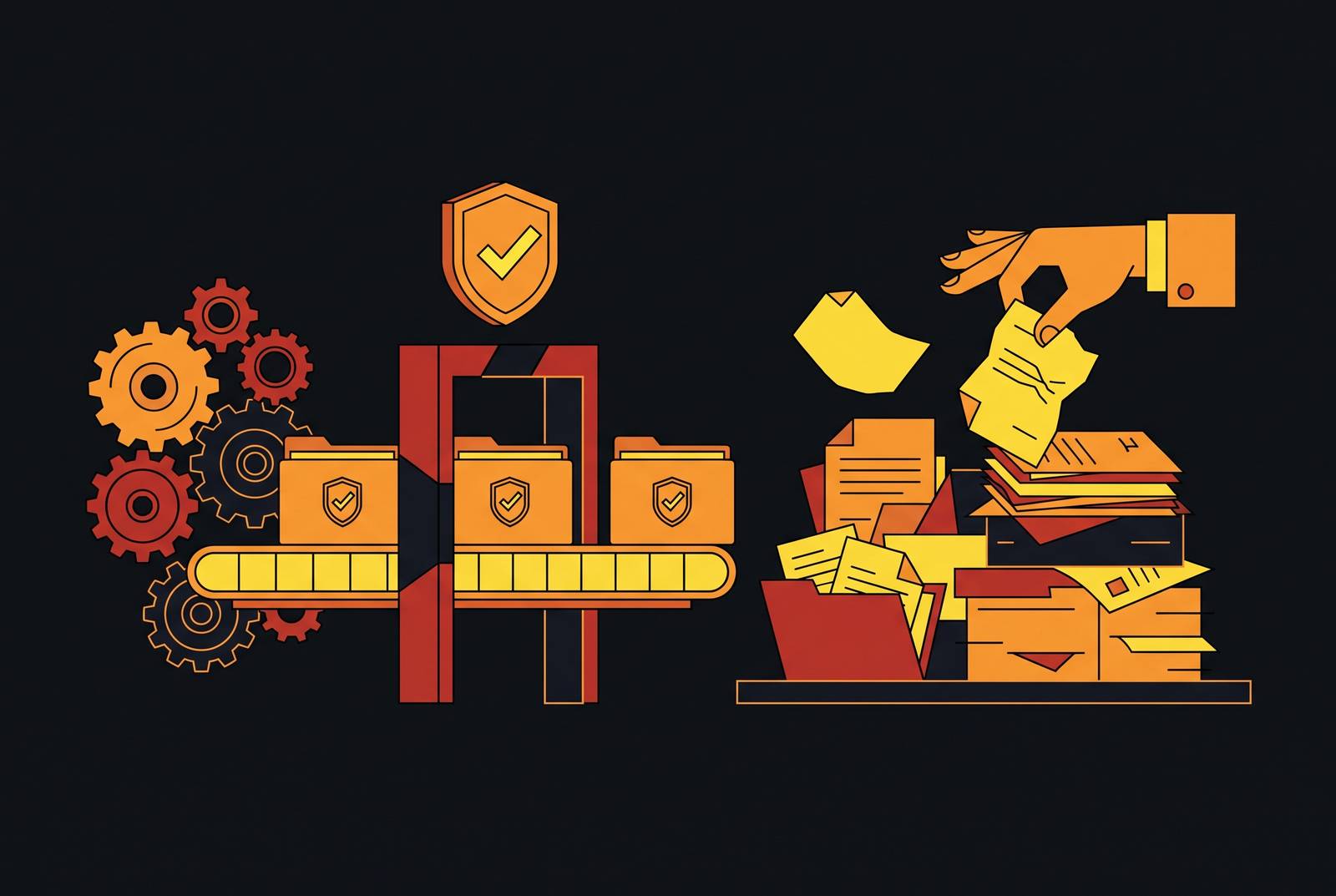
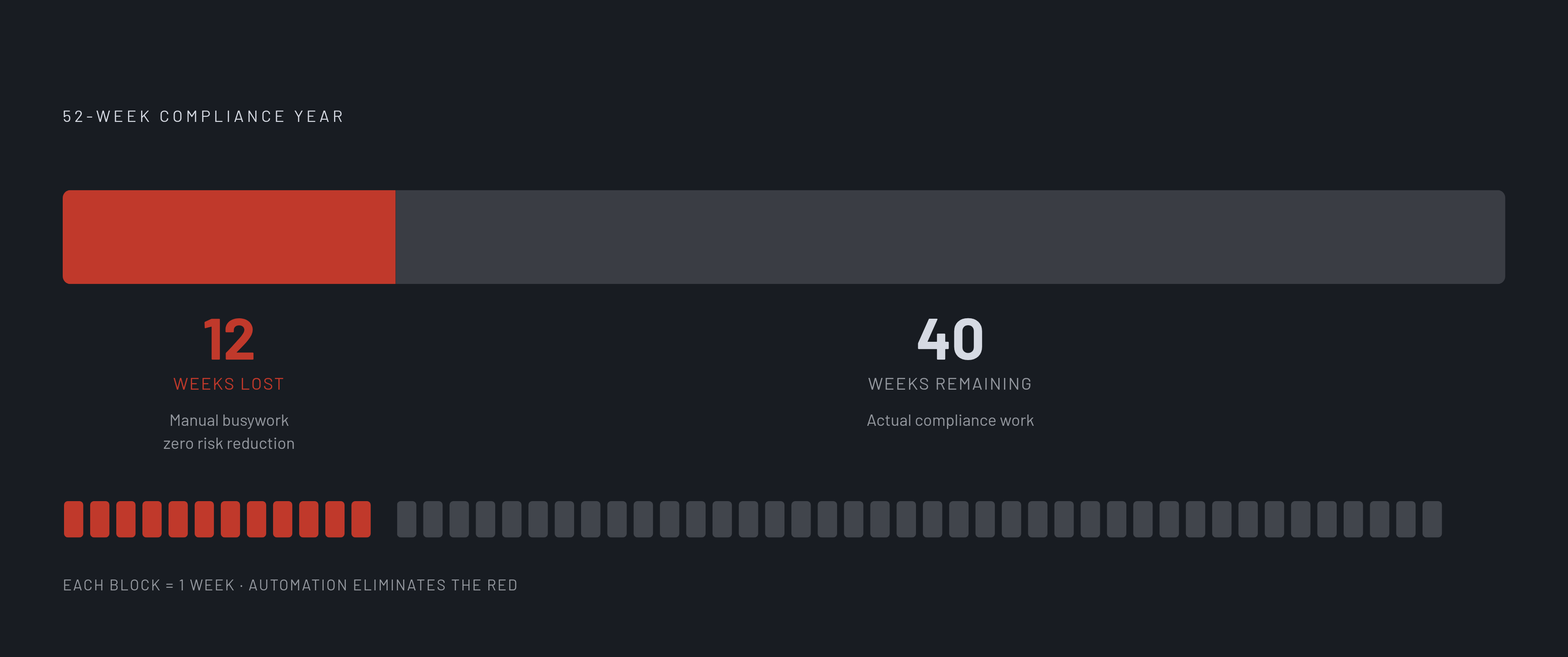
Compliance teams lose about 12 working weeks a year to manual busywork: collecting evidence, tracking controls in spreadsheets, prepping for audits. That figure comes from a 2026 HackerNoon piece: it means a quarter of a compliance program's working year gets eaten by tasks that produce zero risk reduction on their own. Automation exists to remove that category of work entirely, not just speed it up. The distinction matters because lean teams, the ones without a dedicated compliance hire, need to know exactly which tasks disappear and which ones just move to a different desk.
What compliance control automation actually replaces, task by task
GRC automation, in the narrow and useful sense, means software that takes over governance, risk, and compliance processes that used to run through spreadsheets, email chains, and manual evidence runs. Not an "AI layer" bolted onto existing chaos. A direct replacement for specific, nameable tasks (per Scrut, 2025).
Here's what actually goes away:
- Manual evidence pulls from cloud providers, identity platforms, HR systems, and DevOps pipelines, replaced by continuous, automated collection straight from the integrated system
- Hand-built control-to-framework mapping, replaced by automated cross-framework mapping that reuses one piece of evidence across several overlapping requirements
- Rebuilding audit documentation every single cycle, replaced by a persistent evidence library that just stays current
- Status-check emails and ad hoc task assignment, replaced by workflow routing that sends evidence requests to the right person automatically
- Point-in-time control testing crammed in before an audit, replaced by monitoring that runs all year
That's the real list. But automation doesn't erase every job on a compliance team's plate, it just moves some of them.
Evidence still needs a human eye. A platform can pull a screenshot or a log file on schedule, but someone has to decide whether that log actually answers the question an auditor is going to ask. Exception handling works the same way: when a control fails or a system was never hooked into the platform, automation flags the gap. It doesn't fix it. Cross-functional coordination gets automated at the routing level, someone in engineering gets pinged instead of emailed, but a person still owns the response.
And then there's a short list automation never touches, no matter how good the platform is: whether a control design fits the organization's actual risk profile, how to read ambiguous regulatory language against a specific business, how to answer an auditor's follow-up question that needs context instead of a document, and who's accountable for what in the first place. Automation enforces ownership structures once they exist. It doesn't invent them.
Automation pays off when workflows are already defined, ownership is already assigned, and systems are already integrated. Feed it a messy process, and it won't clean the mess up, it'll just run the mess faster (per Scrut).
How continuous controls monitoring changes the compliance posture model
The old way of doing compliance ran on a calendar. Controls got tested in a window before the audit, evidence got gathered in a scramble, and problems got fixed after someone else found them. Continuous Controls Monitoring, CCM for short, throws that calendar out.
Instead of a snapshot, CCM gives ongoing, automated validation of whether controls are actually working, across whatever environment they touch. Real-time alerts fire when a control drifts or breaks, ideally weeks before an auditor would have caught it. The result is assurance built on continuous data instead of a scramble under audit pressure (per Hyperproof, 2026).
This matters more for a five-person compliance shop than a fifty-person one. A large team can absorb the pre-audit sprint by throwing bodies at it for two weeks. A founder running compliance on the side, or an IT generalist wearing six hats, can't. CCM turns that annual fire drill into something closer to a steady hum.
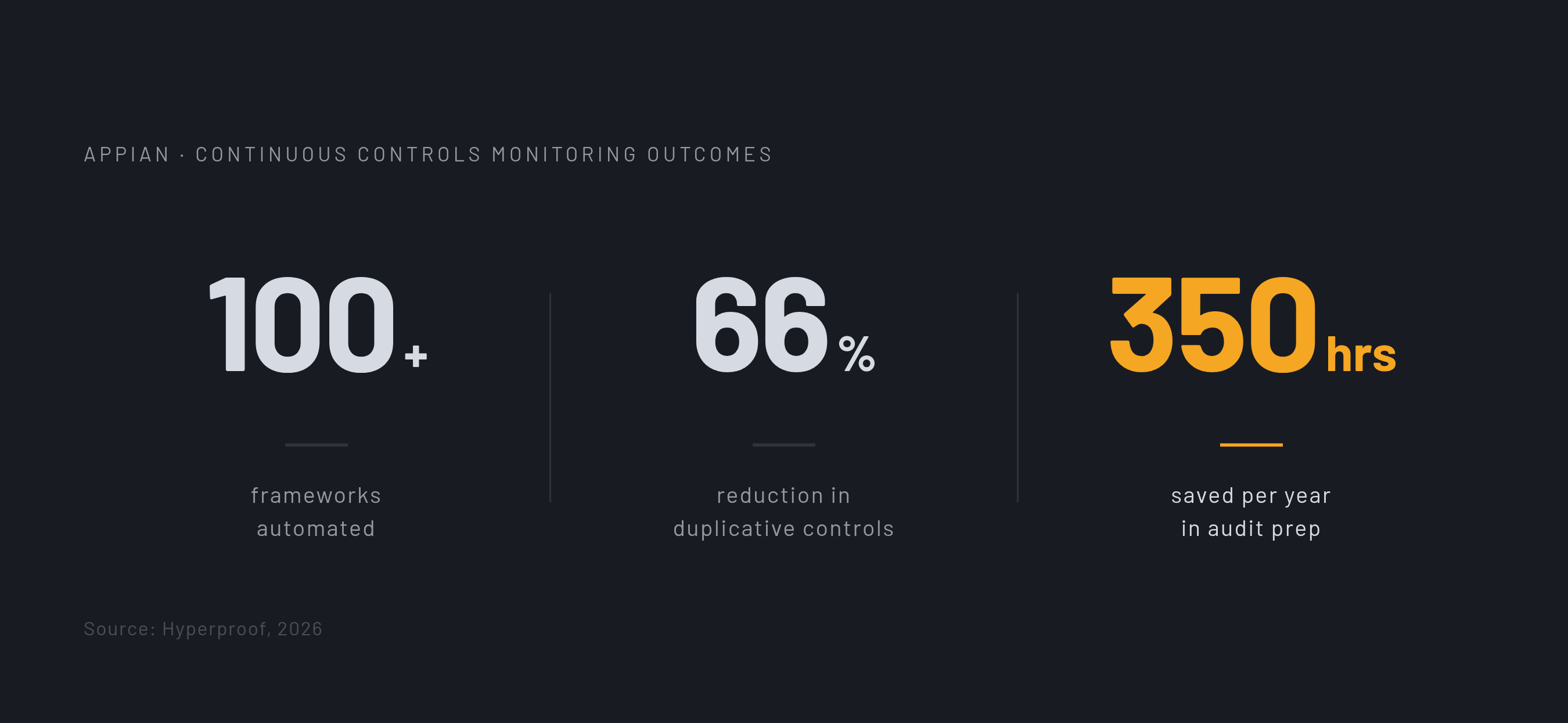
Appian is a useful data point here, as a signal of scale. Per Hyperproof, Appian automated control orchestration across more than 100 frameworks, cut duplicative controls by 66%, and saved 350 hours a year in audit prep. That's not a small optimization. That's a structural change in how much labor a compliance program requires to stay current.
CCM is only as good as what's plugged into it. Cloud infrastructure, identity systems, security tools, whatever isn't integrated isn't monitored. A gap in integration is a gap in coverage, full stop.
And CCM answers one question, not two. It tells an organization whether a control is running. It says nothing about whether that control was the right one to build in the first place. A control can execute flawlessly, every day, and still be aimed at the wrong risk.
The practical difference between a compliance automation tool and a full GRC platform
These two categories get lumped together constantly, and they shouldn't be. Compliance automation tools automate evidence collection for specific frameworks, SOC 2, ISO 27001, that kind of thing. They exist to get an organization certified. Full GRC platforms run the entire risk and compliance program: risk management, vendor risk, policy management, audit management, and compliance, all inside one environment. One gets you certified. The other runs the program (per Compyl).
Picking the narrow tool raises costs quickly, and those costs are visible in what teams do next. Teams keep the automation tool for certification, then go buy separate point solutions for risk scoring, vendor management, and policy tracking. Which recreates the exact siloed-data problem the automation tool was supposed to solve in the first place (per Compyl).
There's a quieter cost too. When tools don't talk to each other, findings appear at audit time instead of the day they actually happen, which is the same failure mode manual compliance produces. Buying automation doesn't help if the automation lives in three disconnected systems.
Cross-framework control mapping is the real dividing line between the two categories. A full platform lets an organization collect evidence once and apply it across overlapping requirements in SOC 2, ISO 27001, HIPAA, whatever else. Adding another framework becomes incremental work rather than starting from scratch. Neither category is one uniform thing, and the right fit depends heavily on how much configuration overhead a lean team can absorb up front.
So how does a lean team actually choose? Two honest scenarios:
If the goal is one certification with a defined audit scope, a purpose-built automation tool is probably faster to deploy and sufficient. If the goal is ongoing, multi-framework compliance plus vendor risk plus reporting up to leadership, a unified platform avoids a second purchase 12 to 18 months down the road. Deployment speed matters here too: a platform with a long configuration runway has already given back much of the time automation was supposed to save.
An integrated approach, one that combines device management, identity, and compliance automation in a single deployment, closes the integration gap directly. Organizations that consolidate this way cut down on the manual handoffs that continuous monitoring depends on to work at all.
The six GRC and compliance automation tools SMBs are actually adopting in 2025
Adoption data here comes from a 2025 Bright Defense report, a 2026 HackerNoon roundup, and a separate HackerNoon piece authored by Vanta. This isn't a ranking. It's an honest account of what each tool is built to do and where it actually fits.
LogicGate Risk Cloud: LogicGate appears in SMB GRC adoption data, though a specific market-share figure is not confirmed in available sources. It is generally positioned for midmarket and growing organizations, with AI capabilities layered in. Fits teams that want flexible risk workflow configuration without enterprise-grade complexity.
Vanta: per Bright Defense, 12% SMB market share. Best known for SOC 2 and ISO 27001 automation, though it now supports more than 35 frameworks, including HIPAA, GDPR, and PCI DSS. Vanta's own 2026 HackerNoon piece calls it the "#1 Agentic Trust Platform," worth reading with the understanding that the source has a commercial stake in the claim. That piece also cites a finding that only 13% of organizations feel very prepared to manage generative AI risk, which frames Vanta's push into AI governance. Fits startups chasing a first certification on one defined framework; less suited as a standalone for multi-framework or vendor-risk programs.
StandardFusion: per Bright Defense, 10% SMB adoption. Built as a GRC generalist, policy and risk management sit alongside the compliance tooling. Fits teams that need more than a certification checklist but aren't ready for an enterprise-scale build.
Drata: per Bright Defense, Drata is growing 50% year over year, the fastest growth rate in this group. Focused on automated evidence collection and audit readiness, backed by a wide integration catalog. Fits teams that want the evidence-collection engine to be as strong as possible.
Hyperproof: per Bright Defense, 9% adoption, with a focus on continuous compliance monitoring. Hyperproof's own materials center the pitch on control mapping, evidence management, and CCM, and the Appian case (100+ frameworks, 66% fewer duplicative controls, 350 hours saved a year) shows what that looks like at scale. Fits compliance teams juggling several frameworks with heavy evidence requirements.
RiskOptics: per Bright Defense, 8% adoption, centered on risk visibility and compliance scoring. Fits organizations where quantifying risk matters just as much as passing the audit.
A note on the bigger names: MetricStream, ServiceNow GRC, and AuditBoard are among the platforms that round out the top tier by analyst recognition, per the 2026 MetricStream roundup. MetricStream was named a Leader in an industry analyst's 2025 MarketScape for GRC software, and a separate study found $8.4 million in benefits and 133% ROI for MetricStream customers. These are enterprise tools, mentioned here for orientation. A lean team evaluating any of them should expect a longer implementation timeline and real configuration overhead before anything runs automatically.
Organizations without an existing GRC stack might find more value starting from a platform that already bundles device management, identity, and compliance automation together, since that gets continuous monitoring and audit-ready evidence without stitching together a multi-vendor stack from scratch.
What human judgment still owns in an automated compliance program
Automation collects evidence, but it cannot always tell whether that evidence is complete, relevant, or lines up with what an auditor actually expects to see (per Scrut, 2025). A compliance program still needs a person for that gap.
Five places where a human stays in the loop, no matter how good the tooling gets:
Evidence review. A system pulls the log. Only a person confirms the log answers the question the auditor is actually asking. Control design. Deciding whether a control fits the organization's specific risk profile takes context no platform has access to. Regulatory interpretation. Ambiguous language in something like NIS2, DORA, or the HIPAA Security Rule needs a judgment call about how it applies to this organization's specific setup, not a generic one. Exception management. When a control fails or a gap surfaces, figuring out the root cause and deciding how to fix it is still a people problem. Ownership structures. Automation enforces who's accountable for what, task routing, reminders, sign-offs, but a person has to define that structure before the platform can enforce anything.
Automation often shifts effort rather than deleting it. Work moves from collecting evidence to reviewing it, deciding on it, coordinating around it. Total hours don't always drop as much as the sales pitch implies, especially if the underlying process was disorganized before the tool was adopted (per Scrut).
For a lean team, that shift is still a win, just not the win they expected going in. The bottleneck moves from gathering evidence to judging it, which is a far better use of five hours a week than screenshotting consoles for one cloud vendor. But the precondition holds regardless: clear workflows, defined ownership, integrated systems. Automate a poorly structured process, and the tool won't clean it up. It'll just reveal how disorganized it already was, faster than a human ever could.
How regulatory demands are making continuous automation a practical necessity, not a nice-to-have
GRC spending hit $15.2 billion in 2025, according to a HackerNoon report, pushed up by tighter data privacy law, new AI governance mandates, and expanding third-party risk requirements. That number isn't a curiosity. It's a measure of how fast the regulatory floor is rising under every compliance team, lean or not.
Each new framework an organization adopts doesn't add compliance work, it multiplies it. SOC 2 brings its own control set and audit cycle. Add ISO 27001, and now there are two sets of evidence requirements running in parallel, mostly overlapping but never quite identical. Add HIPAA or GDPR on top, and a manually managed program isn't handling four separate to-do lists, it's handling something closer to the intersection and union of all four at once, tracked by hand, in a spreadsheet someone rebuilds every cycle.
Regulation keeps arriving faster than manual process can absorb it. That practical reality produces the spending figure. A compliance program built on point-in-time evidence collection was already strained under one or two frameworks. Under four or five, with AI governance rules now entering the mix, that structure doesn't bend, it breaks.
Continuous automation isn't a productivity upgrade at that point. It's the only architecture that scales linearly instead of multiplying with every new requirement a regulator adds to the pile.
Sources
- Top 5 Governance, Risk, and Compliance (GRC) Tools and Solutions for 2026
- GRC automation in 2026: What works, what doesn’t, and what to fix first
- GRC Platforms: 8 Features to Look For in 2026
- 12 Best Governance, Risk, and Compliance (GRC) Tools and Software for 2026 (Compared) | HackerNoon
- Best GRC Platforms for Risk and Compliance in 2026 | HackerNoon
- Compliance Automation vs. GRC Platform: Which Does Your Mid-Market Company Actually Need? - Integrated GRC Platform for Compliance, Risk & Security Governance
- brightdefense.com