Automated Remediation Gaps in SMB-Focused MDR Services
Most MDR contracts stop short of actual recovery, leaving SMBs offline for days.

Most SMB-focused MDR services promise "detection, response, and remediation" in the sales deck, but the word "remediation" hides three very different levels of service, and most contracts only deliver one of them fully. The gap between what a buyer pictures when they sign, and what the contract actually obligates the provider to do, is where businesses end up locked out of their own systems for days after an attack has already been "handled."
MDR vendors use "remediation" to mean threat containment, guided remediation, or hands-on remediation, and those three things are not interchangeable. Containment means isolating a host, killing a process, or blocking a malicious connection. Guided remediation means the provider tells the customer what to do next. Hands-on remediation means the provider's analysts actually do the work. Most SMB-focused MDR contracts deliver the first reliably. Fewer deliver the third.
Industry analysts widely treat immediate remote mitigation and containment, paired with 24/7 staffing, as the defining traits of MDR. Containment is the baseline. Restoration of operations is not assumed, and that distinction is the whole ballgame for a small business that can't afford to be offline for a week.
N-able's manufacturing firm scenario shows exactly how this plays out. MDR isolated three infected endpoints and stopped lateral movement within minutes of detection. Clean response, textbook execution. The firm was still offline the following Monday, because nobody had tested the backups in six months. The MDR provider did precisely what the contract said it would do. The customer was still not recovered. It's a description of where the service stops, an outcome the contract fulfilled without recovering the customer. It's a description of where the service stops.
Where the handoff happens in a typical MDR incident lifecycle
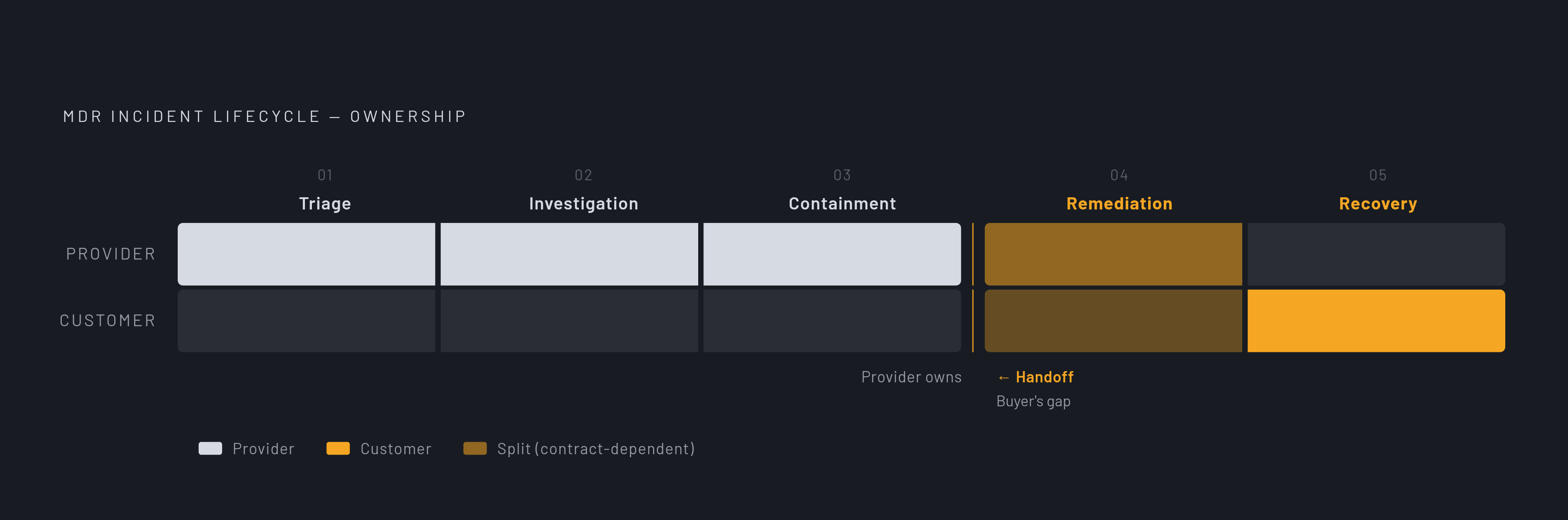
Break an MDR incident down and there are roughly five stages: triage, investigation, containment, remediation, recovery. Full-service providers own the first three almost universally. Stage four and stage five are where the paths split, and where buyers get surprised.
Triage and prioritization: the provider handles it, automated systems plus analyst review, filtering out the noise before it ever reaches the customer's inbox. Threat hunting and investigation: also the provider's job, building the forensic timeline, scoping the compromise, tracing root cause. Containment: still the provider, isolating the host, killing the malicious process, disabling the compromised account. This is the part most buyers picture when they hear the word "response."
Remediation is where it gets murky. The provider might advise. It might guide. It might act directly. Which one happens depends entirely on the contract and on what technical integrations are actually in place between the provider's tools and the customer's environment. Recovery, meanwhile, is almost always left to the customer: restoring systems, rebuilding configurations, validating that backups actually work, getting the business back to normal.
Think about what happens at 2 a.m. A SIEM fires an alert. An MSSP notifies someone. An MDR provider investigates and, within whatever authority the contract grants, starts containment. But "starts containment" and "restores your systems" are two completely different outcomes, and conflating them is where a lot of buyers get burned.
Speed makes this more urgent, not less. Attacker breakout times, the gap between initial compromise and lateral movement, are now measured in minutes rather than hours in many cases. So the containment stage matters enormously. But a contained, non-recovered environment is still a business that can't take orders, can't ship product, can't answer the phone.
Industry research has consistently found median dwell times measured in days or weeks across investigated incidents. That means a lot of breaches MDR eventually catches have already had two weeks of attacker access inside the network before anyone noticed. Longer dwell time means a wider blast radius, which means remediation has more ground to cover once containment is done. None of this is a design flaw in MDR. It's a boundary, and buyers need to know exactly where it sits before they sign anything.
The three MDR response models and the tasks each one leaves the customer to handle
Three distinct operational models exist in the market right now, and identifying which one a vendor is actually selling determines which feature comparison chart is even relevant.
Monitor-and-alert is the closest thing to traditional MSSP behavior. The provider detects, notifies, and stops. Everything after that, investigation, response, decision-making, falls on the customer. It's the least appropriate model for an SMB with no internal security staff, because it assumes exactly the capability that SMB doesn't have.
Guided remediation goes further: the provider detects, investigates, and contains, then hands the customer a remediation playbook or works alongside the internal team as they execute it. This model still requires someone on the customer's side who's available and capable of acting on those instructions, which is a real staffing assumption, not a minor detail.
Hands-on remediation is the fullest version. The provider detects, investigates, contains, and performs the remediation actions directly. Customer involvement stays minimal until recovery.
Take Arctic Wolf as an example of the guided model. Its concierge SOC approach has analysts primarily advise and walk the customer through remediation steps rather than executing those steps on the customer's behalf. Organizations expecting fully autonomous containment, with no internal lift required, may find the model asks more of them than they anticipated. Pricing starting around $44,000 a year also positions it toward the mid-market rather than the smallest SMBs.
Kaseya's MDR offering, per its own listing, runs a SOC staffed by analysts who proactively hunt, investigate, triage, and work directly with customer teams on remediation, with coverage across endpoints, Microsoft 365, Entra ID, and firewalls. Native PSA and RMM integration means tickets surface into workflows the customer's team already uses, and the operation is SOC 2 and HIPAA-certified.
Then there's the integrated-platform model. Acronis MDR bundles MDR with built-in backup and recovery, letting the SOC trigger a point-in-time rollback from immutable backups directly, which is a deliberate answer to the recovery gap that pure-detection MDR leaves wide open. Acronis claims this cuts mean time to recovery from roughly 11 hours for an internal team down to under an hour.
Before signing anything, three questions cut through the marketing fast: Will analysts take action on the environment without waiting for approval, or is sign-off required first? What specific remediation actions are actually in scope, and what falls back to the customer? Does the platform include recovery capability, or is restoration entirely the customer's problem?
Why the handoff is especially dangerous for SMBs with no internal security staff
Handing remediation back to the customer only works if the customer has someone ready to receive it. Large enterprises have a security team for that. Most SMBs have a founder, an IT generalist, or an operations manager who's also handling payroll, vendor calls, and everything else that keeps the lights on.
The ISC2 Cybersecurity Workforce Study found 33% of organizations say they lack the resources to adequately staff their security teams, and that figure almost certainly undersells the SMB reality, where "security team" often means zero dedicated people, full stop.
Formal planning tells the same story. Research consistently finds that many medium businesses lack a formal incident response plan built with actual cybersecurity expertise, and the small business figure sits even lower. So when an incident hits, a meaningful share of these organizations are improvising the recovery in real time, figuring it out as the business bleeds.
Alert noise makes the gap worse, not better. A security team drowning in alerts loses analyst time, which is bad but survivable. An SMB with zero dedicated analysts facing the same alert volume has no triage process at all. Nothing gets escalated correctly, because there's no one whose job it is to escalate.
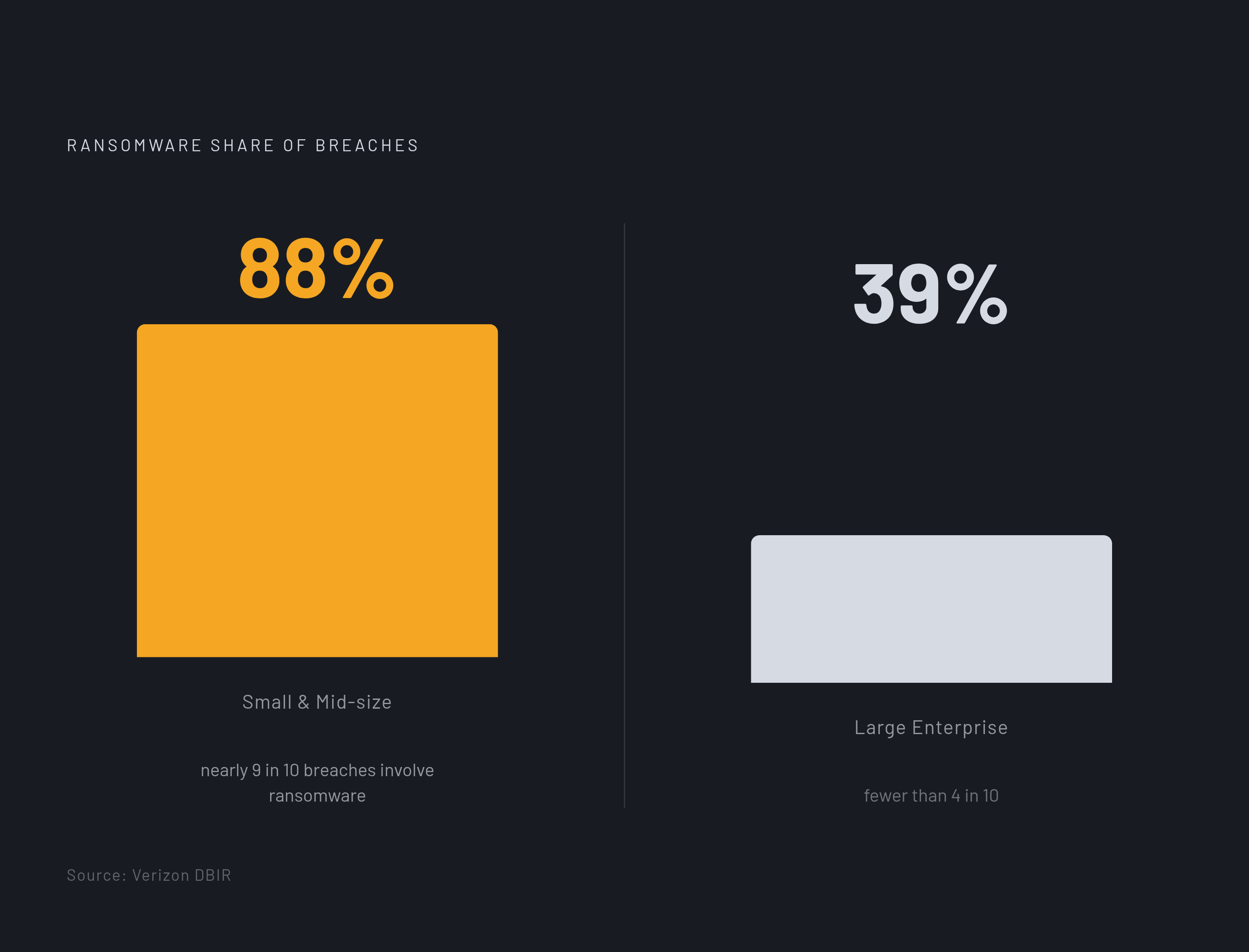
The threat itself skews harder against small businesses too. Verizon's DBIR found ransomware present in 88% of breaches affecting SMBs, compared with 39% at large enterprises. At 88% versus 39%, the gap between SMBs and large enterprises is substantial. It means the threat SMBs face most often is exactly the kind that demands fast, hands-on remediation, not a playbook emailed over at 3 a.m.
The financial stakes back this up starkly: a significant share of small businesses that suffer a serious cyberattack are unable to sustain operations in the aftermath, and many say they couldn't keep operating at all if hit with ransomware. An SMB buying a guided-remediation MDR model is buying a service whose entire value depends on an internal capability that SMB, in almost every case, doesn't have.
The coverage gaps MDR consistently leaves and what fills them
N-able's analysis of MDR coverage lays out five categories that sit outside the typical MDR contract, no matter how the marketing copy reads.
Backup and recovery tops the list. MDR contains the threat. Restoring systems to a clean, working state is the customer's job, and that job only goes fast if the backups were tested and immutable before the incident started, not after.
Vulnerability and patch management is another. MDR detects exploitation of an unpatched hole. It doesn't patch the hole. Sophos research found roughly 29% of small businesses reported attackers got in through an unpatched vulnerability, a gap that detection alone can never close if patching keeps getting pushed to next quarter.
Identity and access management remediation sits in a middle zone. MDR might disable a compromised account during containment, sure. But resetting credentials across the board, auditing who has access to what, and rolling out MFA everywhere afterward, that's on the customer.
Security awareness and training rounds out the human side. MDR catches the phishing-delivered compromise. It doesn't train the employee who clicked the link in the first place, and small businesses face a disproportionately high rate of targeted malicious email relative to their size.
Compliance documentation and reporting closes the list. MDR may produce an incident report after the fact. Maintaining ongoing compliance posture, producing audit evidence, managing the regulatory paperwork, all of that stays with the customer.
None of these are MDR failures. They're scope boundaries, plain and simple, and the real danger is treating MDR as a complete security program instead of one layer in a larger stack. Platforms that combine device management, endpoint security, identity protection, and compliance automation into one managed package close several of these gaps as a baseline, which is worth weighing against MDR alone for a business making its first serious security investment. Deployment speed matters here too: a service that gets running in days rather than months closes coverage gaps faster, and a lengthy onboarding process is that much more time sitting exposed.
How to read an MDR contract before signing (the specific clauses that reveal the remediation boundary)
Most buyers evaluate MDR on the sales deck and the price tag. The remediation boundary almost never lives on the sales deck or the price tag; it's buried in the SLA definitions and the scope-of-service schedule. It's buried in the SLA definitions and the scope-of-service schedule, the pages nobody reads closely until something's already gone wrong.
Four places in the contract deserve real scrutiny. The response authority definition should spell out which actions the provider can take autonomously versus which require the customer's sign-off first, because autonomous containment and "we'll alert you and wait" are not the same service, even if both get called "response."
The remediation scope schedule needs to name actual actions, not just the word "remediation." Isolating a host isn't the same as cleaning it. Cleaning it isn't the same as restoring it to production. If the schedule doesn't spell out which of those the provider actually performs, assume the gap is wider than it looks.
Then there's the SLA language itself: mean-time-to-contain versus mean-time-to-remediate. The MDR category has broadly shifted toward measurable containment and detection commitments, but full remediation SLAs remain less common, so a provider that does commit to one stands out.
Finally, the recovery responsibilities section. Who restores systems to operational state? If that section is missing, or if it dumps the entire responsibility on the customer with no further detail, plan around that gap now, not during an actual incident.
Watch for red flags in the language itself: "guided remediation" with no definition of what the guidance actually involves, response SLAs measured in hours that only cover notification rather than containment action, or recovery excluded from scope entirely with no adjacent capability recommended to fill it.
Good contract language looks different. It names the containment actions the provider will take on its own authority, spells out an escalation path if those actions can't be completed remotely, and states what the customer needs to have ready, tested backups, a patching cadence, incident response contacts, for the service to actually deliver what it promises. Buyers without the background to parse these clauses on their own are strong candidates for a platform model that bundles the security capability together with the compliance and recovery infrastructure, which removes the contract-interpretation problem instead of leaving it for someone to catch at 2 a.m.