Bidirectional Ticketing Integration Between PSA and Security Tooling
Status syncs both ways so alerts don't pile up unseen.
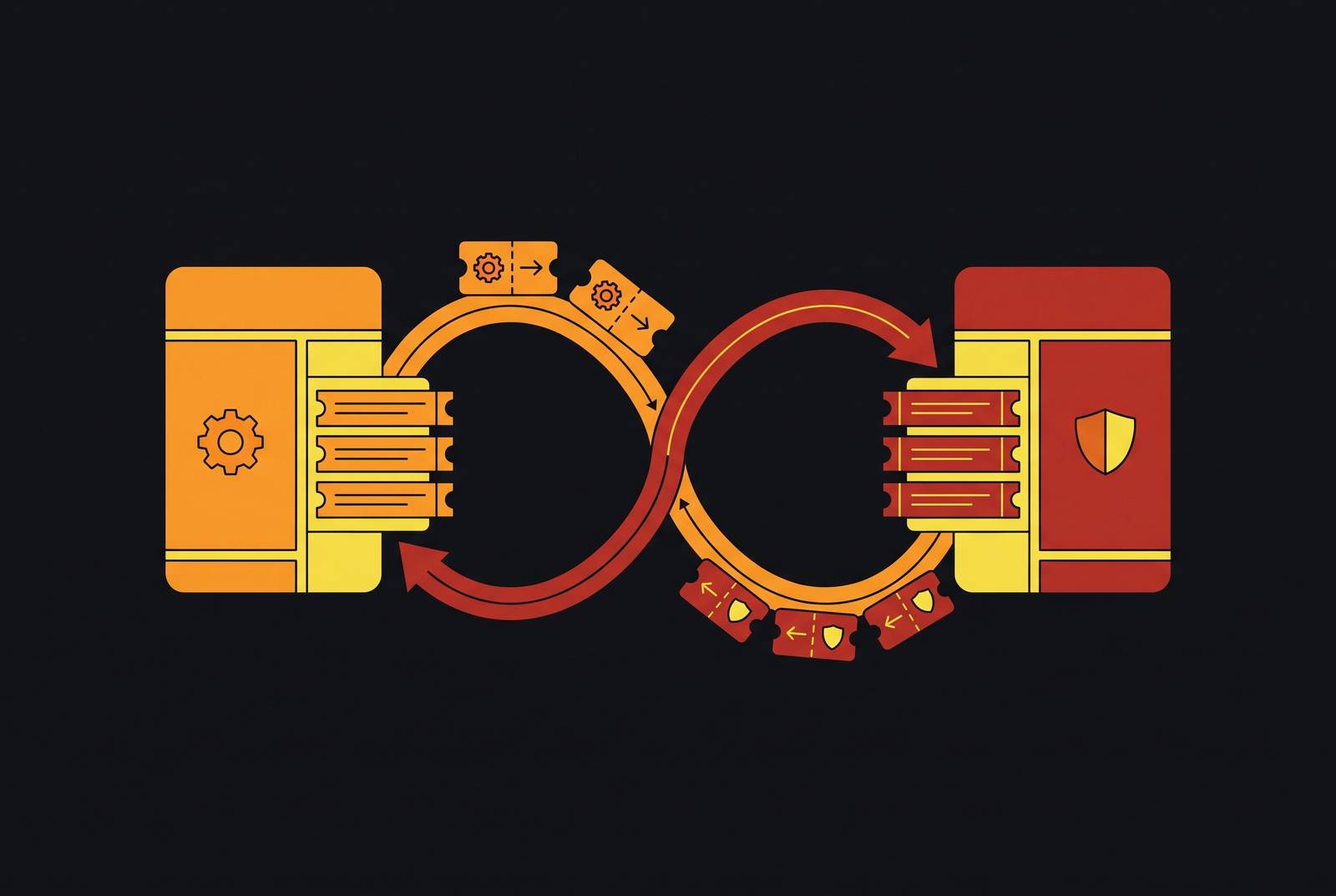
A security alert firing in a SIEM or EDR platform means nothing if the ticket describing it never reaches the team that fixes things. Bidirectional ticketing integration exists to close that gap, connecting the security tooling layer where threats get caught to the PSA where MSP technicians actually work. Get the sync right, and detection turns into resolution without anyone copying and pasting between two screens. Get it wrong, and alerts pile up in a console nobody checks while the PSA queue stays clean and blissfully unaware of the mess sitting one system over.
What bidirectional actually means, and how it differs from one-way alert forwarding
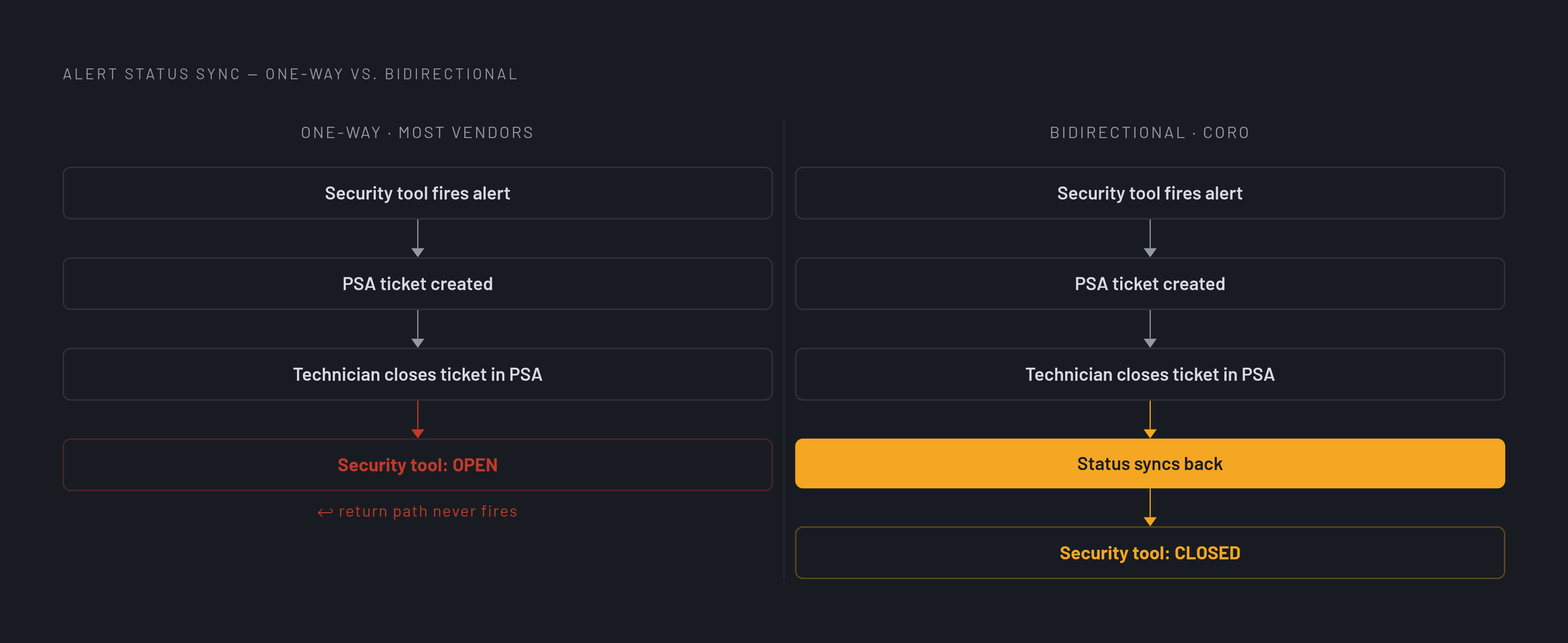
One-way sync is simple: a security tool pushes an alert, the PSA creates a ticket, done. Nothing flows back. A technician can close that ticket in the PSA and the security tool never finds out. The alert sits there, still open, still "unresolved" from the security tool's point of view, even though the human work is finished.
Bidirectional sync closes that loop. A status change on either side updates the other. Close the ticket in the PSA, and the alert resolves in the security tool. Clear the alert at the source, and the PSA ticket updates or closes on its own.
Here's the part vendors gloss over: most products sold as "integrations" are really just half of one, and the half they build is always the easy half. Blumira's ConnectWise integration is a clean example, and it's honest about it in its own documentation. Blumira pushes updates into the same ConnectWise ticket whenever a finding gets assigned, commented on, or resolved inside Blumira. But changes made on the ConnectWise side, an assignment, a manual close, don't sync back to Blumira. That's not a bug sitting in a backlog somewhere. It's the architecture, and it means a technician who closes the ticket in ConnectWise has done nothing at all to the actual alert still sitting open in Blumira's console.
Coro's integration with ConnectWise PSA is the real thing, and it's worth treating as the baseline other vendors get measured against. When an open ticket in Coro moves to closed, that status change flows back into ConnectWise automatically. Status agrees on both sides without a technician re-entering anything, which is the entire point of calling something bidirectional in the first place. If a vendor can't do this, don't let the word "integration" on a spec sheet convince you otherwise.
One more layer worth understanding: reopening. If the same underlying alert fires again after its ticket got closed, does the system open a fresh ticket, or reopen the one that just closed? That's not automatic by default, and assuming it is is where a lot of MSPs get burned. Acronis makes this an explicit configuration choice, a reopen window that someone has to set on purpose, not a behavior baked in at install.
The lifecycle a security ticket should travel, from alert to resolution and back
Start with the alert. A SIEM, an EDR agent, an IDS/IPS sensor, or a cloud-native monitor fires an event. That event carries metadata: which asset triggered it, what time, what severity, what source. All of that should ride along with the ticket automatically. None of it should get typed in by hand later. If a technician is retyping asset names into a PSA ticket, the integration has already failed at its first job, full stop.
Once the alert clears a configured threshold, the PSA ticket gets created automatically, pre-filled with that metadata, and routed to the right service board. A technician picks it up, adds notes, changes the status as work progresses. If bidirectional sync is actually running, none of those status changes need to be manually mirrored anywhere else.
When the alert clears, whether a human resolved it or the security tool auto-resolved it, the linked PSA ticket should update to reflect that. Then the re-occurrence question comes back around: same alert, does it reopen the last ticket or spin up a new one? Acronis documents this as a configurable parameter tied to a reopen window, not a fixed behavior, which means somebody has to go set it rather than assume the vendor picked something sensible by default.
SOAR platforms sit on top of this whole chain and do something the PSA can't do on its own: correlate. Instead of sending five separate alerts about the same incident across endpoint, network, and identity systems, SOAR tooling correlates and bundles them into one case object, reducing the volume of what reaches the PSA. Fewer tickets, less noise, and a technician isn't triaging five tabs describing the same story from five different angles.
Done right, the entire audit trail lives in the PSA: detection time, assignment, resolution, recurrence. Nobody's manually reconstructing a timeline after the fact from screenshots and messaging-app conversations.
How major security tools have implemented PSA ticketing connections in practice
Coro to ConnectWise PSA. Populates mapped Service Boards with ticket descriptions and status at creation, and syncs status changes from Coro back into ConnectWise, so a closed ticket in Coro reflects as closed in ConnectWise.
Guardz to Autotask PSA and ConnectWise Manage. Reports issues straight into the PSA and automates ticket creation inside existing workflows, cutting down on the need to jump between a client dashboard and the ticketing tool.
ConnectSecure to ConnectWise Manage, Autotask, and HaloPSA. Covers company mapping, ticket creation from alerts, and issue tracking across all three platforms. Notably, it reaches HaloPSA alongside the two more dominant PSAs, which many vendors in this space do not prioritize.
Blumira to ConnectWise PSA. Automates ticket creation, merges duplicate tickets tied to the same finding, and assigns priority levels. Updates the ConnectWise ticket whenever a finding changes inside Blumira. But as covered above, it's a one-way street: changes made in ConnectWise don't sync back.
SonicWall to ConnectWise, Autotask, and HaloPSA. A firewall event, say a VPN tunnel dropping or a license about to expire, triggers a PSA ticket automatically, and the ticket closes when the alert clears. Every SonicWall device registered in MySonicWall syncs as a configuration item inside the connected PSA. The documented gap: SonicWall alerts don't reach RMM platforms like Datto RMM or ConnectWise Automate. PSA only, not the full stack.
SaaS Alerts to ConnectWise PSA. Sends critical and medium severity SaaS alerts into the PSA for ticket generation and customer tracking.
AlertOps to ConnectWise PSA. Reflects the full status lifecycle: opens a PSA request on alert creation, updates the assignee when the alert gets assigned, closes the request when the alert closes.
Acronis security and backup alerts to Acronis PSA. Tickets get created from backup failures, disaster recovery events, anti-malware findings, and XDR/EDR alerts, with configurable auto-resolve and reopen behavior.
NinjaOne and similar RMM-native tools. Mapping rules route tickets to the correct board, and auto-close fires once the underlying RMM alert resolves on its own.
Look across this list and one pattern jumps out immediately. Getting an alert into the PSA is a solved problem at this point; nearly every vendor above does it competently. Getting PSA status changes back into the security tool is where many of them still fall short. That gap, not the ticket-creation side everyone advertises, is the one to interrogate hardest before signing anything.
Where the sync breaks, and how the workflow fragments even when integration is configured
The return path is the recurring failure point, full stop. Plenty of tools reliably push alerts into the PSA, but far fewer reliably pull status changes back out. Blumira's documented one-way limitation is common across the category. It's close to the norm, and any MSP assuming "integration" means bidirectional by default is setting itself up to find out the hard way, usually during an incident review nobody enjoys.
Reopen logic without a real policy causes its own mess. If a recurring alert spawns a brand-new ticket every time instead of reopening the last one, the queue fills with multiple duplicate entries describing the same unresolved condition. Nobody wants to triage that at 7am on a Monday, sorting through ten tickets to realize they're all one firewall rule misfiring.
Field mapping drifts, too, and quietly. Alert fields on the security side and ticket fields on the PSA side get mapped once during setup. When either system updates its schema down the line, that mapping can break without any error message. Fields just start showing up blank in the PSA, and nobody notices until a technician asks why the asset column is empty.
Service board routing goes wrong as client rosters grow. A mapping rule that worked fine for the first handful of clients starts misrouting tickets once the account list gets bigger, and this tends to surface around the 20th client onboarded, not the first. By then the rule is buried in a config nobody's opened in months.
Then there's the RMM gap. SonicWall's PSA integration doesn't extend to RMM platforms, which means a technician working a PSA ticket has no linked RMM alert or asset history to reference. The ticket exists, but it's missing half its context, and the technician ends up hunting through a second console to reconstruct what the first one should have told them.
Threshold tuning is its own trap. Set the bar too low, and every minor security event spawns a ticket, burying real incidents in noise. Set it too high, and genuine problems never generate a ticket at all. SOAR correlation cuts the noise before it reaches the PSA, but that's one more layer that needs its own upkeep, not a fix-it-once setting.
What the integration actually automates versus what still needs a human call
Automation earns its keep on a specific set of tasks. Ticket creation from a qualifying alert, no more staring at a security console waiting for something to fire. Metadata pre-fill, so the source, asset, timestamp, and severity land in the ticket without anyone retyping them. Status sync on resolution, so closing an alert closes the ticket without a manual double-update. Duplicate suppression, whether that's Blumira merging tickets tied to one finding or Acronis offering a configurable reopen window instead of always duplicating. Service board routing, sending the ticket to the right team the first time instead of the third.
None of that replaces judgment. Treating it like it does is the mistake worth naming directly, because it's the mistake that actually costs MSPs incidents.
Severity scoring from an automated system is a starting point for triage, not a verdict on business impact. A "critical" tag on an alert doesn't know that the affected server is a decommissioned test box, and a "low" tag doesn't know the affected account belongs to the CFO. Containment decisions, isolating an endpoint, locking an account, escalating to an MSSP or an internal security lead, still need a person weighing the actual situation. Root cause work is investigative by nature: the ticket tells someone an alert fired, not why it fired. Threshold calibration is ongoing, not a setting picked once and forgotten, since attack patterns and client environments both keep shifting under it. And some patterns only become visible across a stretch of PSA ticket history, the kind of slow-building signal no single SOAR correlation rule was built to catch.
The honest value of the integration is time saved and errors avoided, not decision-making replaced. It shrinks the gap between detection and ticket, and it kills the manual transcription step between systems. Someone still has to own getting the ticket to resolution, and no amount of sync fixes that.
How PSA platform choice shapes what security integrations are even on the table
ConnectWise PSA runs at a scale that shapes the entire vendor landscape: ConnectWise reports 40,000 MSPs using the platform globally, and that footprint is exactly why security vendors build for it first. Look back at the vendor list above. ConnectWise shows up in nearly every entry. That's not a coincidence. It's a vendor roadmap decision made because that's where the customers already are, and vendors that skip it are choosing a smaller addressable market on purpose.
Datto Autotask, now under Kaseya, and HaloPSA sit in the next tier. ConnectSecure, Guardz, and SonicWall each reach all three PSAs, though how deep and how polished each connection is varies quite a bit from one to the next. Reaching a PSA and integrating with it well are two different claims, and vendor marketing tends to blur them on purpose.
Unified platforms that fold core MSP functions into one product offer a real convenience: one login, one vendor, one bill. But the breadth of their native security integrations may not match what a dedicated PSA with a long-established marketplace can offer. That tradeoff deserves to be named plainly instead of glossed over. Consolidation buys simplicity and costs selection, and an MSP that needs deep security tooling should weigh that cost before signing a multi-year contract on convenience alone.
The technical approach differs by platform, too. ConnectWise leans on a native marketplace, while Autotask and HaloPSA each take different technical approaches to enabling integrations. How deep the integration actually goes varies across these three platforms, and that variance matters more in production than it looks like on a vendor comparison chart.
The PSA market itself keeps expanding: one industry report projects the PSA software market growing from $13.56 billion in 2025 to $22.14 billion by 2029, a 13% compound annual growth rate. Vendor investment in these integrations tends to follow that kind of growth curve, not lead it, which means smaller or newer PSAs are likely to stay behind on integration depth for a while yet.
Before evaluating any security tool's PSA integration, confirm three things upfront: which PSA it actually connects to, whether the sync runs both ways or just one, and whether the connection is built on native webhooks or a polling model that checks in periodically instead of reacting in real time.
What to verify before calling a PSA-security integration production-ready
Test directionality directly. Don't take a vendor's word for it. Change a ticket's status inside the PSA and watch whether that update shows up in the security tool. Most vendor documentation is upfront about creating tickets from alerts. Far fewer are upfront about whether the reverse actually works, and that silence is itself the answer more often than not.
Run the re-occurrence test by hand. Close a ticket, re-trigger the alert, and see whether the system reopens the closed ticket or spins up a duplicate. If a reopen window is configurable, set it deliberately rather than leaving it on a default nobody chose on purpose.
Audit the field mapping. Severity, asset identifier, event source, timestamp, all of it should land correctly inside the PSA ticket. Blank fields or garbled data are the tell for a mapping gap that's been quietly broken for a while, sometimes for months before anyone notices.
Check service board routing across a real sample of clients, not just the first one or two set up during onboarding. Routing mistakes that show up at customer 20 are almost always a mapping assumption baked in back at customer 1, so test the rule against volume, not against the easiest case.
Look for the RMM gap specifically. If the security tool talks to the PSA but not the RMM, confirm whether technicians working those tickets have any correlated RMM context to pull from. If not, the ticket is missing a piece of the picture it should have, and that gap costs time on every single incident.
Document alert thresholds and put a review date on the calendar: which severities generate tickets, which get suppressed, and when someone revisits that list. Threshold tuning is ongoing maintenance, the same as patching or license renewals, not a one-time setup task, and skipping the review is how thresholds go stale.
Smaller organizations running lean without a dedicated security team should weigh one more factor directly. A platform that folds device management, endpoint protection, and ticketing into one connected layer removes a lot of this mapping-and-maintenance burden by design. The integration comes built in rather than something that has to be configured and re-verified by hand, and that matters more the fewer people there are around to do the verifying.
Sources
- 10 Best PSA Software for Managed Service Providers in 2026
- Smart Ticketing System | Automated Service Desk by Acronis PSA
- Streamlining MSP Efficiency: Guardz Unveils PSA Integration, Global Controls, and More! | Guardz.com
- help.saasalerts.kaseya.com
- marketplace.connectwise.com
- blumira.com
- scopable.io
- docs.coro.net