Single-Pane-of-Glass Claims Versus Actual Data Unification
Most "single-pane-of-glass" tools offer one dashboard, not unified data.

Most "single-pane-of-glass" security tools give you one screen, not one dataset, and that gap is the difference between a platform that actually catches threats and one that just makes the chaos look tidy. The term gets thrown around so often it's lost most of its meaning. This piece walks through how to tell the two apart before a contract gets signed.
The architectural difference between a unified dashboard and genuinely unified data
Two setups can look exactly the same on a screen and behave completely differently underneath.
The first kind is a dashboard bolted onto fragmentation. A middleware layer or a set of APIs pulls data from separate systems, and each of those systems keeps its own database and its own way of describing events. The screen is unified. The data feeding it stays unreconciled. Kestra's infrastructure guide describes this pattern well: the reconciliation is supposed to produce the value of a unified view, and the screen doing the displaying cannot produce it on its own.
The second kind is a genuinely unified platform. Here, every device and every signal writes into the same shared event bus. There's no translation step, because there's nothing to translate; everything already speaks the same language. You can't tell these two architectures apart by looking at them. The difference appears when something breaks, when an audit needs a clean log, or when one part of the system gets updated and the rest has to be checked for compatibility.
In an integrated stack, updating one module means requalifying it against everything else it touches, since each tool keeps its own database. In an integrated stack, each tool keeps its own database, so updating one module means requalifying it against everything else it touches. Investigating an incident still means clicking between four or five different applications, because the systems were never actually talking to each other, they were just being summarized for you. In a truly unified platform, a signal from an endpoint and a signal from an identity system get correlated automatically. Nobody has to notice the connection and go stitch it together by hand.
Think of it like the orchestration platforms used in software engineering. A good orchestration layer doesn't just aggregate outputs from a dozen tools onto one screen, it acts as a control plane that captures the actual execution state across all of them, so the unified view reflects what's really happening, not just what each tool decided to report. Kestra's guide makes this same distinction, and it applies directly to security tooling. A dashboard that aggregates outputs is fundamentally different from a control plane that shares state.
How fragmented architectures produce alert fatigue and slow investigations even when a dashboard exists
Tools that work well individually often fail to work together, and that failure doesn't go away just because someone built a nice screen on top of them. Teams still have to correlate data by hand. The dashboard hides the seams, it doesn't remove them.
This causes alert fatigue first. Over half of organizations, 51% according to a Ponemon Institute study cited in Myriad360's analysis, name alert fatigue as a major barrier to catching threats. More than half the industry is drowning in notifications that all look urgent and mostly aren't, which is not a small number. It means more than half the industry is drowning in notifications that all look urgent and mostly aren't.
Cloudi-Fi's guide adds that 85% of enterprise IT leaders say true unified observability still hasn't happened for them, despite spending real money on monitoring tools. So the investment is there. The outcome isn't.
The hidden cost is time. Kestra's infrastructure guide notes that when something goes wrong, someone has to log into three or four systems, pull the relevant data out of each one, and line up events that happened on different timelines using different formats. That process is slow by nature, and it directly drags out mean time to resolution. It also creates an audit problem: without one central log covering every action and event, proving compliance or tracing a root cause means piecing together log files from separate places after the fact. A pretty dashboard just sits on top of that instead of fixing it. It just sits on top of it.
For lean teams, this hits hardest. Small businesses and generalist IT staff without a dedicated security function end up spending their limited hours babysitting dashboards instead of actually assessing threats. HBS Network's security guide finds that most organizations are somewhere in the middle: not fully fragmented, but not fully correlated either. Identity, endpoint, and SIEM signals start to line up in places. Very few organizations reach the point where threats correlate on their own, without someone manually connecting the dots.
The specific mechanisms that break the SPOG promise even when vendors believe their own marketing
Some of this is structural rather than deliberate deception. It's structural.
Most SPOG tools rely on APIs or SCIM to automate provisioning and deprovisioning. But somewhere between 20% and 40% of applications don't support those integrations at all, an automation gap that no amount of dashboard polish can paper over. Some vendors make it worse by locking SCIM provisioning behind their most expensive enterprise tiers, a practice worth calling a "SCIM tax." IT teams end up doing manual, browser-based work for the apps that fall outside the automated scope, because no traditional SPOG tool can automate what it was never built to touch. The dashboard turns into a to-do list. It stops being a control panel.
The middleware approach creates its own kind of drag. Because everything's connected through APIs rather than sharing one data layer, updating any single module means checking it against every other module it touches. Those seams are invisible from the user's chair, but they raise maintenance overhead and outage risk on the vendor's side.
There's also a self-grading problem. Because a provider that monitors its own security delivery faces little structural pressure to expose gaps between what's reported and what's actually covered, those gaps stay hidden until a breach forces the issue.
And tool boundaries themselves create blind spots. DLP tools watch endpoints. CASB tools watch SaaS. DSPM tools watch cloud environments. Each one sees its own slice, and threats that move between those domains fall into the space the dashboard was never built to render. A vendor demo showing one clean screen proves nothing about what happens when a signal crosses from one tool's territory into another's. The real question is who owns that handoff, and what happens to the signal in transit.
What genuine data unification looks like in practice, and the three signal types it must cover
HBS's security guide lays out three pillars any real unified view has to cover: identity visibility (who's accessing what, from where, under what conditions), endpoint visibility (what devices are doing, and whether they're compromised), and cloud or network visibility (how workloads behave, and whether traffic looks off).
None of that is new information on its own. What actually matters is whether those three signal types feed into one shared data environment. A platform that can connect an identity anomaly, a change in endpoint behavior, and a spike in network traffic, all in real time, is doing something architecturally different from a platform that just displays all three side by side after the fact.
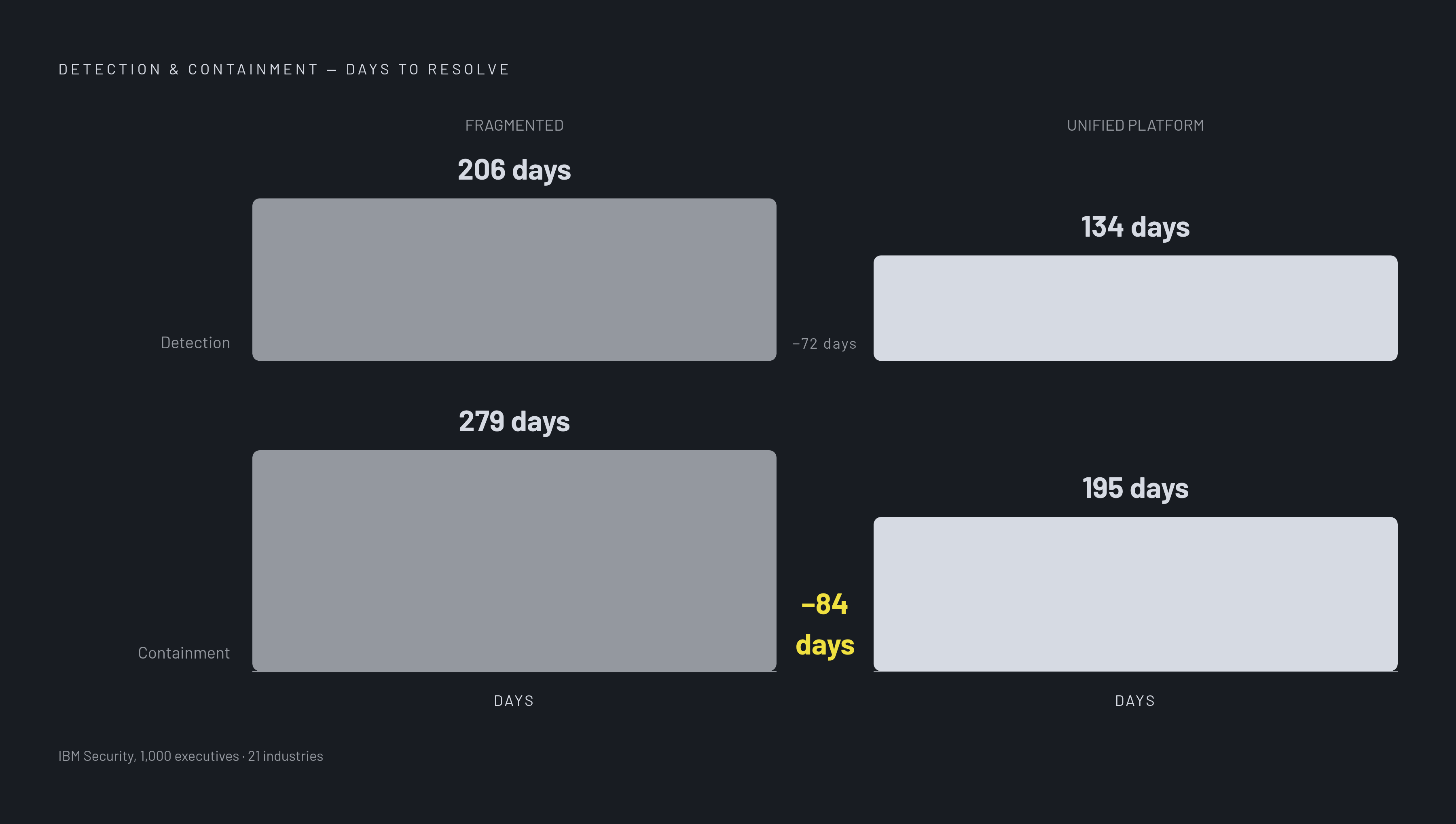
The clearest proof of this is visible in speed. IBM's study of 1,000 security executives across 21 industries, cited in Wavestore's guide, found that organizations using a genuine platform approach detect incidents 72 days faster and contain them 84 days faster than organizations running fragmented toolsets. That gap is about data that doesn't need a human to manually stitch it together before anyone can act on it. It's about data that doesn't need a human to manually stitch it together before anyone can act on it.
Broader industry trends point to where this is headed: enterprises increasingly want architectures that unify visibility across all the places data moves. For a lean team, this matters even more, because genuine unification means the platform is enforcing policy and correlating signals continuously. For a lean team, this matters even more, because genuine unification means the platform is enforcing policy and correlating signals all the time, not just when someone finally has a spare hour to check the dashboard.
How to evaluate a vendor's unification claim before signing a contract
There's one question that cuts through most of the marketing noise: does the data share a common event model, or does it pass through a translation layer before it reaches the screen?
Ask the vendor directly whether the endpoint agent, the identity directory, and the network monitor all write to the same data store, or whether each writes to its own store that gets aggregated later. A vendor who can't answer that directly is probably selling a dashboard sitting on top of fragmentation, whether they realize it or not.
A few red flags tend to appear in demos:
- The screen looks unified, but taking action (isolating a device, revoking a credential) requires switching to a separate console
Coverage is worth pressure-testing too. Ask exactly how the platform confirms that every device across the fleet has the enforcement agent installed. A dashboard that only reports on enrolled devices can't tell anyone anything about the devices that were never enrolled in the first place, and those are usually the ones that get compromised.
The automation gap test is simple and revealing: ask which provisioning and deprovisioning actions still require manual steps, and which applications fall outside the automated scope. Any honest vendor has an answer ready. Dodging the question is itself the answer.
Then there's the audit test. Ask for a sample log tracing one security event end to end, across identity, endpoint, and network. If producing that sample means stitching together exports from three different systems, the data was never unified to begin with, no matter what the sales deck says.
Deployment timelines tell their own story. Genuinely unified platforms tend to deploy faster, because there's no integration architecture that needs to be built from scratch. A vendor quoting a multi-month professional services engagement for a standard small-business deployment is often selling integration labor, not a unified product.
The broader market backs up why this scrutiny matters now. ProvenData's cybersecurity trends analysis finds that by 2028, 45% of organizations expect to run fewer than 15 cybersecurity tools, and Wavestore's guide finds that 64% of security professionals say they'd pick a single-vendor platform if they were building their stack from scratch today. Consolidation is coming whether vendors like it or not, and that means unification claims are going to face more scrutiny, not less.
What lean teams should prioritize when they have no dedicated security staff to manage gaps
Tool sprawl isn't just an expense line. For a team with no dedicated security staff, it's a coverage problem, because nobody has the bandwidth to audit the gaps sitting between all those separate tools.
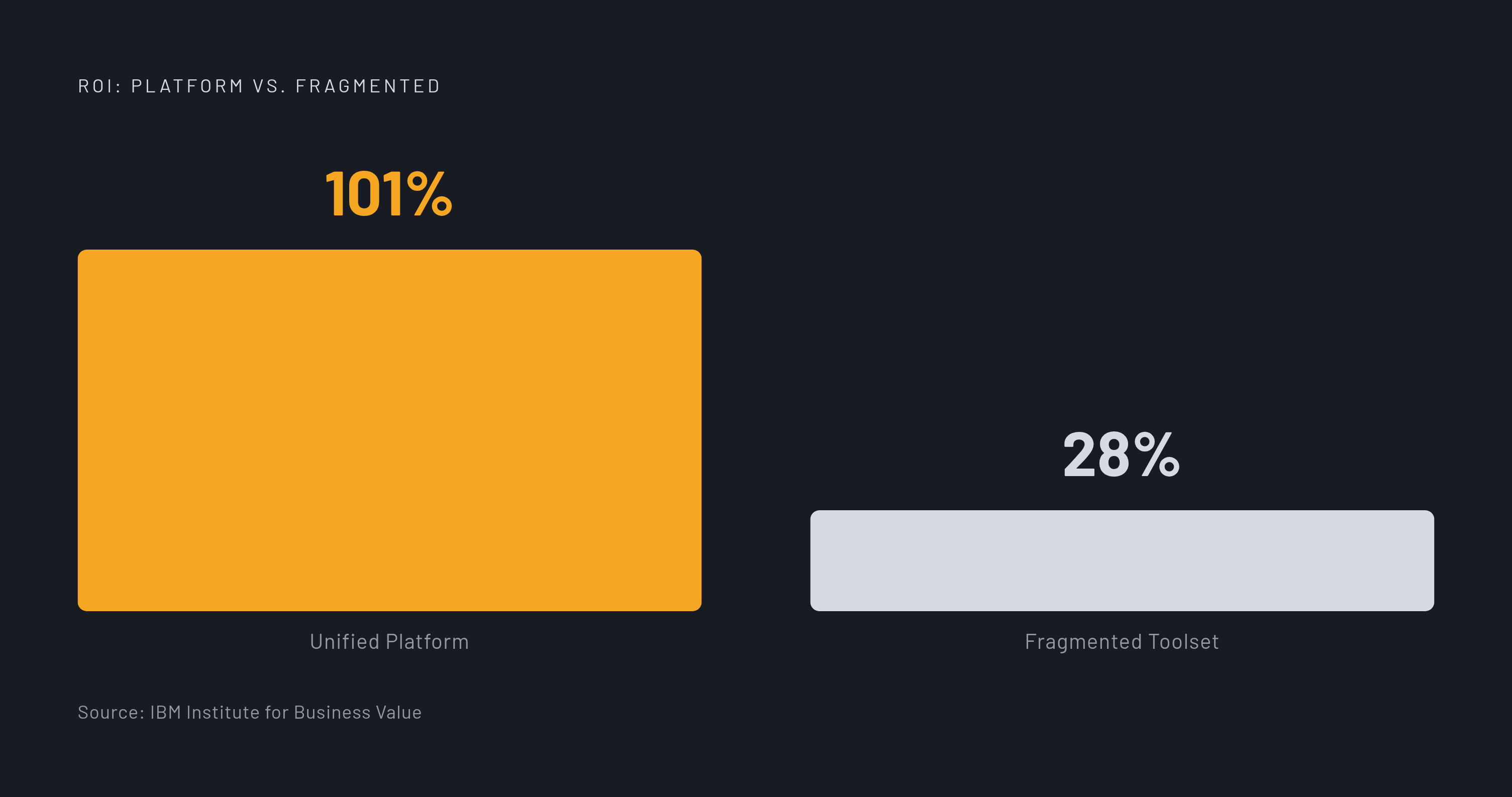
The ROI case for real consolidation is not subtle. IBM's research, cited in Wavestore's guide, found that platformized organizations see an average ROI of 101%, compared to 28% for organizations running fragmented toolsets. For a team without dedicated security headcount, that gap in operational savings matters just as much as the security improvement itself, maybe more.
So where should the evaluation actually focus? Device management, endpoint security, identity protection, and compliance need to share data with each other, not just share a screen. A platform that deploys fast and enforces policy on its own is worth more to a lean team than a feature-heavy tool that needs constant expert tuning to stay useful. Managed, continuously enforced protection means the platform is doing its job whether or not anyone happens to be watching the dashboard that day, which for a team of one or two generalists is the whole point.
Avoid treating this as an all-or-nothing choice. Full unification versus total fragmentation is a false binary that obscures the real decision, which is picking a platform that genuinely integrates the highest-risk signal types (identity, endpoint, compliance) instead of one that loosely connects everything and calls it a day.
The next stage of the industry points toward the same conclusion: the goal isn't a nicer-looking dashboard, it's systems that can act on correlated data without waiting for a human to interpret it. For a small or midsize business, that means a platform that automates enforcement on top of genuinely unified data is a stronger first investment than one that hands you a beautiful unified view and expects a trained analyst to make sense of it.
So the next time a vendor says "single pane of glass," don't ask if they have one. Every vendor will say yes. Ask where the data actually lives, who's doing the correlating, and what happens automatically the moment a threat crosses from one domain into another. Those three answers tell you whether the platform is going to reduce actual risk, or just reduce the clutter on the screen in front of you.
Sources
- Unified Security Platforms: Complete Guide for Enterprise [2026] | Wavestore
- Single pane of glass: Complete guide to unified network monitoring
- Single Pane of Glass: Unified Visibility for Orchestration | Kestra
- hbs.net
- Single Pane of Glass for IT: Why It’s Hard to Build and How to Get It Right
- myriad360.com