User Behavior Anomaly Response Automation in Mid-Market Platforms
Automated response to suspicious behavior closes the gap between detection and containment.

Credential theft has made the old detection model obsolete. When an attacker logs in with stolen but valid credentials, nothing looks wrong on paper: the username matches, the password checks out, the session starts like any other. Signature-based tools built to catch known malware or blacklisted network addresses simply have nothing to flag. That's the gap User and Entity Behavior Analytics, or UEBA, was built to close, and it's why mid-market platforms are now racing to pair that detection with automated response instead of leaving a human to react on their own.
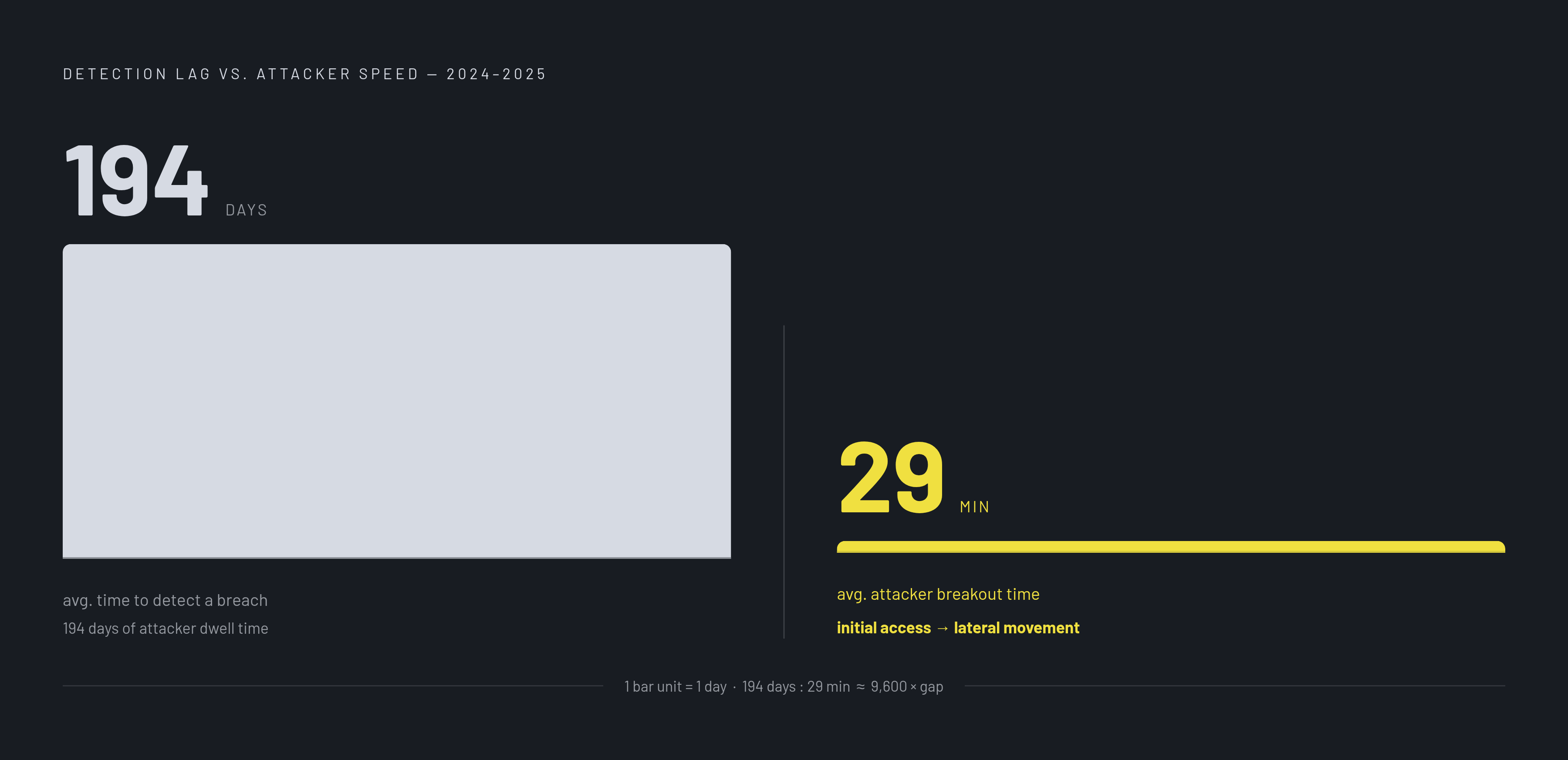
The numbers explain the urgency better than any pitch deck could. The average time to detect a breach sat at 194 days in 2024, meaning attackers had roughly six months of free rein before anyone noticed. Meanwhile, breakout time (the gap between initial access and lateral movement) dropped to just 29 minutes in 2025. Putting those two figures side by side makes the math uncomfortable fast: teams that rely on a human analyst noticing something odd, opening a ticket, and pulling logs are operating on a timeline that's orders of magnitude slower than the threat they're chasing. About 70% of breaches now start with stolen credentials moving through a network at machine speed. The entire premise of "wait for a human to notice" has quietly stopped working.
What UEBA does, how behavioral baselining and anomaly scoring work
UEBA stands for User and Entity Behavior Analytics. Stripping the acronym away, the idea is simple: instead of watching for known bad things (a virus signature, a blacklisted domain), the platform watches for behavior that doesn't match what's normal for a specific person or device.
That starts with a baseline. The platform learns, over time, what a given user typically does: what hours they log in, which files they usually touch, how much data they normally move, where they log in from, and how their activity compares to peers doing similar jobs. A finance analyst who logs in from the same city every weekday morning and downloads a few spreadsheets a day has a very different baseline than a sales rep who's constantly traveling and touching records in a customer relationship management system. Once that baseline exists, everything gets measured against it.
To build that baseline, the platform needs data, and lots of it. Good UEBA tools pull from identity systems (who's logging in and with what permissions), endpoints (what's happening on individual devices), network logs, cloud applications, and SIEM infrastructure the organization already runs. The wider the net, the sharper the baseline.
From there, anomaly detection runs continuously. The system isn't checking activity against a list of known threats, it's checking activity against the baseline itself. A login at 3 a.m. from a country the user has never visited. A download volume ten times the daily average. Access to a file share the user has never touched in six months on the job. None of these actions are individually malicious on their own; they're just unusual, and unusual is the signal.
Every flagged anomaly gets a risk score, based on how far it deviates from baseline and how often deviations are stacking up. That scoring matters because it's what lets a small team prioritize. Nobody has time to review every login anomaly manually, so the platform ranks them by severity and surfaces the ones worth a human's attention first. The more advanced platforms take it a step further and map flagged behavior to the MITRE ATT&CK framework, translating a raw anomaly into "this pattern resembles credential access followed by lateral movement," which gives an analyst actual investigative context instead of just a red flag with no story attached.
UEBA is built for situations where each individual action looks fine on its own, and the pattern is the only tell. That's the pattern at the center of high-profile insider threat cases, where activity spread across multiple platforms goes undetected because no single action triggers an alert. Traditional data loss prevention tools miss it because no single export or share looks out of place in isolation. Cross-platform behavioral monitoring, the kind UEBA is designed to run, is built precisely to catch the cumulative pattern that DLP tools, checking one action at a time, are structurally blind to.
How automated response closes the detection gap
Detection alone doesn't stop anything. A risk score sitting in a dashboard, however accurate, does nothing to slow down an attacker already moving laterally through a network. Somebody still has to act on it, and if that somebody is a single overworked IT admin checking alerts between other tickets, the 29-minute breakout window has already closed by the time they open their laptop.
This is where the idea of an agentic SOC architecture comes in: four layers of automation working together instead of one alert queue waiting on a human.
Detection AI handles the front end, using supervised machine learning for patterns that are already well understood and unsupervised methods for the zero-day and behavioral cases nobody's seen before. Correlation AI comes next, using graph-based machine learning (GraphML) to automatically connect related events across the full environment, so a suspicious login in one system and an unusual file transfer in another get tied together instead of sitting as two disconnected alerts. Response AI does something concrete: hyperautomation workflows that execute containment, like suspending an account or isolating a device, across multiple tools at once, without pausing to wait on a human's sign-off for routine actions. Investigation AI rounds it out with natural-language interfaces, letting someone without SQL or log-parsing skills ask a plain question and get an answer about what happened and why.
What that architecture actually replaces, for a lean team, is the grunt work: manual log pulls, enrichment queries, cross-referencing threat intel feeds by hand. Those steps eat the majority of the time an analyst spends on any single alert, and none of it requires human judgment, just human patience. Automating it doesn't remove the need for a person to make a final call. It removes the hours of legwork that used to happen before that call could even get made.
That matters more given the state of the workforce doing this job. A survey of a large group of security professionals found that 59% of organizations report a critical or significant skills shortage, a sizable jump from the year before. Manual triage was already a stretch for teams stretched thin. It's becoming close to impossible.
The mid-market UEBA platform landscape in practice
UEBA has moved fast from a niche add-on to something closer to standard infrastructure. The market was valued at roughly $0.41 billion and is projected to reach $14.18 billion by 2035, growing at a 38.0% compound annual rate. That kind of growth doesn't happen because a technology is nice to have. It happens because organizations of every size are realizing behavioral detection isn't optional anymore.
The mid-market field is a set of platforms built with different priorities. It's a set of platforms built with different priorities, and the right fit depends on what an organization already has and what it's missing. A few dimensions matter more than the rest when comparing them.
Baseline sophistication is one. Some platforms model individual user behavior in isolation; others compare a user against their peer group, which tends to catch subtler deviations. False positive rates matter just as much: a platform that floods an inbox with noise defeats its own purpose, no matter how sharp its underlying model is. Cloud and SaaS visibility has become close to non-negotiable, since 78% of insider-style incidents now touch cloud or SaaS resources; a tool that only watches on-premises activity has a structural blind spot built in from day one. SIEM integration depth decides whether UEBA enriches a workflow a team already runs or forces them to run a second, parallel stack. Automated response capability is the line between a platform that only alerts and one that actually acts. And deployment friction deserves real weight: some platforms need months of tuning before they deliver anything useful, and a lean team without a dedicated analyst doesn't have months to spare.
Among the platforms reviewed in the expertinsights.com 2026 UEBA guide, the differences appear clearly along those lines.
Teramind is built for real-time insider threat monitoring, running as an agent-based monitor with live control over user actions on Windows and macOS devices, deployable through Oracle, AWS, Azure, or on-premises for air-gapped networks; it includes automated response. ManageEngine Log360 combines machine-learning baselines with log consolidation in a native SIEM, and includes automated response as well. ActivTrak leans into workforce analytics with ML baselines and real-time monitoring, though it doesn't build its detection natively into a security information and event management platform, and still supports automated response. Cynet UBA runs behavioral baselines inside an XDR platform, with automated response included.
IBM Security QRadar SIEM UBA builds risk profiling directly out of existing SIEM data, with ML baselines and real-time monitoring native to the platform. Logpoint Converged SIEM brings SIEM, SOAR, UEBA, EDR, and Business Critical Security together in one converged system, with automated response built in. LogRhythm UEBA integrates behavioral analytics as a SIEM add-on with native SIEM support. Rapid7 InsightIDR runs as a cloud-native SIEM with UEBA built in, and includes automated response.
Securonix UEBA offers enterprise-grade peer group analysis with native SIEM support; Securonix launched Securonix EON in 2025, an AI-reinforced SIEM architecture with continuous self-tuning algorithms. Splunk User Behavior Analytics has offered behavioral detection as a SIEM add-on, but reached End of Sale in December 2025 following Cisco's acquisition of Splunk. Its UEBA capabilities are being folded into Splunk Enterprise Security Premier, and existing licenses are supported through January 31, 2027, so organizations currently on Splunk UBA should be planning that transition now, not later. Varonis Data Security Platform rounds out the field with data-centric behavioral analytics and no native SIEM.
How to evaluate automation depth, what mid-market buyers should ask
The question that actually matters for a lean team, more than any feature list, is this: does the platform cut down how much analyst time is required, or does it just hand over better data that a human still has to act on manually? A lot of platforms are excellent at the first half of that equation and quietly weak on the second.
A few questions cut through the marketing fast:
Does the platform execute containment on its own (suspending an account, killing a session, isolating a device from the network), or does every response step wait on a human to click approve? How long does it actually take to get a usable baseline running, and will the vendor put that timeline in writing rather than leaving it vague? What data sources does it pull from natively: just endpoints, or also cloud apps, SaaS tools, identity providers, and network traffic? Does it work as one converged platform (UEBA, SIEM, and SOAR together), or is it built assuming there's already a security stack to bolt onto? Is the response logic adaptive, updating based on the specific threat context, or is it running static playbooks that don't flex? And can the platform explain why it flagged something, or is the scoring a black box nobody on staff can interrogate when something looks off?
Alert fatigue isn't a soft concern here, it's a real deployment risk. Roughly 83% of daily security alerts turn out to be false positives across the industry. A UEBA platform with a poorly calibrated baseline doesn't fix that problem, it makes it worse, burying the one alert that matters under a pile of noise nobody has time to sort through.
For an organization with no dedicated security staff, the calculus should tilt toward platforms with strong defaults out of the box, not platforms that promise maximum flexibility after months of expert tuning. A pre-tuned model that gets most of the way there on day one is worth more, practically speaking, than a fully customizable system that takes a quarter to configure correctly, because most lean teams don't have a quarter to spend tuning software before it starts paying off.
What mid-market organizations without a SOC should do now
This is already happening. It's already happening. Roughly 39% of small and mid-sized businesses report having faced a cyber incident tied to human error at some point, and 1 in 4 small businesses have been hacked despite having cybersecurity tools already in place. Tools need a behavioral monitoring layer added on top, because tools check whether the right box is installed, while behavioral monitoring checks whether the person logging in is behaving like themselves.
A few concrete steps matter more than the rest, in roughly this order.
Start with an honest audit of current visibility. Can anomalous login times actually be seen? Unusual data movement? Unexpected privilege escalation? If the honest answer to any of those is "no idea," that's the gap to close first, before shopping for anything.
Figure out which accounts hold the most access, and watch those first. Insider risk and credential misuse aren't distributed evenly across a company, they cluster around whoever holds the keys, whether that's an admin account, a finance lead, or an executive assistant with calendar access to everyone.
Name one person as the incident response owner, with a named backup. A short plan that names a real decision-maker beats a 40-page playbook nobody has ever run through. Draft the internal notification and customer breach disclosure language now, while there's no fire to put out, because writing that language calmly in advance produces a far better outcome than writing it under pressure during an actual incident.
None of that replaces the behavioral basics UEBA can't substitute for either: no shared credentials, ever. MFA enforced on every account, not just the sensitive ones. And accounts get disabled the same day an employee leaves.
On the bigger question of whether to build an internal SOC: for most organizations without security staff already on payroll, that's not a realistic near-term goal, and it doesn't need to be. The platform choice matters more than the staffing model does. An integrated platform that automates triage, response, and the evidence trail needed for compliance gives a resource-constrained team consistent protection without requiring anyone on staff to have deep security expertise to run it. That's the actual trade mid-market buyers are making when they choose automation depth over raw detection power. Given how the breakout-time math has shifted, it's the trade that makes sense.
Sources
- Top 25+ Security Automation Tools in 2026: The Enterprise Buyer's Guide with ROI Frameworks
- Top 10 Agentic SOC Platforms for 2026
- Best 11 User and Entity Behavior Analytics (UEBA) Solutions For Enterprise (2026)
- Best UEBA Software: Top 7 Options in 2026
- UEBA explained: user and entity behavior analytics guide