Evidence Retention Architecture and Audit Log Immutability in SaaS Security Platforms
Most SaaS platforms generate logs that wouldn't survive a serious audit or investigation.
Logs get generated constantly. Whether they hold up when someone actually needs them is a separate question entirely, and the gap between "we log events" and a legally defensible audit trail is wider than most SaaS teams expect. A request can come back 200 OK, hand over the wrong tenant's data, and sit in the log file looking completely unremarkable SaaS Security Compliance Checklist for 2026. That's the trap. Nothing looks broken until an investigator goes looking for the one detail that was never captured.
When the logs are thin, investigations don't fail loudly, they just stall. Reviewers can't pin down what happened, which tenant got touched, or whether a privileged workflow granted access, denied it, or quietly changed something in between. The causes tend to repeat across companies: records that can be edited after the fact, missing actor or tenant context, and different services logging the same action in different, incompatible ways. Add short retention windows on top, and evidence disappears before anyone even opens a postmortem doc.
The scale of this is bigger than a handful of sloppy teams. Codequiry data cited by Activepieces found that 83 out of every 100 codebases carry undetected audit flaws, things like logic errors, log injection vulnerabilities, or missing integrity checks that let records get deleted without anyone noticing SaaS Security Compliance Checklist for 2026. Read that number straight: four out of five companies could be sitting on unreliable or incomplete evidence right now and have no idea. Not because anyone was careless on purpose. Because the logging code was written to satisfy a debugging need, not an evidentiary one, and nobody circled back to check the difference.
That difference matters more than it sounds like it should. An audit trail that can't be verified is, legally, no different from having no audit trail. Once a record's authenticity is in question, it becomes a liability instead of evidence, because opposing counsel or a regulator can point at it and ask why anyone should believe it.
Audit log requirements versus what most logs record
Operational logs and audit logs get treated as the same thing far too often, and they're not. Operational logs exist to help engineers trace a failed request or measure how a service behaves under load. Audit logs exist to preserve evidence about security-sensitive actions, the kind investigators, external auditors, and courts will eventually want to examine. Confuse the two and you'll build a system that's great for debugging and useless for defense.
Tamper-evidence versus immutability is a related distinction, and they are not interchangeable. Tamper-evidence means you can tell, after the fact, that something got altered. Immutability means the alteration couldn't happen. Auditors want both, not one standing in for the other.
So what does a log actually need to prove? Not "can you store data," but can you show identity: that a specific, real person took the action, not a shared login or a compromised account. Can you show authority: that the person had the standing to do what they did on the organization's behalf. Can you show intent and context: what got reviewed, approved, or acted on, and why. And can you show integrity and chain of custody: that the record has been complete and consistent since the second it was written.
Get granular, and a minimum viable event needs a specific set of fields. User identity that traces to an actual person, not just a session token. A timestamp in UTC, down to the millisecond, because ordering is everything in approval chains and access workflows. An action type pulled from a fixed vocabulary rather than free text someone typed in a hurry. A resource identifier pointing to the exact thing acted on. Before-and-after state, so a reviewer can reconstruct what changed rather than just confirming that something did. IP and session context for when security needs to dig in. An authorization result, granted, denied, or altered midstream. And tenant context, so nobody's left guessing whose data was actually involved.
None of this is about whether an entry exists. Disputes and audits almost never hinge on that. They hinge on whether the record is complete, reliable, and able to survive someone trying to poke holes in it. Heading into 2026, auditors are leaning harder on reproducibility specifically: timestamped, attributable evidence like system logs, ticket histories, and exportable reports, not a folder of screenshots SaaS Security Compliance Checklist for 2026. Screenshots can be staged. A properly chained log record is a lot harder to fake convincingly.
The four architectural layers that together produce genuine immutability
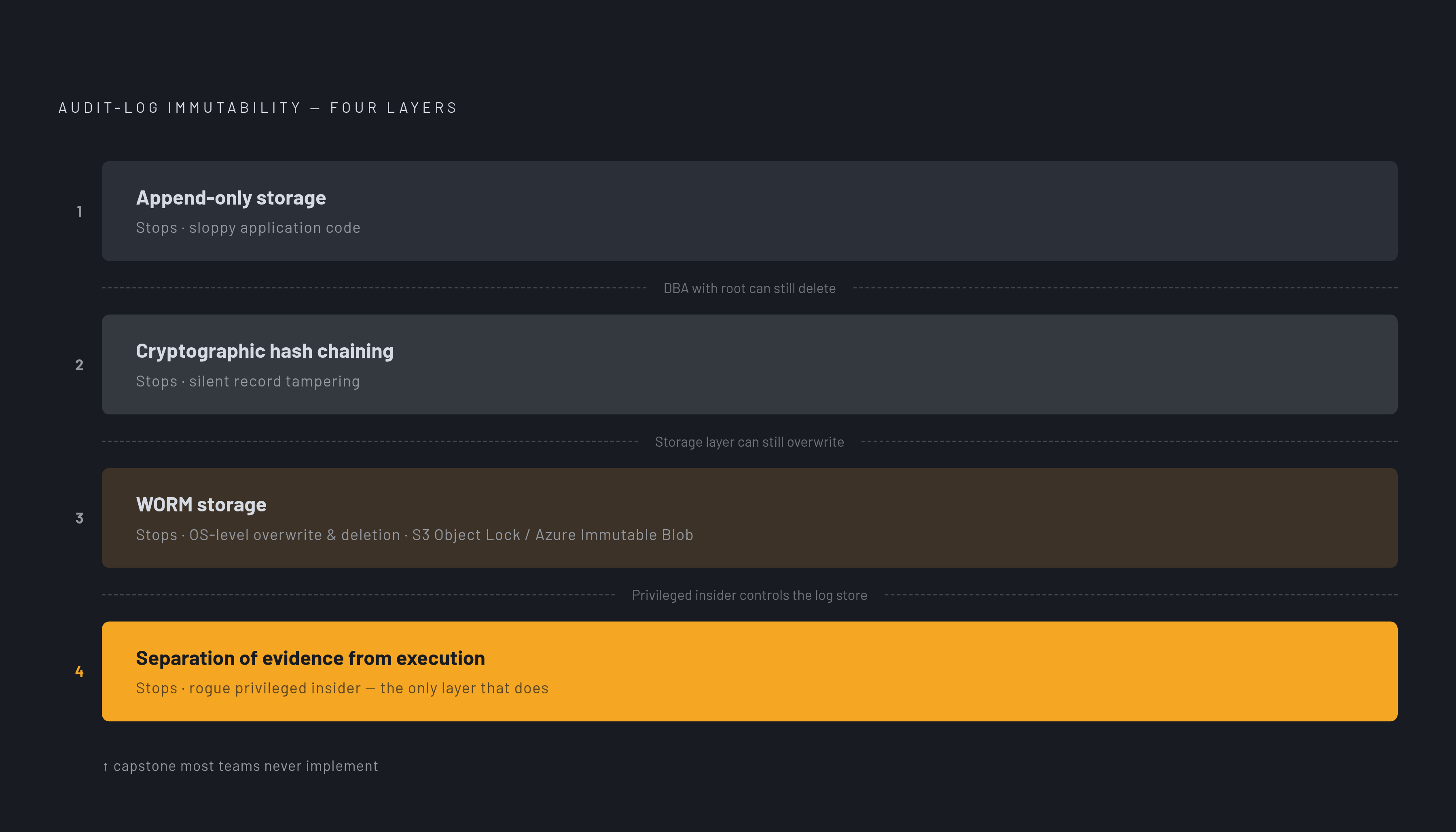
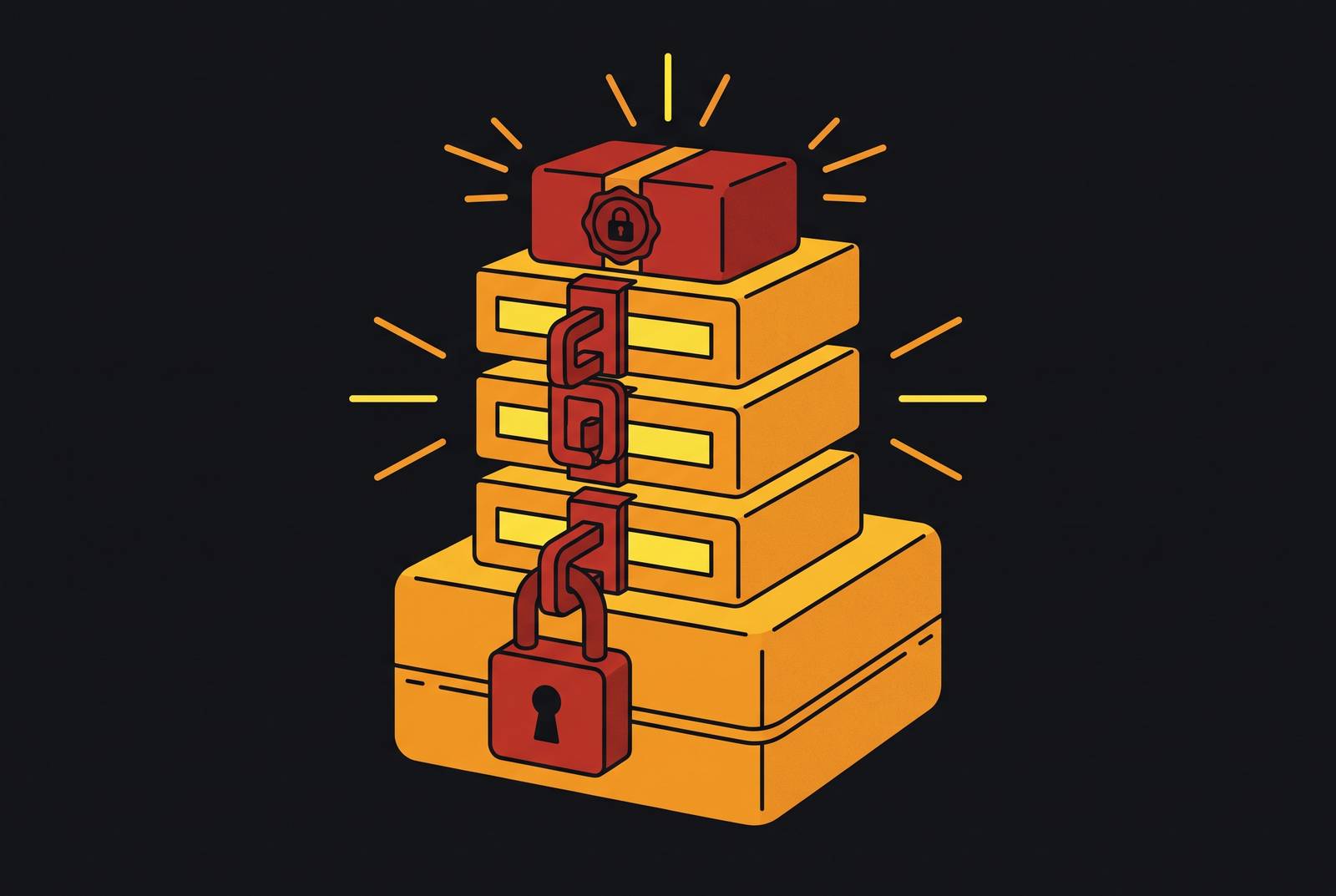
Immutability is a spectrum of guarantees a vendor either has or doesn't, layer by layer. It's a stack, and each layer closes a hole the layer beneath it leaves wide open.
Start with append-only storage. The rule is simple: INSERT only, no UPDATE, no DELETE, at the application layer. This is table stakes, and it's a fine place to start, but it doesn't finish the job. A database administrator with direct access to the underlying tables can still reach in and change or erase records. Append-only design stops sloppy application code from mutating history. It does nothing about a person with root access and bad intentions.
That's where cryptographic hash chaining comes in. Each new record embeds a hash of the one before it, so altering any single entry breaks the entire chain going forward. This turns tampering from something that might slip by unnoticed into something mathematically obvious. SHA-256 shows up as the standard across most implementations; some platforms, like Volidator, go further and use HMAC-SHA-256 to hash identity fields while chaining each record's SHA-256 signature to the one before it. The point isn't the specific algorithm, it's that this layer is what actually separates logs that satisfy an auditor from logs that just look tidy on a dashboard.
Then there's WORM storage, write once, read many. This is where modification gets blocked at the storage layer itself, with no override path, no admin console button, nothing. It closes the exact gap append-only tables leave open: even a privileged DBA can't touch these records once they're written. In S3 Compliance Mode, a 7-year retention setting holds for the full 7 years, no exceptions, and not even AWS Support can release the lock once it's set. Azure's legal hold mode works on similar logic: objects can be created and read, but modification or deletion is blocked until the hold gets explicitly cleared.
Last is separation of evidence from execution. Real immutability needs the systems generating logs kept physically or logically apart from the systems storing them. If a system administrator gets compromised, or goes rogue, they shouldn't be able to erase their own tracks, because the evidence store sits outside their administrative reach. This is exactly where vendor-hosted, shared-tenant setups run into trouble: audit logs sitting in the same environment as thousands of other customers means one misconfiguration by the vendor's own internal DBA can expose or overwrite a customer's entire compliance history.
Hash chains combined with WORM storage deliver the same non-repudiation guarantee that blockchain-based logging promises, at a fraction of the infrastructure cost. Blockchain rarely makes sense for SaaS audit logging once you weigh what it actually buys against what it costs to run. Named implementations confirmed in sources include AWS S3 Object Lock (Compliance Mode) and Azure Immutable Blob Storage.
Where WORM storage lives in cloud-native implementations
WORM, again: data gets written and retained, but it cannot be altered or deleted after the fact. That's the definition, not a feature name a vendor slapped on a pricing page.
AWS S3 Object Lock in Compliance Mode is the clearest real-world version of this. It blocks any user, at any privilege level, from deleting or overwriting a locked object before its retention period runs out. Even AWS's own support team can't release that lock once it's applied.
Azure runs a parallel model through Immutable Storage. Time-based retention policies can lock blobs at the container level or drill down to the account, container, or individual blob-version level. Legal hold mode adds another layer on top: once applied, an object can't be modified or deleted until someone explicitly clears the hold.
Google Cloud rounds out the third major option, pairing Cloud Audit Logs with retention controls for teams running GCP-native workloads SaaS Security Compliance Checklist for 2026.
WORM storage on its own isn't the finish line, it's the foundation for a forensic chain of custody. That means freezing relevant logs before retention windows close, particularly cloud control-plane, SaaS, IAM, and vault telemetry, since those tend to be the first things a retention policy quietly ages out. It means recording exact identity context, service account name, workload identity, session ID, privilege level, so nobody's left guessing who or what actually took the action. Ken Grohe, President of LeverageGTM, described the operational version of this: pull critical identity, network, and API logs out of the cloud environment and store them somewhere isolated and long-term, separate from the cloud provider itself, and build response workflows that lock in log preservation and legal-hold steps the moment an anomaly gets flagged.
The stakes here aren't hypothetical. A SaaS vendor's default retention may be shorter than what the federal government just decided was the floor. AWS CloudTrail and S3 Object Lock are used as described tools for AWS-native audit trails and WORM retention, per Pactvera's immutable audit trails platform comparison (SaaS Security Compliance Checklist for 2026). Azure documentation states that Azure supports compliance with SEC 17a-4(f), CFTC 1.31(d), and FINRA. Senior Executive reporting states that CISA, OMB, and ONCD worked with Microsoft to expand cloud audit logging for federal customers regardless of license tier and increase default retention from 90 to 180 days (CISA, OMB, ONCD and Microsoft cloud audit logging expansion, SaaS Security Compliance Checklist for 2026).
Why SOC 2 compliance does not prove immutable logs
SOC 2 Type II gets treated like a seal of technical guarantee. It functions as a snapshot of process adherence, confirmation that a policy exists and that an auditor watched it get followed over a defined window. It's a snapshot of process adherence, confirmation that a policy exists and that an auditor watched it get followed over a defined window. What it cannot do is prove that one specific row of data sat untouched last Tuesday.
Part of the reason is structural. SOC 2 audits run on sampled evidence and point-in-time interviews, not a continuous mathematical check on every record. A vendor could, in practice, modify a database entry and never trip an audit exception, because the audit wasn't built to catch that specific kind of change SaaS Security Compliance Checklist for 2026.
Line the two up side by side and the gap gets obvious. A SOC 2 report is a third-party narrative saying controls were designed effectively. A cryptographic hash is a mathematical fingerprint that breaks the instant a single bit gets altered. A vendor's cloud environment is a black box run by that vendor's own staff. Self-hosted or isolated storage puts the logs on infrastructure the vendor can't reach. One of these is a statement about intent. The other is a property that either holds or doesn't, with nothing in between.
Shared-tenant SaaS architecture makes this worse, not better. Audit logs sitting next to thousands of other tenants' data means a single configuration mistake by the vendor's own database administrator can overwrite a customer's compliance history entirely, and that customer would have no way to know it happened until it mattered SaaS Security Compliance Checklist for 2026.
Closing the gap takes actual discipline, not another compliance report. Integrity checks need to run on a schedule, recalculating the hash chain's continuity and signature validity on a set cadence, not just whenever someone remembers. The person doing that verification should never be the same person who administers the system being checked, otherwise the check means nothing. Verification itself should leave its own audit trail.
Retention requirements that define the minimum defensible window by regulatory framework
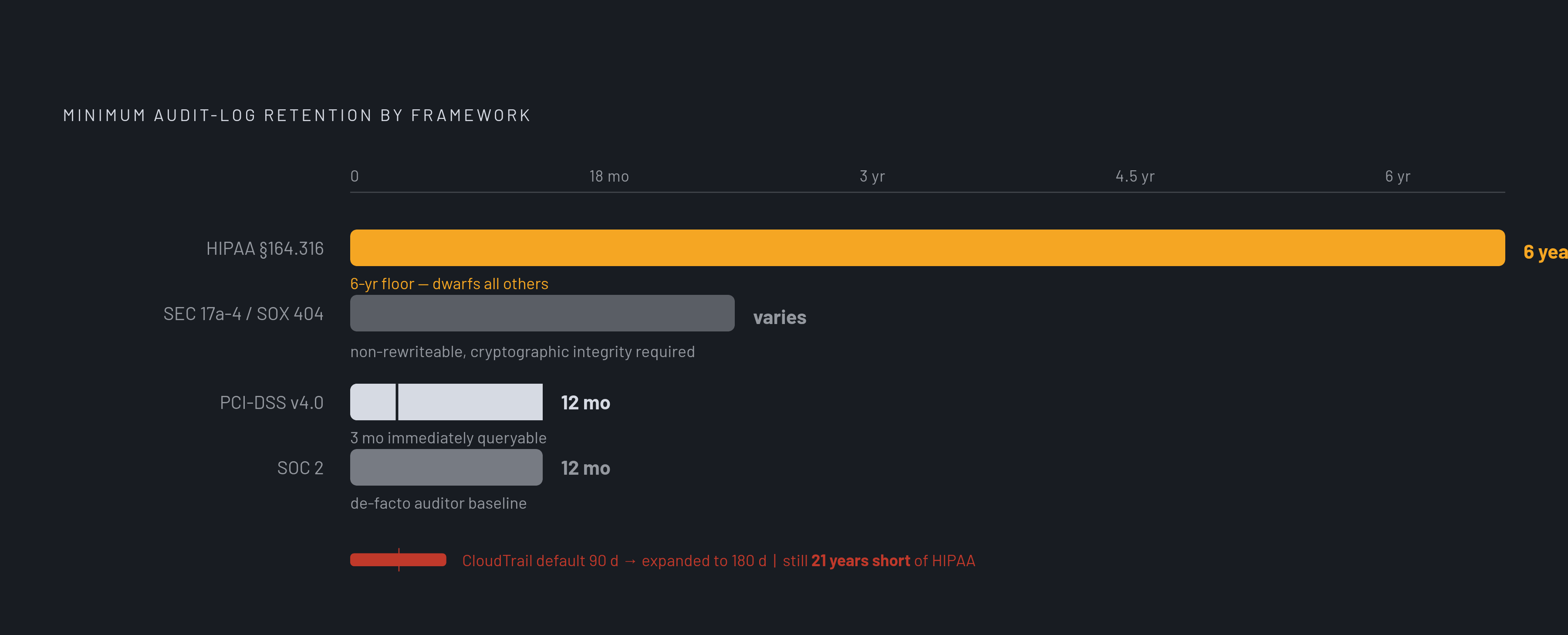
Immutability solves one problem. Retention solves a different one, and skipping it is still a failure even if the hash chains are perfect: evidence held for 90 days is worthless to an investigation that starts 18 months after the fact CISA, OMB, ONCD and Microsoft cloud audit logging expansion.
Under PCI-DSS v4.0, the most recent 3 months of audit logs must be immediately available for analysis (queryable without a restoration process). "Immediately available" isn't a soft target here, it's a hard technical bar a system either clears or doesn't.
SOC 2 doesn't mandate a specific retention period in the standard itself. In practice, though, 12 months has become the common baseline most auditors expect to see, and a wider scope of controls can push that expectation higher PCI-DSS v4.0.
HIPAA runs longer. Under §164.316(b)(2)(i), certain documentation needs 6 years of retention, counted from the date it was created or from its last effective date, whichever is later HIPAA. A proposed update to the HIPAA Security Rule, filed as an NPRM in December 2024, would go further still, requiring covered entities to review their audit logs at least once every 30 days specifically to catch unauthorized access HIPAA Security Rule proposed update SaaS Security Compliance Checklist for 2026. That's a shift from "keep the logs" to "actually look at them," which is a meaningfully higher bar.
Financial software answers to a different pair of rules. SEC Rule 17a-4 and SOX Section 404 both apply. SEC 17a-4 specifically requires a non-rewriteable, non-erasable storage format, language that maps directly onto WORM storage requirements without much translation needed. SOX Section 404 auditors, meanwhile, look for cryptographic integrity controls or write-protected storage, anything that makes a retroactive tampering attempt detectable after the fact.
None of these numbers matter if the storage layer itself isn't isolated properly. In S3-compatible systems running improper multi-tenant policies, one tenant can end up overwriting another tenant's stored artifacts entirely. Retention policy is a paper promise if isolation breaks at the storage layer, no matter how generous the retention window looks on a compliance datasheet. PCI-DSS v4.0, Requirement 10.7. PCI-DSS v4.0 requires a minimum of 12 months of audit log retention. Microsoft Azure documentation states that Azure Immutable Storage supports compliance with SEC 17a-4(f), CFTC 1.31(d), and FINRA.
AI agents, large payloads, and the breakdown of legacy audit logging assumptions
Every assumption baked into traditional audit logging rests on a simple model: a human performs one discrete action against one database target, login, update, delete, and the system writes one clean structured record. AI agents don't work that way, and they break the model in three specific, compounding ways.
First, the notion of a single "actor" performing a single "action" falls apart. Logging that as one event erases everything that actually happened in between.
Second, the payloads involved are enormous compared to what legacy logging systems were built to handle. Full system prompts, complete user context, raw model output, these can run huge. Plenty of legacy systems cap metadata payloads at around 500 characters, so a prompt running 50,000 tokens gets truncated before it ever reaches storage, and the resulting log is functionally useless for compliance verification Top Audit Trail Platforms to Use in 2026 for B2B and Agentic Applications. Nobody can reconstruct a decision from half a prompt.
Providers update models silently behind the scenes, temperature settings introduce randomness by design, and live API responses shift over time. Logging just the final output tells an investigator what came out, but nothing about whether that output would even reproduce under the same conditions.
The architectural answer taking shape is something like a Flight Data Recorder pattern. That level of detail is what makes offline, air-gapped forensic replay possible, reconstructing the exact chain of events later for a compliance review or a debugging session, rather than trying to guess at it from a truncated log line. Platforms like Volidator are building toward exactly this kind of record-everything approach for agentic systems. SOURCE PAGES (what the pages behind the outline's links say).
Sources
- AI Vendor Questions for Audit Trail Integrity in 2026
- Add Audit Trail to SaaS Product (May 2026)
- Top Audit Trail Platforms to Use in 2026 for B2B and Agentic Applications
- SaaS Security Compliance Checklist for 2026
- decryptiondigest.com
- SaaS Audit Trails: How to Design Tamper-Resistant Logs for Access Control | Blog | Agnite Studio
- netapp.com
- jatheon.com