Ripping Out Separate MDM and EDR Tools for a Single Platform When You Have No Security Staff
Unmonitored security tools give attackers time to act before anyone notices the alert.

Replacing separate MDM and EDR tools with a unified MDM, EDR, and compliance platform is the operationally honest choice for a small business with no security team, but only if the platform includes continuous monitoring and authority to respond. Unread alerts are not protection. The goal is to replace an unstaffed collection of tools with a managed service that can act without waiting for someone at the company to wake up.
Why staffless SMBs keep two tools running and get protection from neither
An endpoint tool flags activity that looks suspicious, but nobody reads the alert. The device management console remains separate, and any change to the affected user’s access requires another workflow. To contain the threat, someone has to make device management, identity, and endpoint detection work together at the same time. There is no security employee assigned to do it. The business has bought the parts of a response without providing the operator who connects them.
Each tool has an agent, a console, and an alert queue of its own. With three separate agents on an endpoint, the overhead slows the device and adds work for the IT generalist responsible for keeping it running. During an incident, that same fragmentation slows response because completing one coordinated action requires the generalist to move between systems. Owning the tools does not close that gap. The company needs to know who runs its products when protection requires a decision.
A business that knows it has no EDR can account for that absence in its risk assessment. A business paying for unmonitored EDR may tell itself, its insurer, and its customers that detection and response are covered. That belief distorts compliance discussions and internal decisions about risk. When an alert requires action and receives none, the practical outcome is the same as having no detection and response at all.
Why attackers have already priced in the staffing gap
Small businesses are targets in their own right as well as victims of attacks aimed at larger companies. Ransomware operators have money to gain from going after organizations that have valuable data and weak defenses and are likely to pay. Ransomware-as-a-Service makes that targeting practical at scale. A small headcount is not a deterrent here. Thin IT staffing can make a company more attractive because it suggests slower patching and fewer people watching for an intrusion.
That logic turns an internal staffing problem into an external vulnerability. Attackers favor the conditions that allow activity to go unnoticed, including an overnight alert queue with nobody assigned to it. A tool can detect something correctly while the business still fails to respond. The delay helps the attacker whether or not the victim bought a well-known security product. An unattended console is therefore part of the opportunity, rather than a minor weakness around otherwise complete protection.
Acronis’s guide notes that many SMBs rely primarily on endpoint prevention without continuously operated detection and response. That leaves credential theft, vulnerability exploitation, and fileless techniques largely unmonitored. These attacks need not arrive as recognizable malicious files. They can look like a user signing in with stolen credentials or a legitimate process running an unusual command. In that situation, prevention alone is insufficient, and unmonitored EDR may produce a logged alert with no action behind it.
What staffing a real SOC actually costs — and why it ends the internal option immediately
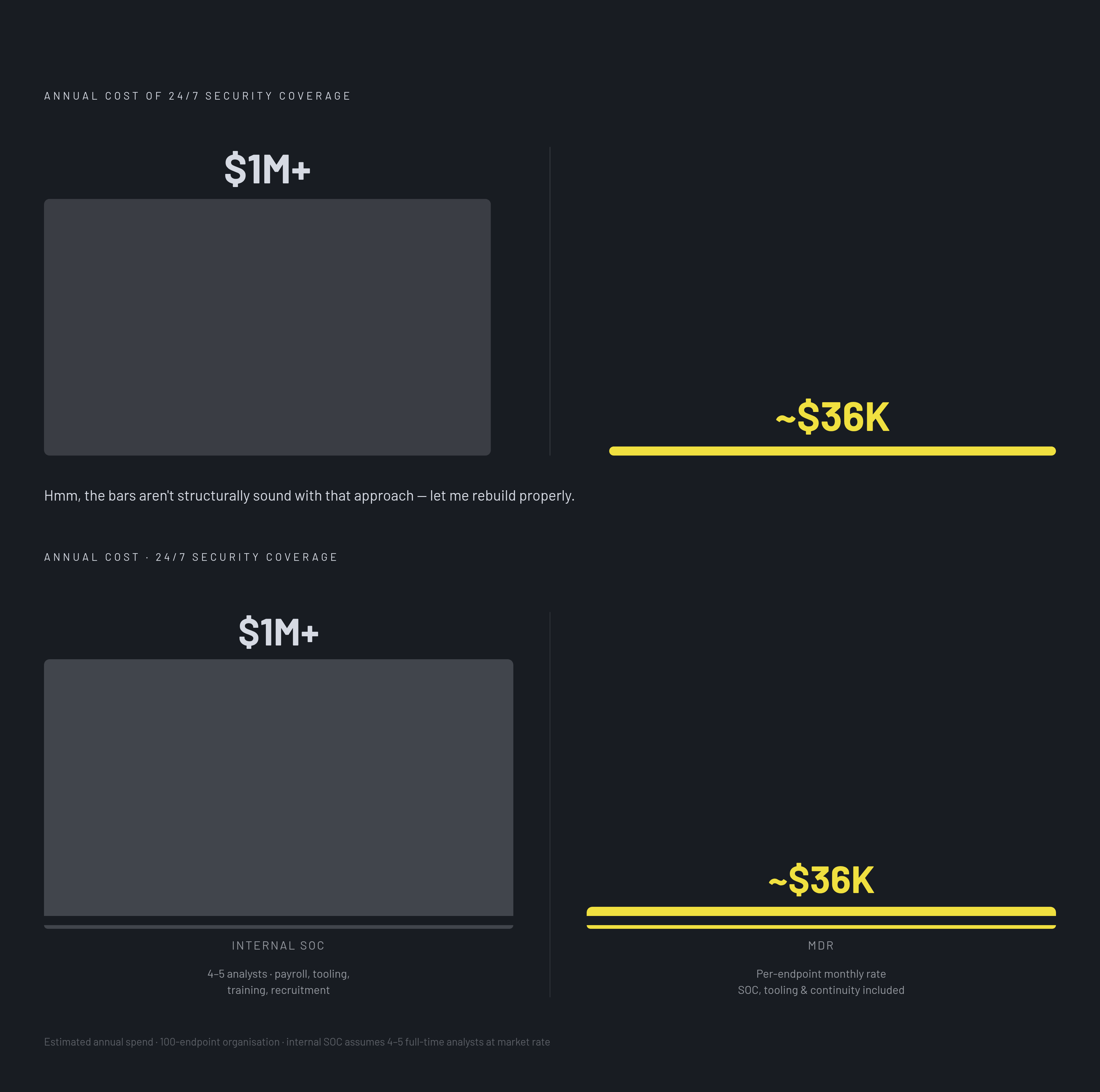
Genuine around-the-clock coverage requires four to five analysts to account for shifts, holidays, and attrition. That is the starting arithmetic for a security operations center, or SOC, before the company considers the tools those analysts need. At typical loaded salaries, payroll alone costs hundreds of thousands of dollars and can run over a million dollars a year. Tooling, training, certification renewals, and recruitment add to it. A fully staffed operation can cost well over a million dollars annually.
An analyst may have excellent judgment, but that person cannot cover every night, weekend, holiday, and absence. The same hours still need coverage even when there is no budget to pay for them. Assigning those hours informally to a single employee creates periods when a tool is running but nobody is available to interpret what it finds.
Business-hours IT makes that limit easy to see. An alert at 2 a.m. on a Sunday in an unmonitored environment can wait until Monday, while the attacker keeps working. Hiring a more capable generalist does not remove the interval between those two events. A better dashboard still leaves that shift without anyone to work it. For the companies this article addresses, the internal SOC option ends at the staffing calculation.
Managed detection changes the unit of purchase from an employee to a service. At a per-endpoint monthly rate, a managed detection service can cost a fraction of one analyst’s salary while including SOC infrastructure, tooling, and continuity. Comparing managed detection and response, or MDR, with the cost of staffing that coverage gives the business a more useful comparison than the subscription price of self-managed EDR. The cheaper license excludes the labor needed to turn its findings into protection.
How self-managed EDR specifically fails without a person on the other end
An EDR alert arrives at 3 a.m., and nobody acts. The product may have done its detection job perfectly, but the business has not completed the response. With self-managed EDR, the customer has to take that next step. For a company without anyone capable of operating it, the missing response step is a gap built into the operating model.
During working hours, the gap takes a different form. An IT generalist may face overlapping alerts from several tools while also handling help desk requests, patching, and user onboarding. Behavioral alerts also require interpretation, and knowing how to install a tool does not necessarily mean knowing how to distinguish a false positive from an active intrusion.
A generalist cannot give uninterrupted attention to security while remaining responsible for the company’s other IT work. Self-managed EDR has real value when someone can run it, but that condition cannot be assumed simply because someone has access to the console.
Acronis’s guide identifies AI-guided incident interpretation and single-click isolation and remediation as useful capabilities for SMBs. They make findings easier for a generalist to understand and act on without SOC training. Simpler controls help, but they do not supply overnight coverage. Even an MDR contract can recreate the gap if the provider must call the customer and wait for approval before isolating a host. The change required is therefore not just better software, but an operator with enough authority to respond.
What should an all-in-one security platform do for a small business with no security staff?
A platform should bring device management, endpoint detection and response, identity protection, and compliance automation together, with people to keep it running around the clock. The last part separates a solution from a bundle. Putting several products behind one login does not help much if the customer still has to investigate every alert and coordinate every response. For a staffless company, the platform must reduce the work required to stay protected.
At the endpoint, a genuinely consolidated design replaces three agents with one, reducing performance drag and simplifying deployment and updates. At the console, one alert queue lets the platform correlate signals that a person would otherwise have to connect across separate tools. During an incident, one action makes MDM, identity, and EDR respond together, so the person in charge no longer has to manage each one on its own. These operational changes remove handoffs that are especially fragile when nobody has security as a full-time job.
Management must extend beyond collecting those signals. The service needs to watch for threats around the clock and be allowed to take the response actions the company has agreed to, without waiting for an employee who is away to approve each step. Otherwise, the overnight delay survives the consolidation. A unified platform is the right fit only when it provides the operating capability the separate tools lacked.
Common cyber insurance requirements include MFA, EDR, tested backups, vulnerability management, email security, and demonstrable monitoring. A fragmented stack makes proving those controls harder because evidence sits in different systems. Automated compliance reporting cuts the work people have to do to produce evidence for insurers or auditors. Reporting helps the company demonstrate which controls are actually being operated.
Deployment is part of the fit as well. A platform intended for companies without security staff should be deployable by an IT generalist in weeks, with protection fully managed and continuously enforced. Extensive professional services and configuration assume resources that these businesses do not have. If a tool needs three months of configuration before it provides coverage, its eventual capabilities do nothing for that interval.
What to prioritize before, during, and after consolidation when you're starting from scratch
A company starting from scratch should choose based on the controls it lacks, with the number of features taking second place. Before consolidation, the priority is MFA on all accounts, especially email and administrative access, followed by tested offline or immutable backups. MFA blocks a major way into the business and costs little. Backups provide a way to survive ransomware when prevention and detection fail. Even when an incident is detected as it should be, it can put the company’s ability to keep running at risk if there is no tested way to recover.
During consolidation, managed EDR with round-the-clock human coverage comes next, followed by patching with verification and email security with phishing protection. Known vulnerabilities are now the most common exploitation path, having overtaken credential theft as the top initial access vector. That makes verified patching a control the business needs to treat as more than background maintenance. Email security deals with one of the main ways attackers gain initial access.
Before signing, the company should ask who watches alerts at 3 a.m. on a Sunday and what that operator can do without calling first. The vendor should also explain what compliance evidence appears automatically, in what format, and how long deployment takes with the company’s required contribution. Answers should be concrete enough to judge. Pricing hidden behind a sales conversation, seat minimums that force overbuying, deployment measured in months, and investigation instructions that assume a tier-3 analyst are warning signs of a poor fit. The platform must fit the staff available.
After consolidation, a written one-page response path still helps people know what to do when an incident occurs. For ransomware, that path should call for immediate isolation of the affected device, confirmation that the offline backup is intact before recovery, and a report to the FBI IC3. It should also say not to pay before consulting counsel. Consolidation reduces the complexity of response without removing the company’s decisions about recovery and legal consequences. Done correctly, it leaves the business spending less time managing security tools and more time on the work it exists to do.
Sources
- Connect Your Security Tools to Simplify Endpoint Security Management | Zip Security
- Best EDR for Small Business: A Buyer's Guide to Endpoint Security | Zip Security
- Identity Access and Device Management: A Simple Model for Modern SMB Security | Zip Security
- Zip Security: Security, IT, and Compliance Made Easy