Why Fragmented MDM, EDR, and Compliance Tools Collapse Under SMB Resource Constraints
Unified platforms cut through the manual work that scattered security tools pile onto lean teams.
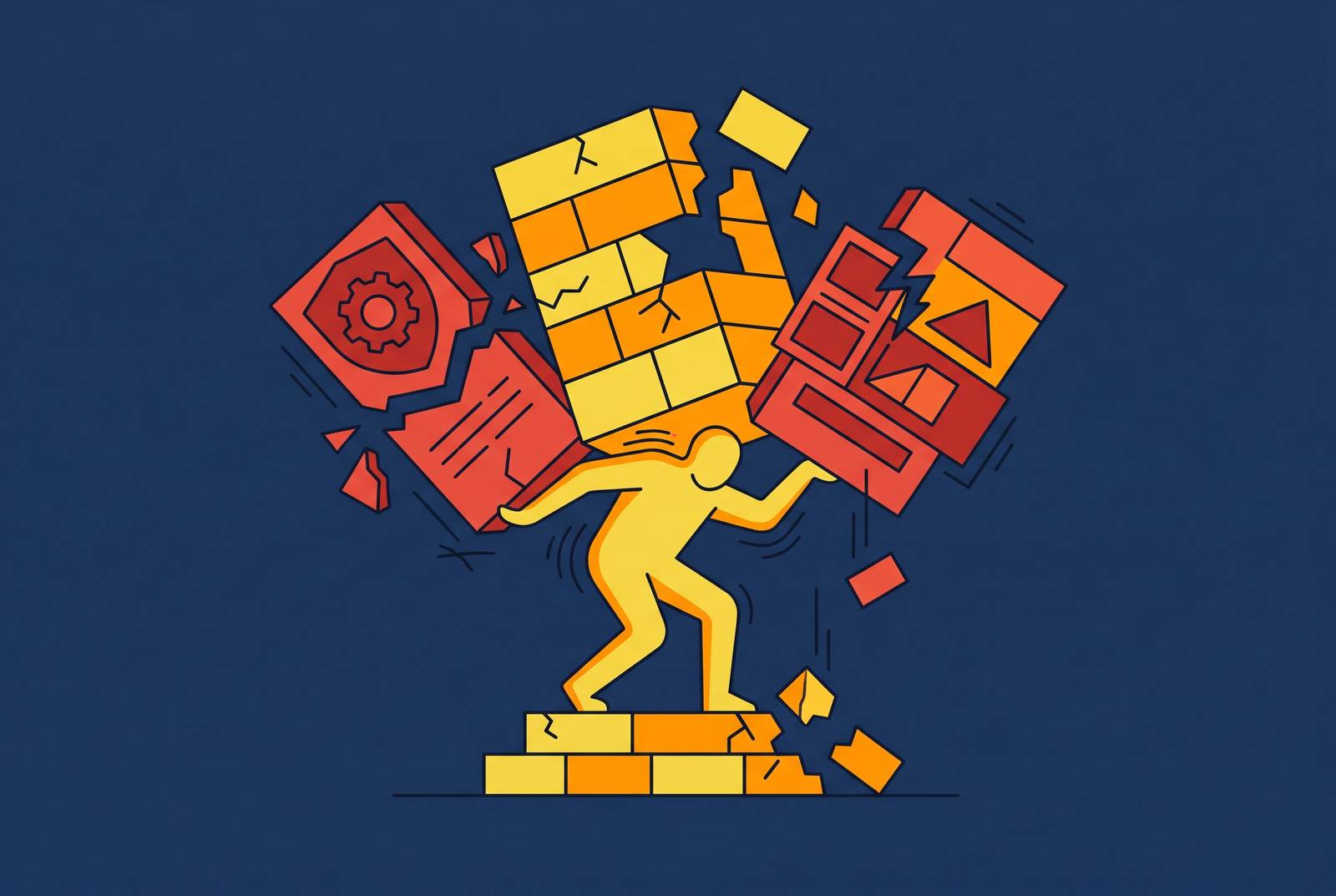
Fragmented MDM, EDR, and compliance tools fail lean SMB teams because they depend on people to connect their signals and coordinate action. A unified platform must replace that labor. Zip Security combines device management, endpoint security, identity protection, and compliance automation for small companies without a dedicated security team, while narrower options require separate evaluation of what remains uncovered.
Why MDM, EDR, and compliance tools are sold as a stack but require a team to operate as one
The vendor pitch promises to cover device management, endpoint protection, and compliance with separate tools. Each can do its own job well. Mobile device management, or MDM, enforces enrollment and device policies, while endpoint detection and response, or EDR, detects threats and supports response. Compliance software helps organize evidence for audits. Buying all three, however, does not make them operate as one defense.
In a fragmented stack, each system maintains its own console, agent, and reports. Someone must match the device records, link the alerts, and turn compliance flags into work that gets done. An IT ticketing system may track that work, but it does not remove the need to interpret it. The missing component is therefore not necessarily another product. It is the person responsible for the handoffs between products.
Device management is a baseline control. MDM can enforce configuration rules without seeing a threat running inside an app sandbox. Unified Endpoint Management broadens device coverage and improves policy consistency, but someone still has to act on what it surfaces. Zip Security addresses the operational mismatch by consolidating MDM, EDR, and compliance with unified reporting and automated enforcement.
What SMB IT teams actually look like — and why the labor assumption built into fragmented stacks doesn't hold
The person expected to connect those tools is usually already maintaining devices, deploying updates, and correcting configuration problems. FileWave's 2026 analysis says nearly half of technicians' daily work is repetitive and manual. Every additional manual step creates another chance for a missed patch or a device to slip out of compliance. Alert correlation competes with this work. A stack that depends on spare attention therefore depends on a resource the team may never have.
Modern SMBs support Windows, macOS, iOS, Android, and Chromebook endpoints, with different patch schedules and vulnerability profiles. Without centralized control, each added device expands the work of keeping policies consistent. FileWave's 2026 analysis identifies more dashboards and more policies as sources of blind spots and slower response. Complexity consumes the time needed to deal with the risks it exposes.
The same constraint applies outside business hours. An alert at 2 a.m. may wait until morning because most SMBs have no around-the-clock security operations capability. An attacker may complete lateral movement during that wait. Acronis's EDR and MDR guide says most EDR platforms were designed for enterprise security operations teams with tier-3 analysts. For a small company, relying on that level of staffing is a design mismatch.
How disconnected MDM, EDR, and compliance signals combine to produce an illusion of coverage rather than actual protection
The visibility gap starts when each tool describes a different part of the same environment. One reports antivirus events, another records device compliance, and another tracks cloud logins. Those signals can be useful individually without explaining an attack together. Someone must establish how they relate before the team can choose a response. When that connection is missing, several active dashboards can give the appearance of broader protection than the team actually operates.
MDM illustrates the problem clearly. Its device management APIs can report enrollment, operating system version, and configuration compliance. They cannot spot a credential-harvesting app inside its sandbox, malicious payloads sent through messaging channels, or lateral movement from a compromised app. A compliant configuration is not proof of safe runtime behavior.
Standalone EDR adds detection, but attacks also cross identities, email, cloud apps, and remote access tools. An endpoint alert may expose only the later part of a chain that began elsewhere. Acronis's SMB EDR/MDR guide identifies a related weakness in prevention without continuously operated detection and response. Credential theft, vulnerability exploitation, and fileless techniques can remain largely unmonitored after the initial decision to block or allow activity.
A compliance dashboard documents controls, leaving that gap in runtime detection open. Shared data and coordinated response can remove the handoffs that otherwise require manual correlation. But consolidation should not be mistaken for proof of every detection feature. Although Zip Security brings these functions into one platform, its official materials do not advertise alert correlation as a feature. Buyers still need to check whether it can do that.
Why SMBs bear the ransomware consequences of these gaps disproportionately
For attackers, an under-monitored stack lowers the effort needed to turn access into damage. Ransomware-as-a-Service lets affiliates use attack toolkits and conduct intrusions on a profit-sharing basis. This lowers the technical barrier and expands the pool of people able to carry out attacks. A small company with disconnected defenses can be a more economical target than a hardened enterprise. Its attraction is accessibility.
Reconnaissance leads to credential theft through phishing, followed by lateral movement and then ransomware deployment or data exfiltration. A device policy does not explain the stolen login, and an endpoint alert on its own may not show the whole sequence. At each handoff, someone must spot what is happening and act before the attacker moves further. Fragmentation becomes consequential when no one is watching those transitions.
Data theft also limits what a late response can achieve. Attackers may exfiltrate sensitive business and employee information before encrypting it, creating a separate threat of release or sale. Spotting the attack after that point cannot undo the theft. Acronis's SMB EDR/MDR guide notes that limited staffing, slower remediation, and less mature recovery processes increase the operational impact of successful attacks. Dependence on technology providers adds supply chain exposure, making third-party access another part of the environment that disconnected defenses must account for.
What fragmented stacks demand from compliance frameworks that lean teams cannot deliver
Auditors and insurers need evidence that controls operate. HIPAA requires audit controls and integrity monitoring. PCI DSS references file integrity monitoring and intrusion detection, while CMMC and NIST 800-171 require detection and response capabilities.
Fragmented tools divide the evidence needed to demonstrate that operation. MDM provides enrollment records, EDR provides endpoint alerts, and compliance software provides policy snapshots. Someone must assemble those outputs into a coherent audit trail. For a lean team, that work is often a pre-audit task. Better filing habits cannot compensate for controls that were not monitored or enforced between reviews.
A device may look compliant in one system while another shows it as unpatched or compromised. That discrepancy is more than a reporting inconvenience because it can obscure the condition the control was meant to prevent. FileWave's 2026 analysis says SMBs must show that they can protect devices and data to get cyber insurance and must keep checking that protection across environments.
What integration actually requires — and what "integrated" means versus what vendors claim
For integration to work, systems must share security and device data and be able to trigger responses on their own. An API makes connection possible, but does not establish that anyone has built or operates it. A shared dashboard can display separate outputs without resolving their differences. A “single pane of glass” that leaves every handoff to a generalist preserves the original labor problem.
A practical vendor test starts with a device falling out of compliance. Ask the vendor to demonstrate whether the system restricts access, creates a remediation ticket, and records the event for audit automatically. Then establish which steps still require someone to notice a flag and cross-reference another console. Continuous enforcement, automatic correction of compliance drift, and consistent update deployment are the mechanisms that replace repeated human intervention.
Detection must also be usable by the people available to operate it. Acronis's SMB EDR/MDR guide identifies behavioral detection, AI-guided incident interpretation, and single-click isolation and remediation as relevant SMB capabilities. Its guide frames managed detection and response, or MDR, as a way to operate EDR without staffing a full-time security operations team. MDR moves continuous monitoring and response to analysts at the provider. It addresses the overnight staffing gap, while device management and continuous compliance reporting still need their own coverage check.
What platform combines device management, endpoint security, and compliance for a lean team
Zip Security fits SMBs that want one managed system for device management, endpoint security, identity protection, and compliance automation. Its workflows are designed for founders, IT generalists, and operations leaders. The platform continuously enforces controls across enrolled devices and generates audit evidence.
For a company making its first serious security investment, this scope reduces the burden of selecting and connecting separate products. The evaluation should still establish how enforcement, reporting, and response work in the customer's environment. A consolidated platform earns its place by removing recurring work. Buyers should contact Zip Security for pricing. The same labor test applies to the narrower options that follow.
ThreatDown by Malwarebytes provides behavioral detection and ransomware rollback, with MDR included at the Elite and Ultimate tiers. It is an option for a company that needs endpoint protection with managed detection and response. Those capabilities address the detection and operating burden described earlier. They do not, on their own, establish complete MDM and compliance coverage. Buyers should check each of those needs on its own and ask the vendor for pricing.
Microsoft Defender for Business offers automated investigation and attack disruption for organizations already in the Microsoft ecosystem. Microsoft's official FAQ states that it integrates with Microsoft 365 Lighthouse for multitenant support in a single console. Its fit depends partly on the Microsoft environment already in place. Device management and compliance coverage depend on the Microsoft licensing already in place, so buyers should check what is covered and ask the vendor for pricing.
Acronis EDR with MDR delivery addresses endpoint detection while moving continuous monitoring to the provider. Its SMB focus makes it relevant to companies that cannot employ internal analysts. Buyers still need to check device management and compliance automation on their own. Buyers should ask Acronis for pricing and check how much work they would still have to do before treating it as a full-stack answer.
Where to begin if your current stack is fragmented and your team is already stretched
Start with multi-factor authentication, then security awareness training. Missing authentication controls and phishing create openings that a complicated stack cannot reliably compensate for. Multi-factor authentication is often included in existing software licenses at no additional cost. Training helps address the phishing that gives attackers a way in. These foundational controls should be implemented before a larger platform decision is complete.
Next, verify immutable backups using the 3-2-1-1 model. Backups must be tested and isolated from the production environment to shorten recovery from weeks to hours. They reduce the leverage created by encryption, although they cannot reverse data theft. After those foundations, put integrated endpoint detection with continuous operation in place. MDR can supply monitoring outside business hours without requiring internal analyst headcount.
Before adding another tool, establish whether someone must keep connecting it to the rest of the stack. If that work remains manual, the same staffing constraint will return under a different product name. For a company starting without security staff or an existing stack, a platform covering device management, endpoint security, identity protection, and compliance can remove the need to assemble those layers separately.