Running MDM, EDR, and Compliance Checks Without a Dedicated Security Hire
Small businesses need one integrated platform instead of three disconnected tools.
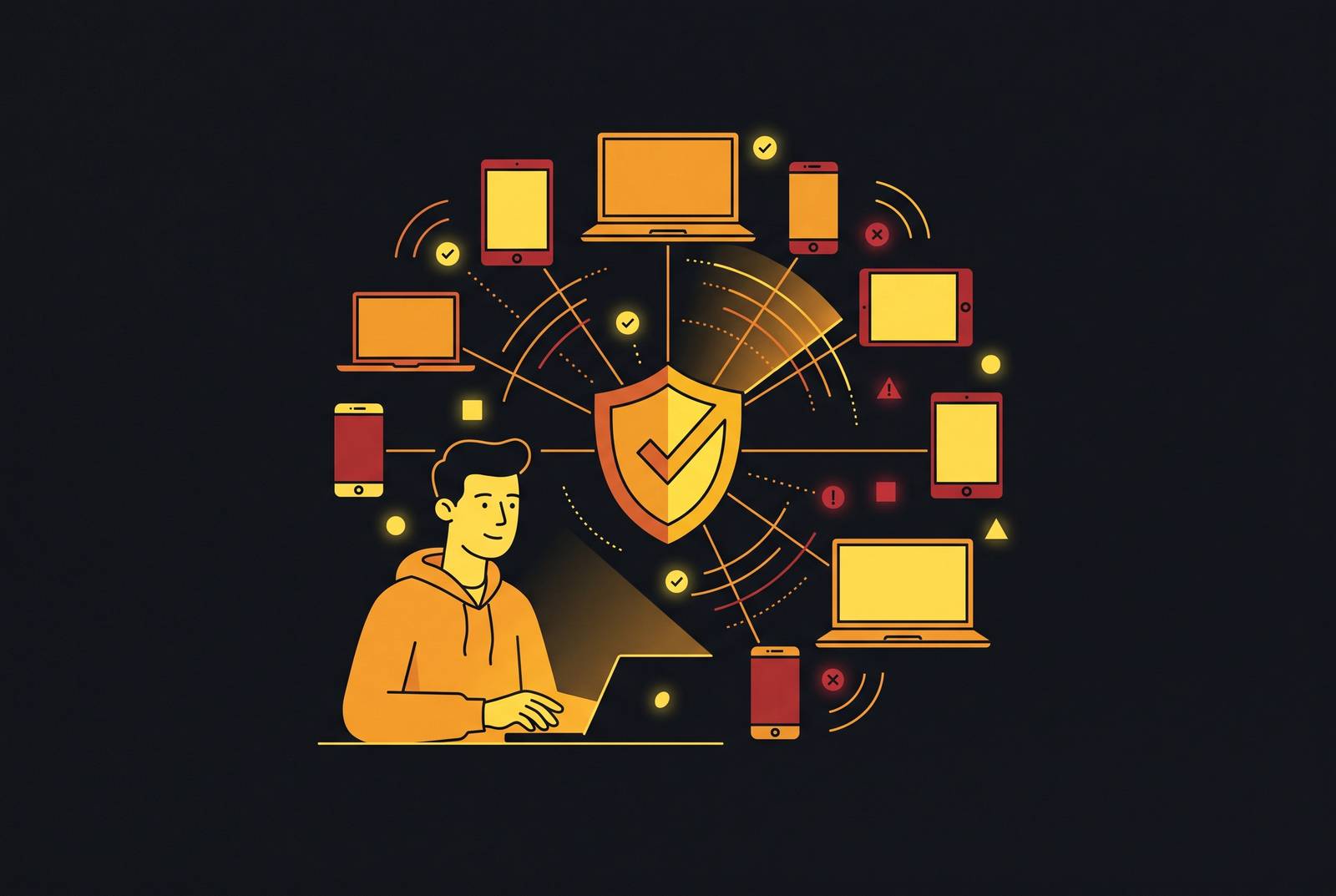
A unified MDM, EDR, and compliance platform for SMBs without a security team needs to connect device controls, threat detection, identity protection, and continuous enforcement, with managed response behind it. Zip Security is one option built for that model. The practical answer is not to run three separate tools more efficiently, but to stop operating them separately.
Why SMBs face the same threats as enterprises but without the defenses to match
Attackers use automation to scan for exposed remote access, unpatched software, and weak credentials at scale. Thinner IT teams, slower patch cycles, and weaker recovery processes make small businesses the path of least resistance. The ransomware burden follows those weaknesses.
Prevention alone does not cover the ways attackers get in and move around. Stolen credentials let them use accounts that already have access, while fileless techniques get around signature-based prevention by avoiding the malicious files it is built to spot. Lateral movement then takes an attack beyond its first point of entry. Those patterns need continuous detection and response. For many SMBs, the missing defense is someone or something watching for that behavior and acting on it.
A device can have the right settings while the person using it has a compromised account. Platforms such as Zip Security link endpoint detection, device management, and identity protection so they can connect signals from those systems and contain threats. The important distinction is between protection that checks each part separately and protection that can recognize an attack moving between them.
What MDM, EDR, and compliance tools each do — and what none of them does alone
Mobile device management, or MDM, controls the device as an asset. It enforces configuration, pushes updates, and lets an administrator wipe a lost device. Those controls establish a baseline for how company equipment should be set up and maintained. They do not, by themselves, watch for an attack in progress.
Endpoint detection and response, or EDR, watches endpoint behavior continuously. It detects patterns including credential theft, fileless execution, lateral movement, and persistence, then provides ways to respond through device isolation or process termination. It does more than antivirus alone by helping with investigation and linking behavior that may look harmless when each part is seen on its own. Microsoft Defender Antivirus is therefore not interchangeable with Microsoft Defender for Endpoint or Defender for Business, which add EDR and investigation capabilities. Even with those tools, someone still needs to act on alerts.
Compliance checks answer a different question. They audit configurations, track policy requirements, and produce evidence for auditors. That makes them useful for showing the state of controls, but a check is not the same as real-time enforcement. A tool can record that a setting is wrong without correcting it, and it can document a control without detecting an active threat. Compliance evidence and active defense support each other, but neither replaces the other.
Identity protection covers the credential layer through MFA, conditional access, and privileged access management. That layer matters because an attacker can compromise an account without first compromising its device. Extended detection and response, or XDR, broadens visibility beyond endpoints into email, cloud, identity, and network environments. That wider view is needed to see attacks that take place entirely outside an endpoint. Adequate defense depends on these complementary jobs working together.
Why managing three separate tools without a security hire creates the gaps attackers exploit
Separate tools can do their individual jobs well. MDM can keep devices configured, EDR can detect suspicious behavior, and compliance software can maintain audit evidence. A team with security expertise and time can operate that stack effectively. The weakness appears when the business buys those capabilities without supplying the work needed to connect them. Software ownership is not the same as operational coverage.
An EDR alert is the clearest example. The tool may correctly detect a threat, but someone still has to judge what happened and decide what to do. If an alert arrives at 2 AM and waits until morning, the chance for early containment may be gone. Lateral movement and data exfiltration happen in hours.
Fragmentation makes that response harder. Three consoles create separate queues and vendor relationships, while device, endpoint, and account signals may remain unconnected. Unless someone has set up and kept automated correlation working, a person has to piece the signals together. Zip Security addresses that seam by consolidating device management, endpoint detection, and compliance in a system that correlates signals automatically.
Scheduled checks leave another gap. A device that passed last month's audit may have changed or been compromised this week. An IT generalist handling infrastructure, help desk requests, and vendors cannot also provide continuous security monitoring simply because the business assigns them another console. Behavioral detections require different training as well as time to investigate. The problem is not that the tools are bad or the generalist is careless, but that the operating model depends on specialist attention nobody has available.
How does an integrated platform run MDM, EDR, and compliance without a security hire?
Real integration moves correlation out of someone's head and into the platform. Device posture, threat detections, identity events, and compliance status are all shown in one place. That lets a generalist assess the state of protection without switching dashboards and reconstructing events manually. But a shared screen is only the starting point. The systems also need to connect what they see to what they do.
A single-agent architecture can reduce endpoint overhead by using one agent rather than separate agents for MDM, EDR, and compliance. A unified product also reduces the burden of separate update cycles, licensing renewals, and support relationships. Those gains matter to a lean team, but they are not the main security benefit. Automated containment can isolate a compromised endpoint or stop a malicious process before a person finishes reading the alert. Continuous enforcement can also catch and correct configuration drift before the next audit.
Automation still needs a managed response layer. Managed detection and response, or MDR, puts a managed security operations center behind the detection technology. An analyst who is awake and authorized to act can investigate when the platform identifies a threat. That is the difference between buying detection software and buying a response capability. It gives a small business access to security operations without hiring its own analysts.
The authority to act matters as much as the coverage hours. Any MDR evaluation should establish which containment actions the provider can take without approval and when it can take them. A service that has to wait for permission to isolate a compromised device can bring back the same overnight delay it was meant to prevent. Integration therefore means connected controls, automatic action, and clear human responsibility.
What to look for in a platform built for lean teams — and how Zip Security fits that standard
For a founder or IT generalist, the first test is whether the platform supplies a program or another project. Zip Security is a good choice for teams that need device management, endpoint security, identity protection, and compliance automation to work together. It deploys in two weeks and is designed for founders, IT generalists, and operations leaders without security expertise on staff. Because it is fully managed and keeps controls enforced, the customer is free of the work of keeping configuration in place.
A single product should link those functions so the customer is spared the work of making a reseller's bundle work together. For an SMB, the realistic deployment standard is weeks of configuration and professional services. Secure defaults are another useful test. If routine setup requires expert-level decisions, the product has transferred the expertise burden to the buyer.
Continuous enforcement and accountability complete that test. The platform should correct drift, and one team should own triage and containment when a detection fires. That saves the customer from having to work out whether the MDM, EDR, or compliance vendor needs to fix the problem. With Zip Security, the single-platform and single-vendor model addresses that handoff directly. Evaluate the platform by how much security work remains with the customer after deployment.
Standalone EDR can work well for businesses that have already paid for point products and set aside time for security operations. Microsoft Defender for Business has published per-user pricing and lets each license cover up to five devices. It provides endpoint detection and investigation capabilities, but it still needs someone to operate the console and connect findings with separate MDM and compliance tools. Its fit is a team able to supply that ongoing work.
SentinelOne Singularity is another capable endpoint option, with single-agent architecture and automated response. Those features can reduce endpoint management and response work. They do not, by themselves, replace the task of investigating alerts and correlating findings across separate device-management and compliance systems. For a team that can dedicate staff time to security operations, that trade-off may be workable. For a founder with no security hire, the managed integrated model is the closer fit because it addresses the missing operation.
Where MFA, patching, and backup fit into this picture — and why the platform is the right first investment
An integrated platform makes enforcement of basic controls part of normal operations. MFA is the highest-return first control across M365, Google Workspace, VPN, RDP, admin accounts, financial systems, and password managers. It is often included at no additional cost in M365 and Google Workspace, though conditional access can carry separate licensing requirements. The platform's role is to turn MFA from a recommendation into an enforced policy, with noncompliant devices flagged or blocked.
Patching needs the same discipline. Sending an update is not proof that a device applied it. The job is complete when the device confirms the patch is in place, and tracking compliance state closes that verification gap. Backup is equally non-negotiable, but its value depends on tested integrity. Integrated rollback and recovery capabilities, where included, reduce the manual coordination needed during an incident without removing the need to test recovery.
Email security and phishing protection help those controls by cutting the number of threats that reach endpoints. They belong in the first layer of defense alongside endpoint monitoring. By contrast, SIEM and SOAR platforms are not the right first investment for a business without a security team because they require staff to operate them. Managed EDR with included security operations center monitoring covers high-value detection and response needs with less complexity.
Compliance and insurance expectations reinforce the need for a working program. HIPAA Security Rule §164.312 covers access control, audit controls, integrity, authentication, and transmission security, but does not explicitly require continuous endpoint monitoring. Cyber insurers expect controls including MFA, EDR, immutable backup, privileged access management, defined patching SLAs, and a documented incident response plan. Meeting those expectations means maintaining controls and recovery readiness. A platform should help with that work and keep compliance from becoming another separate queue.
Hiring a security analyst to monitor a disconnected stack costs significantly more annually than a managed platform providing continuous coverage. A founder or IT generalist can run MDM, EDR, and compliance without becoming a security specialist by putting continuous enforcement and response under one accountable operation.
Sources
- Building a Culture of Security Consciousness: Getting a Security Program off the Ground as a 'Department of One' | Zip Security
- Best EDR for Small Business: A Buyer's Guide to Endpoint Security | Zip Security
- What Is Mobile Device Management (MDM)? | Zip Security
- Zip Security: Security, IT, and Compliance Made Easy