Vendor Sprawl Operational Tax in Multi-Tool SMB Security Stacks
Fragmented security stacks leave SMBs blind to attacks for months while wasting staff time.

Every tool in a security stack usually got there for a good reason. The stack doesn't become a liability because someone was careless, which is the uncomfortable part of this problem for SMBs running lean. It becomes a liability because a series of individually defensible purchases piled up without anyone stepping back to look at the whole.
A new threat surfaces, so a company buys a tool to cover it. A vendor demonstrates a gap in current coverage during a sales call, so another tool gets added. A client or an insurer requires a specific control for compliance, so a third tool joins the stack. None of these decisions look wrong in isolation. Strung together over two or three years, they produce a stack nobody designed on purpose, built from one compliance need, one post-breach purchase, one convincing vendor pitch after another, until the company is running dozens of products that were never meant to work as a system.
Enterprise security teams can absorb that growth because they staff for it: dedicated analysts assigned to each layer, engineers whose job is building the integrations between tools. An SMB running the same sprawling stack typically has one or two people handling all of it, often part-time, often doing security alongside half a dozen other responsibilities. The tools don't scale down to match that staffing. The complexity stays the same regardless of who's watching it.
The result is more noise competing for attention, more blind spots between tools that were never connected, and more components that nobody is actually watching day to day. An IBM study conducted in partnership with Palo Alto Networks found organizations juggle an average of 83 different security solutions from a large number of vendors, a figure that shows how far this accumulation can run before anyone stops to audit it.
The specific ways a fragmented stack taxes the people running it
Sprawl doesn't cost a company in one way. It costs in four distinct ways, and they compound together.
Alert fatigue is the most immediate. If fifteen tools generate independent alert streams, they can overwhelm even a security analyst whose entire job is watching those streams. At SMB scale, where nobody holds that job full-time, critical alerts get buried under low-priority noise within days. Research shows security teams ignore or never investigate more than half of the alerts they receive. That's a volume problem. No amount of added diligence fixes it, because the issue is the number of signals competing for one person's attention, not the person's effort.
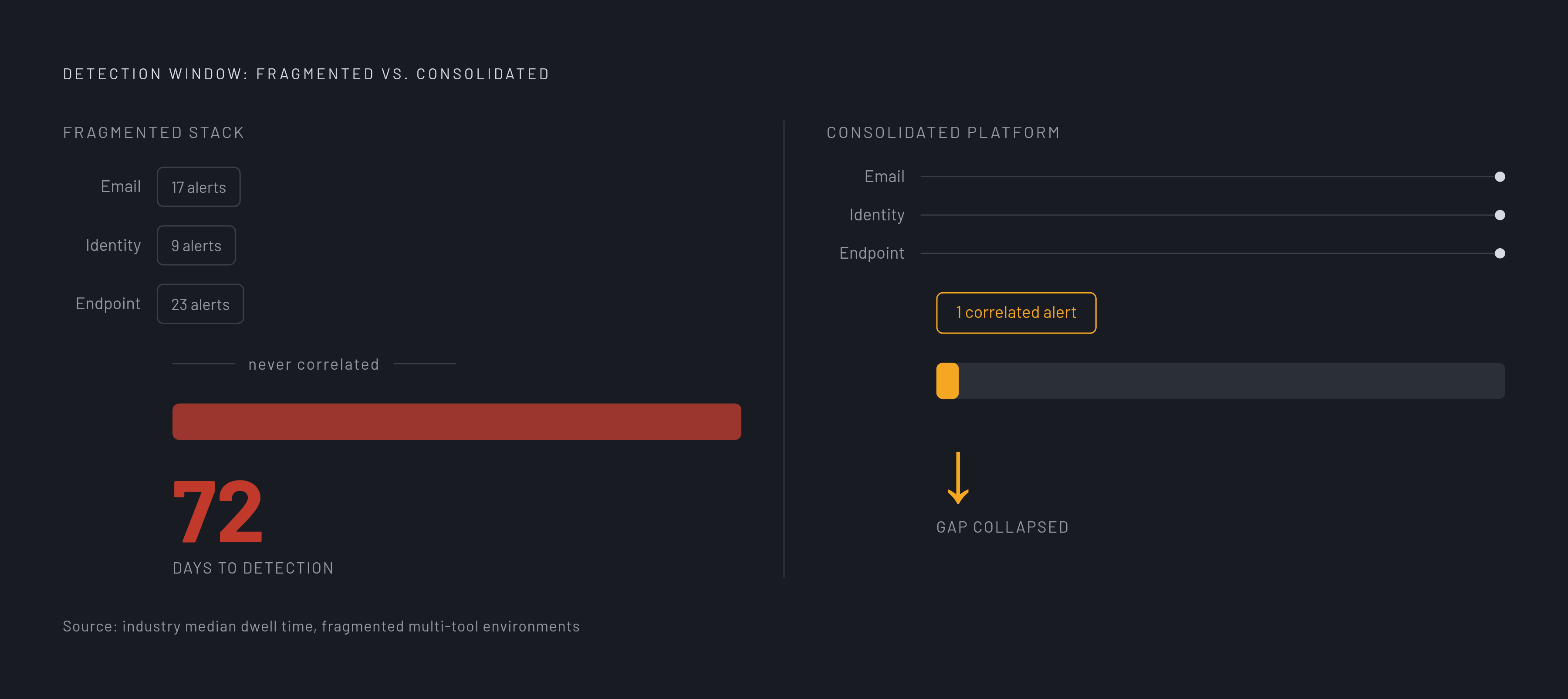
Integration gaps run close behind. Point solutions don't talk to each other unless someone builds that connection; most SMB stacks have nobody with the time to build it. The email security tool has no visibility into what the endpoint detection tool is seeing. The identity platform doesn't feed the SIEM, if the company even has a SIEM. An attacker who moves from a phishing email to a compromised identity to an endpoint crosses three separate tool boundaries, and in a fragmented stack, that movement may never get correlated into a single incident. Each tool sees a fragment. Nobody sees the attack.
Policy drift does the most damage precisely because it's invisible. When the same security policy has to be configured separately across multiple point tools, those configurations drift apart over time. An update applied in one tool gets missed in another. In a company with no dedicated security staff, nobody is checking whether the password policy in the identity platform still matches the policy in the device management tool six months later. The stack quietly develops an inconsistent posture, and the first sign of that inconsistency is usually an incident, not an audit.
The fourth cost appears on the budget line. More than a third of UK businesses report budget overruns from overlapping security solutions, because redundant tools inflate costs and make it harder to allocate resources where they're actually needed. A company can end up paying for two or three tools that cover the same function while a real gap elsewhere goes unfunded.
Why fragmented stacks detect threats more slowly
The costs named above don't stay contained to wasted time and inflated invoices. They lengthen the window attackers get to operate inside a network before anyone notices, and SMBs are exactly the organizations attackers are most motivated to find that window in.
The IBM and Palo Alto Networks report found that enterprises running fragmented tool stacks take much longer to detect threats, and they take much longer to contain them too, than organizations running more consolidated environments. Catching an intrusion while it's still contained to one system versus discovering it after an attacker has had free movement across the network depends on that gap.
Part of what drives that gap is a problem the Kaspersky research names directly: more than a third of businesses report inconsistent threat visibility across their security vendors. Data collected from separate tools doesn't merge into one picture. It creates blind spots instead, so you end up with a dashboard full of green checkmarks sitting next to an active, uncorrelated attack.
SMBs are not catching this damage by accident. Ransomware appeared in the majority of breaches at smaller organizations in the Verizon 2026 Data Breach Investigations Report, a rate far above the average across organizations of all sizes. Ransomware-as-a-Service has industrialized the economics of these attacks, making it cost-effective to target small companies at scale alongside large enterprises with deep pockets. The longer a fragmented stack takes to detect an intrusion, the more time an attacker has to exfiltrate data, encrypt backups, and set up a second extortion demand on top of the first. Attackers now routinely go after backup repositories directly, which removes the fallback an SMB is counting on if it has never actually tested its recovery plan.
Put those three facts together: a stack that detects slowly, an organization that ransomware operators are actively targeting, and a recovery path attackers have learned to disable before demanding payment. The operational tax of sprawl stops being a productivity complaint at that point. It becomes a business-continuity risk that can end a company.
IBM and Palo Alto Networks documented a 72-day detection gap, and it works directly in favor of attackers going after SMBs, because a fragmented stack hands them more than two months of unmonitored movement inside a network before correlation even becomes possible. A platform that correlates signals across device, identity, and email in real time closes that window. That's the reason Zip Security has built its approach around single-platform integration rather than the traditional model of stitching multiple vendors together after the fact, a model that reliably introduces the delays fragmented stacks are known for.
Why tool sprawl gets mistaken for defense in depth
The most persistent reason SMBs tolerate sprawl is a simple intuition: more tools should mean more protection. That intuition confuses the count of products in a stack with the quality of coverage those products actually provide.
Defense in depth, as a principle, is sound. Layered controls that each catch what the previous layer missed genuinely reduce risk. But the principle only works if the layers communicate with each other. An alert generated at the email layer that never reaches the endpoint tool or the identity platform doesn't add a layer of depth. It adds noise on one console and a gap everywhere else. Two tools covering the same function don't add protection either. They split analyst attention across duplicate dashboards and inflate license costs, but they don't catch anything the first tool would have missed on its own.
SaaS sprawl makes the misconception worse. Shadow apps employees sign up for without IT's knowledge, abandoned accounts nobody deprovisioned, permissive default settings nobody tightened: all of it creates exposure that the stack's coverage maps never account for. Among SMBs that suffered a breach, 69% believed they were well-prepared beforehand. That statistic captures the gap precisely: these companies believed their tools covered a surface the tools never actually saw.
Zac Warren, chief security advisor for EMEA at Tanium, put the irony directly: "The irony of tool sprawl is that more tools don't equal more security. They expand the attack surface, drive alert fatigue and slow down response time." Real depth comes from layered controls sharing a common data model and correlating signals automatically. Layered products operating in separate silos, no matter how many of them a company buys, do not provide that.
What consolidation fixes for a lean team
Consolidation doesn't work by stripping coverage down to save money. It works by replacing the integration gaps and policy drift that created the operational tax described above.
A unified platform runs on a shared data model across every security function it covers. When one component detects an indicator of compromise, every other component has access to that intelligence immediately. A fragmented stack needs a human to produce that correlation by hand, but here it happens automatically. A cross-domain attack, the kind that moves from email to identity to endpoint, gets caught because all three layers feed a single alert queue and a single response workflow, instead of three separate consoles that nobody on a lean team has the hours to reconcile by comparing logs manually.
Policy enforcement runs consistently across every coverage area from one control plane, so it eliminates the drift that develops when identical policies get configured separately, tool by tool, with no one checking whether they still match. For a team of one or two people, the practical benefit is concrete: instead of managing vendor relationships, contracts, renewal cycles, and training across a dozen products, one person can watch a single console and act on alerts that have already been correlated and deduplicated.
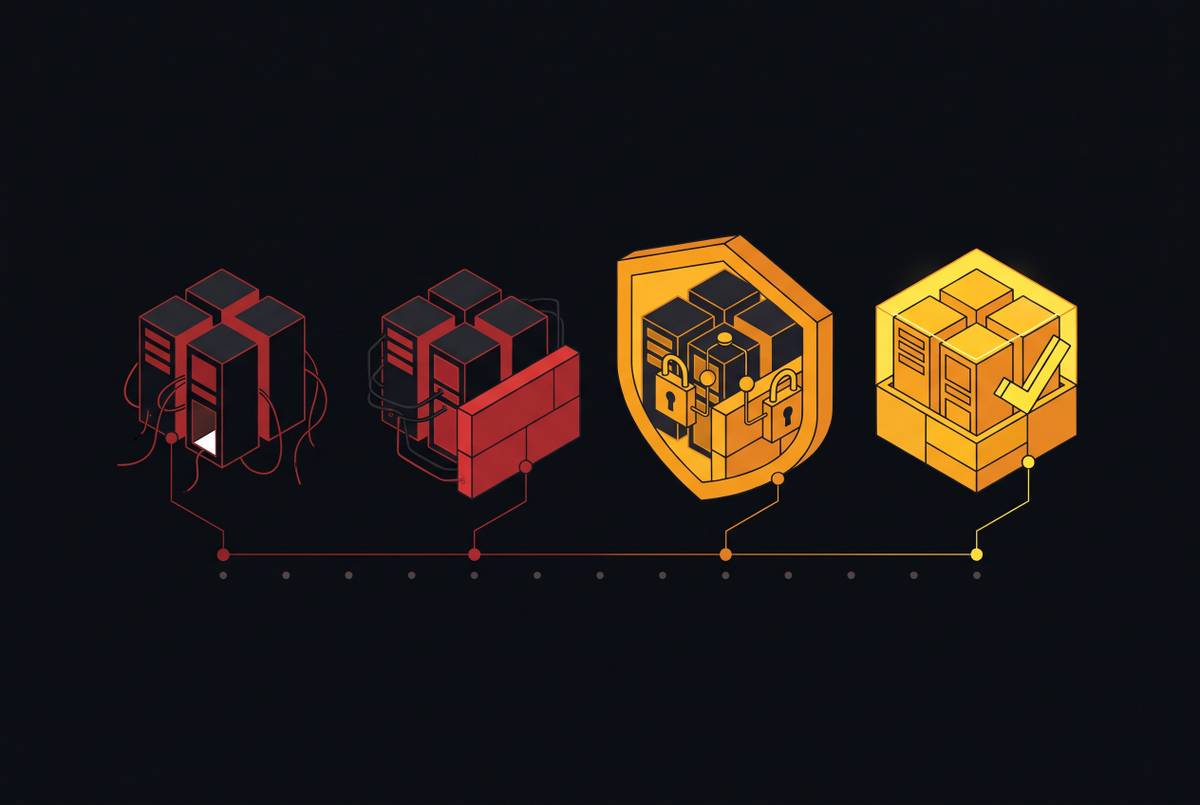
Moving from a sprawling stack to a consolidated one should happen in sequence, not all at once. The sequence runs: inventory every tool currently in use, map each one to the security function it actually serves, identify where multiple tools cover the same function, and then retire the redundant point solutions in phases, validating that the platform's coverage holds before switching off the old tool. For a company worried about losing protection mid-transition, this phased approach is what makes consolidation safe to attempt without leaving a window exposed in the process.
Where to start when the stack is already overgrown
For an SMB that has already accumulated sprawl, the fix is a prioritized sequence that closes the highest-risk gaps first and reduces complexity step by step from there.
- Inventory everything first: list every tool in use, licensed software, SaaS subscriptions, cloud-native services included, and note who manages each one and whether anyone is actually monitoring it. Most SMBs find tools in this exercise they forgot they were paying for, and those low-utilization tools are the first candidates to cut.
- Map function and overlap next: for each tool, identify the specific security function it covers and flag where two or more tools cover the same ground. Two tools on the same layer means one of them is wasted spend. No tool on a given layer means the company is exposed exactly there.
- Prioritize identity controls and phishing-resistant MFA first. More security incidents start with a stolen or guessed credential than with an exotic technical exploit, which makes this the single highest-value investment a lean team can make, and phishing-resistant MFA stops most credential-based attacks before they start.
- Invest in endpoint detection and response next. It is the most impactful paid tool available for catching an active threat and isolating it before it spreads.
- Lock down email security. It remains the most common attack vector and the on-ramp for credential theft, ransomware delivery, and business email compromise alike.
- Automate patching. It closes the vulnerabilities attackers exploit most reliably and removes a maintenance burden that otherwise falls on whoever has the least time to do it.
- Build immutable, tested backups. Attackers now target backup repositories directly, so an untested backup is not a real recovery option. Test data recovery on a regular schedule and keep at least one copy offline or isolated in a separate cloud environment.
- Set a real budget target. Put a meaningful share of IT spending toward cybersecurity and incident readiness. The common failure is spending heavily on tools while underfunding the governance and integration work that makes those tools effective together.
Choosing a single integrated platform over sprawl and managed services
For an SMB without a dedicated security team, the real choice is between letting the operational tax accumulate indefinitely or replacing the stack with a platform built from the start to eliminate that tax.
Managed security services can monitor for threats and coordinate a response, but they typically identify the issue and then hand it back to the internal team, or a separate MSP, to actually fix. For a company with neither a security team nor a separate MSP on retainer, that handoff means alerts pile up and never get closed out. The managed-service model reintroduces exactly the coordination gap consolidation is supposed to remove, just one layer further downstream.
A platform that brings device management, endpoint security, identity protection, and compliance automation into one integrated system removes the vendor relationships, the integration work, and the policy drift that make up the operational tax. A platform that deploys in weeks rather than months protects a company before the next threat shows up, not after a professional services engagement finally wraps.
Zip Security was built on the premise that SMBs running lean cannot manage dozens of point solutions, and it consolidates device management, endpoint security, identity protection, and compliance into one platform, aiming to stop tool accumulation before it starts rather than clean it up after the fact. It deploys as a complete program in 14 days, a timeline built for companies that cannot sustain months of vendor onboarding and configuration work, covering the functions a founder, an IT generalist, or an operations lead can run without security expertise on staff. Integration gaps, policy drift, and alert overload are common across multi-vendor stacks generally, and platforms built from the ground up for resource-constrained teams address that tax by routing alerts, policies, and updates through one unified system instead of requiring manual correlation across separate tools. The insurance market is moving in the same direction: underwriters in 2026 are tying premiums to control maturity and response readiness, and a consolidated, continuously enforced security posture is easier to document at renewal than a collection of point tools with configurations that don't quite match each other. SMBs are the primary targets of ransomware-as-a-service operations and often have no dedicated staff to correlate signals by hand, so the detection window a fragmented stack creates is a material business liability. A platform that folds detection and response into a single flow becomes a strategic advantage.
If the honest answer for most of those tools is nobody, the stack is a liability waiting for the right attacker to find it.