Security Platforms That Guarantee Full Enforcement Timelines
Multiple compliance frameworks now demand continuous enforcement, not periodic documentation.
The simultaneous closure of phase-in periods across HIPAA, NYDFS Part 500, PCI DSS, and CMMC has converted "best practice" security into active legal obligation for SMBs in regulated industries. PCI DSS 4.0 is the clearest case: the 51 future-dated requirements introduced with that version became mandatory on March 31, 2025, version 4.0.1 is now the only active version, and requirements covering payment-page script inventories and expanded MFA get scored in full, with no exceptions left on the table.
HIPAA moved on a similar clock. The 2026 proposed Security Rule update would make MFA, encryption, and 72-hour recovery mandatory, closing what had been an "addressable" loophole that let covered entities treat those controls as optional. That rule had not been finalized as of mid-2026, but the penalty structure already changed: the maximum fine for the most serious violations rose to $2,190,294 per violation category, effective January 28, 2026, and a single breach can trigger multiple violation categories at once.
CMMC tells a more complicated story, but the direction is the same. Phase 1 enforcement began in November 2025. On July 13, 2026, the Department of War suspended CMMC Phase II and the third-party certification assessments that were set to appear in contracts already in active solicitations. Compass MSP's guide makes a point of noting that the underlying security requirement did not change just because the certification timeline paused. A defense contractor that built its security program around passing an audit, rather than around operating securely, is now exposed in a way a paused audit schedule does not fix.
Enforcement is not just a regulatory story either. Salesforce is rolling out a cluster of security controls through 2026: MFA for all employee users in production starting July 20, phishing-resistant MFA for privileged users from July 1, step-up authentication on report actions from July 1, and anomalous export step-up along with a default Transaction Security Policy from July 13. A platform vendor is building enforcement directly into its architecture, so the controls apply whether or not a customer's compliance program is ready for them.
The pattern across all four frameworks, plus the platform-level example, is the same. Years of phased-in guidance gave organizations time to plan, and that runway has ended. Compass MSP's 2026 guide states that a program that wakes up a few weeks before an audit cannot satisfy frameworks that now require continuous operation. Regulators expect controls running today, and they expect evidence on demand, not evidence assembled after the fact. The compliance surface is still expanding too. NYDFS has already signaled that AI and large language models are on its radar for future rulemaking, so the list of frameworks closing their grace periods in the next cycle is not going to shrink.
For a lean SMB without a dedicated security team, none of this is a future planning exercise anymore. Compliance with these frameworks is no longer optional. Tools and vendors currently in place must guarantee that MFA, encryption, monitoring, and documentation run continuously, every day, with evidence ready before an assessor shows up.
Why SMBs are primary targets and the cost of a breach
Small and midsized businesses get hit because they carry real money and real data without the security depth that larger organizations can afford, and that combination makes them both accessible and profitable to attack. SMBs account for 46% of all cyber breaches globally, and they get targeted at a rate well out of proportion to their size.
Much of that risk runs straight through employees. People working at small businesses face far more social engineering attempts per person than employees at larger enterprises. The human factor is the primary way attackers get in, ahead of the technical controls. It is the primary way attackers get in.
Ransomware drives most of the damage. The overwhelming majority of SMB breaches include a ransomware component, a share far higher than what larger organizations see, and both business email compromise and ransomware are targeting small businesses at rising rates. The playbook has also changed. Ransomware crews now steal data before they ever encrypt it, then set short extortion deadlines to pressure a fast payout. Many attacks also try to find and destroy backup systems specifically, removing the option to simply restore from a clean copy and walk away.
Paying does not solve the problem the way business owners hope it will. A majority of SMBs that paid a ransom did not get their data back in full, and a significant share of those who paid got hit with a second demand not long after. The money spent on the ransom buys uncertainty, not resolution.
Supply chain exposure adds another layer. A majority of ransomware attacks on SMBs trace back to a compromised third-party vendor, not a direct attack on the business itself, and these intrusions typically go undetected for many months before anyone notices. By the time the breach surfaces, the damage has often gone undetected in the vendor's systems for the better part of a year.
The financial stakes are not abstract for a business this size. A large share of SMBs say that an attack costing a relatively modest dollar amount could put them out of business entirely. That is not a large enterprise absorbing a line-item loss. That is a company closing its doors over an incident that a bigger competitor would barely notice on a balance sheet.
Put the regulatory picture from the previous section next to this threat picture: continuous, enforced security controls are now both a legal requirement and a survival question for lean SMBs. Regulators are closing grace periods at the same moment attackers are getting faster and more organized. The tool or partner a business relies on to meet both pressures at once has to actually work, continuously, not just look good in a folder of documentation.
What SMBs buy when they buy "security support
Many SMBs conflate MSPs and MSSPs, and the wrong choice produces a structural enforcement gap that patchwork tooling cannot close. A managed service provider, an MSP, is built to keep infrastructure and IT operations running. A managed security service provider, an MSSP, focuses exclusively on cybersecurity and typically runs that work out of a security operations center. These are different jobs, staffed differently, and priced differently, and confusing one for the other leaves a business unprotected in ways it will not discover until something goes wrong.
The service lists make the difference concrete. MSPs typically handle IT management and endpoint management, and some offer a degree of threat detection on top. MSSPs provide SOC operations, SIEM, XDR and NDR integration, threat hunting, compliance monitoring, and incident response as standard parts of the contract. A business paying for the first and expecting the second is going to be surprised at exactly the wrong moment.
The reason this matters so much for compliance enforcement specifically comes down to what the customer is actually paying for. Customers pay MSPs to keep IT running, not to enforce security controls. Security becomes a task bolted onto that relationship, handled manually, and manual work drifts. Coverage that depends on someone remembering to check a setting scales in a straight line with the size of the fleet, and it falls apart the moment attention moves somewhere else.
There is a structural reason this keeps happening. Most MSPs were built at a time when the security perimeter was the office network, with a firewall at the edge and a clear line between inside and outside. Companies now run on cloud identity providers, and identity itself is the real perimeter. The MSP model, built for the older perimeter, was never designed to enforce identity-based security at the level these frameworks now require.
Switching to an MSSP does not automatically close the gap either. MSSPs are good at finding problems, but they often hand remediation off to someone else, typically the MSP, and that handoff is where enforcement breaks down. Two providers end up pointing at each other while the control that needed fixing stays unfixed. Securafy's 2026 guide states that not all cybersecurity support is built the same way, and a buyer needs to understand what a strong program actually includes before signing with any provider.
None of this is a minor administrative distinction. The frameworks closing their grace periods in 2025 and 2026 require continuous enforcement of specific, named controls: HIPAA's mandates on MFA and encryption, NYDFS's requirement for written asset inventories, PCI DSS's ongoing script monitoring on payment pages. A reactive, ticket-driven support model, whether it comes from an MSP or an MSSP with a remediation handoff problem, cannot guarantee any of those run continuously. Compass MSP draws a clean line here between a general IT vendor and a compliance-focused managed IT partner: regulated businesses need controls, documentation, and framework-specific expertise working together, not split across vendors who each own a piece of the puzzle. Closing that gap takes a different architecture than a better version of the same split-responsibility model.
What a platform that guarantees enforcement timelines does differently
An enforcement timeline guarantee means a single system deploys, configures, and continuously enforces the security stack, catching drift the moment a setting slips and fixing it before it becomes an audit finding or a breach. One source calls this a built and managed security platform, or BMSP: one platform responsible for the whole enforcement lifecycle, with continuous drift detection and remediation built in rather than handed off. For a lean team with no dedicated security staff, that consolidated responsibility is what actually prevents breaches, rather than just documenting that a breach did not happen last quarter.
The SOC 2 compliance software market shows this distinction at scale. Strac's 2026 ranking of SOC 2 platforms splits the field into two categories: evidence-only platforms that prove controls exist on paper, and evidence-plus-active-security platforms that verify controls actually stop something in practice. That distinction matters because testing operating effectiveness, not just the existence of a policy, has been a core part of SOC 2 Type II audits since 2017, and the 2022 update to the Trust Services Criteria refined the points of focus around evolving threats without changing that underlying requirement. A platform can hand an auditor every document requested and still leave the business exposed to the exact breach that triggers next year's audit.
Around-the-clock monitoring across networks, endpoints, and cloud environments catches problems as they happen. Patch and vulnerability management closes gaps before an auditor ever gets the chance to flag them. Compliance documentation, meaning policies, risk assessments, and audit evidence, gets produced as a byproduct of daily operation rather than assembled in a scramble before a review.
Cyber Advisors' 2026 trends brief identifies the priority controls that consistently block the majority of incidents: identity-centric security, well-managed endpoints, modern detection and response, immutable backups, and a right-sized governance cadence. On the endpoint side, the standard is endpoint detection and response deployed everywhere, on a single vendor, with tamper protection and one consistent policy applied across the fleet, not antivirus software and not a patchwork of point tools bought at different times for different reasons.
Timelines are where the guarantee becomes real rather than aspirational. Basic protections like MFA and endpoint security can be stood up within days. A full security program, with compliance documentation built in, typically takes four to eight weeks to reach maturity.
The obvious pushback is that consolidating onto one platform creates concentration risk, putting too much weight on a single vendor. That risk has to be weighed against the risk already sitting in the fragmented alternative. Five vendors running five separate configurations and five separate monitoring dashboards means five places where drift can go unnoticed, and each of those five is a documented failure point in the patchwork model. Compass MSP frames the underlying logic directly: a program that wakes up weeks before an audit cannot meet the bar these frameworks now set, and the case for consolidation is structural, built into how continuous enforcement actually works, not a matter of vendor preference.
Where to put the first dollar in an enforcement timeline
For an SMB with no security staff on payroll, the order of spending controls how much damage a breach ultimately causes.
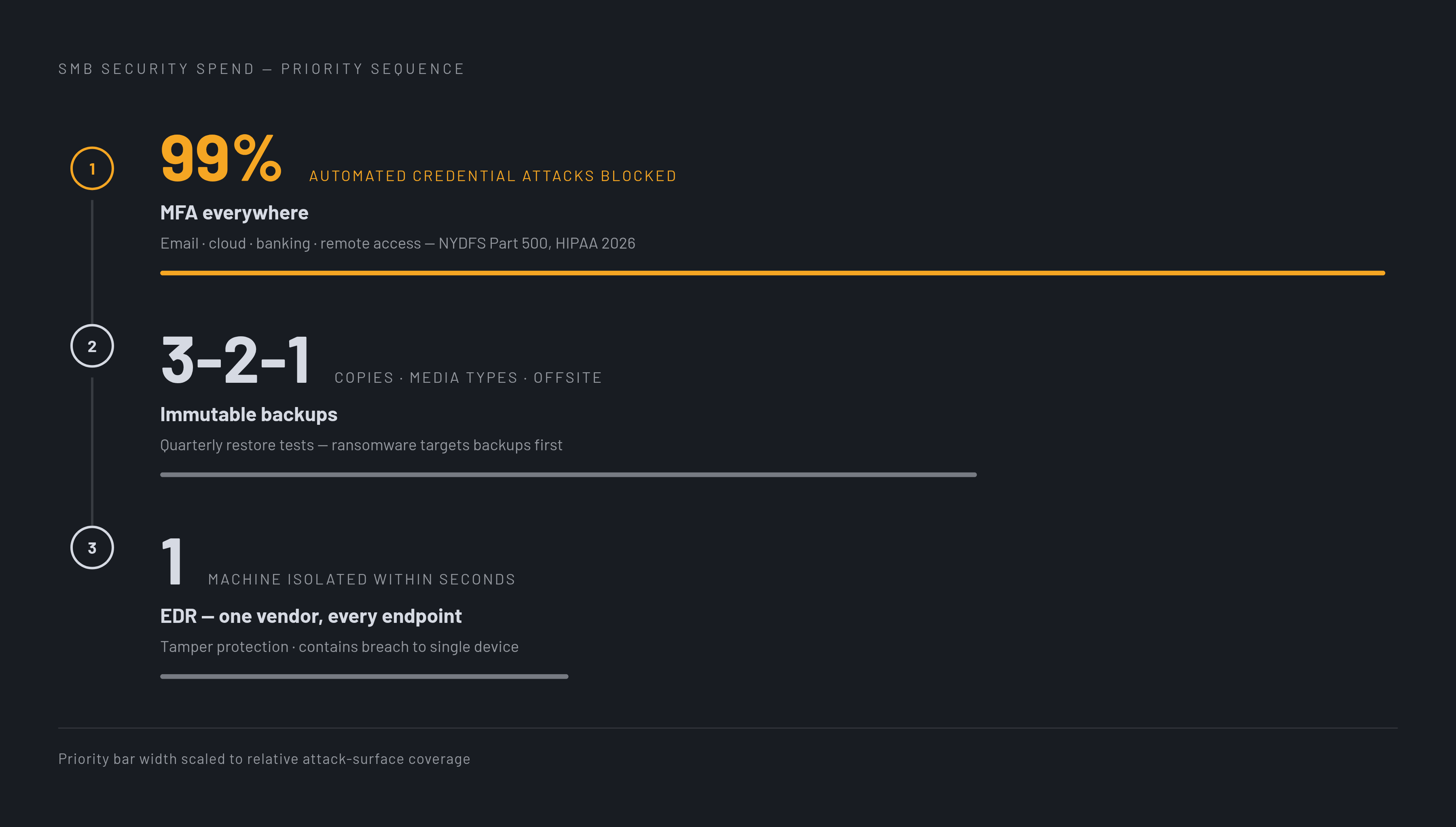
The first dollar goes to MFA. Turn it on everywhere access to something sensitive exists: email, cloud storage, banking, accounting software, remote access into the network. MFA blocks more than 99% of automated credential attacks, and those automated attacks drive the majority of small business breaches. Securafy and Cyber Advisors both align on phishing-resistant MFA, FIDO2/WebAuthn or device-bound passkeys for critical apps, as the highest-leverage single control. This is one of the rare security investments that satisfies a legal requirement while reducing real breach risk. NYDFS Part 500 and HIPAA's 2026 update both mandate MFA explicitly, so the first dollar spent here checks a compliance box and closes the door attackers use most often, at the same time.
The second dollar goes to backups. Automated backups with offsite storage, following the 3-2-1 rule, three copies of data, on two different media types, with one copy stored offsite, protect against ransomware, hardware failure, and physical disasters alike. Those backups need to be immutable so they cannot be altered or deleted even by someone with administrative access, and they need regular restore testing, not just a backup job that runs quietly in the background and is never actually verified. Ransomware crews specifically hunt for backup systems to disable before they ever trigger the encryption stage of an attack, so immutability is not a nice-to-have feature here. Quarterly restore tests are what produce actual proof, for a business and for an auditor, that disaster recovery works when it is needed rather than in theory.
The third dollar goes to endpoint detection and response, EDR. It is the single most impactful paid security tool available to a small business, and the standard is to run one vendor across every endpoint in the organization, with tamper protection and one consistent policy, rather than splitting coverage across several tools bought at different times. A strong EDR deployment can isolate a compromised device from the rest of the network within seconds, cutting off lateral movement before ransomware has a chance to spread from one machine to the rest of the company. That speed can keep an incident contained to one laptop instead of spreading to take down the whole network.
MFA, immutable backups, and EDR, in that order, form the floor. Together they answer the two pressures already on the table: a regulatory calendar with no more grace periods left in it, and attackers who are faster, better organized, and increasingly targeting the exact businesses least equipped to notice them in time.
Sources
- Managed IT for Cybersecurity Compliance: What Regulated SMBs Need in 2026
- SOC 2 Compliance Software: 10 Platforms Ranked (2026 Guide)
- How to Choose SMB Cybersecurity Support in 2026
- Cybersecurity Trends Every SMB Must Prepare For in 2026
- Salesforce Security Enforcement in 2026: Every Change, Date, and What Admins Must Do