Evidence Mapping Accuracy Between Security Controls and Audit Framework Requirements
Most organizations have the controls but lack the timestamped records auditors require.
Picture a control that works exactly as intended: access gets revoked the day someone leaves, changes go through review, incidents get logged and closed. Now picture an auditor asking for proof it happened that way in March, or in July, and finding nothing that ties the event to a system, a timestamp, and a name. That gap, not a missing control, is what actually sinks audits. The most commonly cited reason for failed compliance audits is incomplete or poorly organized evidence, not missing controls and not bad policies. Swimlane's GRC research found that 71% of companies admit their compliance programs fall short, and more than half still lean heavily on manual processes, which points to a systemic pattern rather than a string of one-off oversights.
The distinction changes what a team does next. A team convinced it has a control problem starts writing new policies and buying new tools. A team that correctly diagnoses an evidence gap does something different: it instruments the controls already in place so they leave a trail. Evidence collection is not a cleanup task squeezed into the week before an audit opens. It has to run as an ongoing engineering discipline, operating in parallel with the controls themselves, all year, not just during the weeks someone remembers an audit is coming.
E|The three-layer chain between requirements, controls, and evidence
Auditors work down a chain with three links: requirement, control, and evidence. If any one link breaks, the other two become invisible, no matter how well-designed they are. The requirement is the legal or framework mandate, the definition of what compliance actually means for a given organization. The control is the internal policy or technical safeguard built to satisfy that mandate. The evidence is the verifiable, timestamped proof that the control operated the way it was designed to.
ISO 27001 Clause 7.5 draws a distinction that lines up neatly with this chain and clarifies where teams actually get tripped up. Documentation describes how a control is supposed to work, laid out in policies, procedures, and standard operating instructions. Records are the logged outcomes of what actually happened: access logs, approval trails, monitoring output, incident reports. Evidence is whatever gets pulled during an audit to confirm the control is in place and functioning, which in practice usually means the records themselves get surfaced as the evidence.
The break auditors find most often sits between records and evidence, not between documentation and records. The control exists and is written down. But the records it should be generating are missing, incomplete, or impossible to correlate to a timestamp, a system, and an authorized person, which is the exact standard auditors are now applying. A policy that says "we review access quarterly" is documentation. A spreadsheet with four dated rows, each tied to a named reviewer and a specific account, is evidence. Most organizations have plenty of the first and not nearly enough of the second.
Cloud environments make this a many-to-many mapping problem, not a checklist
Most teams start compliance work assuming a clean one-to-one relationship: one control, one piece of evidence, done. Cloud environments break that assumption almost immediately. A single control can depend on identities, logs, network paths, workload configuration, and process evidence all at once, and a single cloud setting often only partially satisfies several different requirements at the same time.
The NIST AC-2 control makes this concrete. On paper, AC-2 sounds almost trivially simple: manage accounts and access. In practice, satisfying it means pulling evidence from IAM roles, single sign-on, federation, workload identities, automated account lifecycle rules, periodic access reviews, and activity logs, all at once. An auditor reviewing AC-2 isn't reading policy language closely. The auditor wants to see who had access, why they had it, and exactly when that access changed.
This is where a lot of teams get a false sense of security. A cloud service provider or a CSPM tool might map one setting to one control and call it done. That mapping doesn't prove the requirement is actually met, and it doesn't even confirm the control applies to that particular workload in the first place. Applicability, not the mapping exercise itself, is the genuinely hard part. Teams that treat a vendor's compliance report or a CSPM dashboard as sufficient proof tend to drift into duplicate controls that look equivalent on paper but aren't, which opens gaps during the audit, muddies who owns what, and makes exception handling inconsistent from one case to the next. Audit failures in cloud environments trace back to scope, ownership, and evidence lifecycle far more often than to control selection. If assets, exceptions, identities, and findings aren't tied to live cloud state as it changes, the team ends up trying to reconstruct what actually happened during the audit itself, which is the worst possible time to be doing that work.
The point-in-time trap turns working controls into audit liabilities
A control that fires once and leaves no proof of running consistently might as well never have run, at least from where an auditor sits. The AICPA's updated SOC 2 guidance calls this the completeness and accuracy principle: evidence has to show the control fired consistently across the entire audit window, not just once. For a Type II engagement, that window typically runs 12 months. A single access review screenshot from November proves nothing about January through October.
NIS2 Article 21 enforcement extends this expectation beyond SOC 2: supervisory authorities expect organizations to demonstrate continuous risk management processes rather than point-in-time snapshots, and by mid-2026 supervisory reviews against those requirements are actively under way. PCI DSS v4.0, effective since March 2024, adds a layer that makes point-in-time collection even harder to fake retroactively: QSAs now check not just whether evidence exists but whether that evidence links back to a documented risk analysis justifying the specific control implementation a team chose. Provenance matters as much as presence.
The cost of getting caught in this trap is measurable. Teams that only collect evidence once an audit gets announced face a four-to-eight week reconstruction effort per cycle. Continuous monitoring compresses that same work into days rather than weeks. Once that math becomes visible to a security team, the decision to automate narrows to a single question: proving that a policy actually operated, week after week, across all 52 weeks of the year.
The multi-framework burden for teams managing SOC 2, NIS2, GDPR, and other overlapping frameworks
Few organizations today answer to just one framework. Most lean teams are juggling SOC 2, NIS2, and GDPR at the same time, and each one has its own evidence categories with its own rules for what counts. SOC 2 Type II requires evidence across whichever Trust Services Criteria a company has chosen; Security is the only mandatory category out of five, while Availability, Processing Integrity, Confidentiality, and Privacy stay optional. The gaps auditors cite most often cluster around a familiar set of records: user access provisioning and deprovisioning logs under CC6.2 and CC6.3, and change management records tied to specific ticket references under CC8.1.
NIS2 asks for more than SOC 2 does: its Article 21 requirements explicitly call for supply chain security assessment records and cybersecurity training completion logs, proof that employees actually finished the training. National transposition adds another wrinkle: Germany's updated BSIG, France's NIS2 transposition, and Romania's implementation each carry local specifics that change what counts as sufficient evidence in that jurisdiction.
GDPR operates on a different clock. Article 5(2)'s accountability principle functions as a permanent, standing evidence mandate: Records of Processing Activities, Data Protection Impact Assessments, consent records, and data subject request logs all need to be retrievable the moment a supervisory authority asks. EU Data Protection Authorities have issued fines specifically for the inability to produce that evidence, separate from fines over the underlying violation itself.
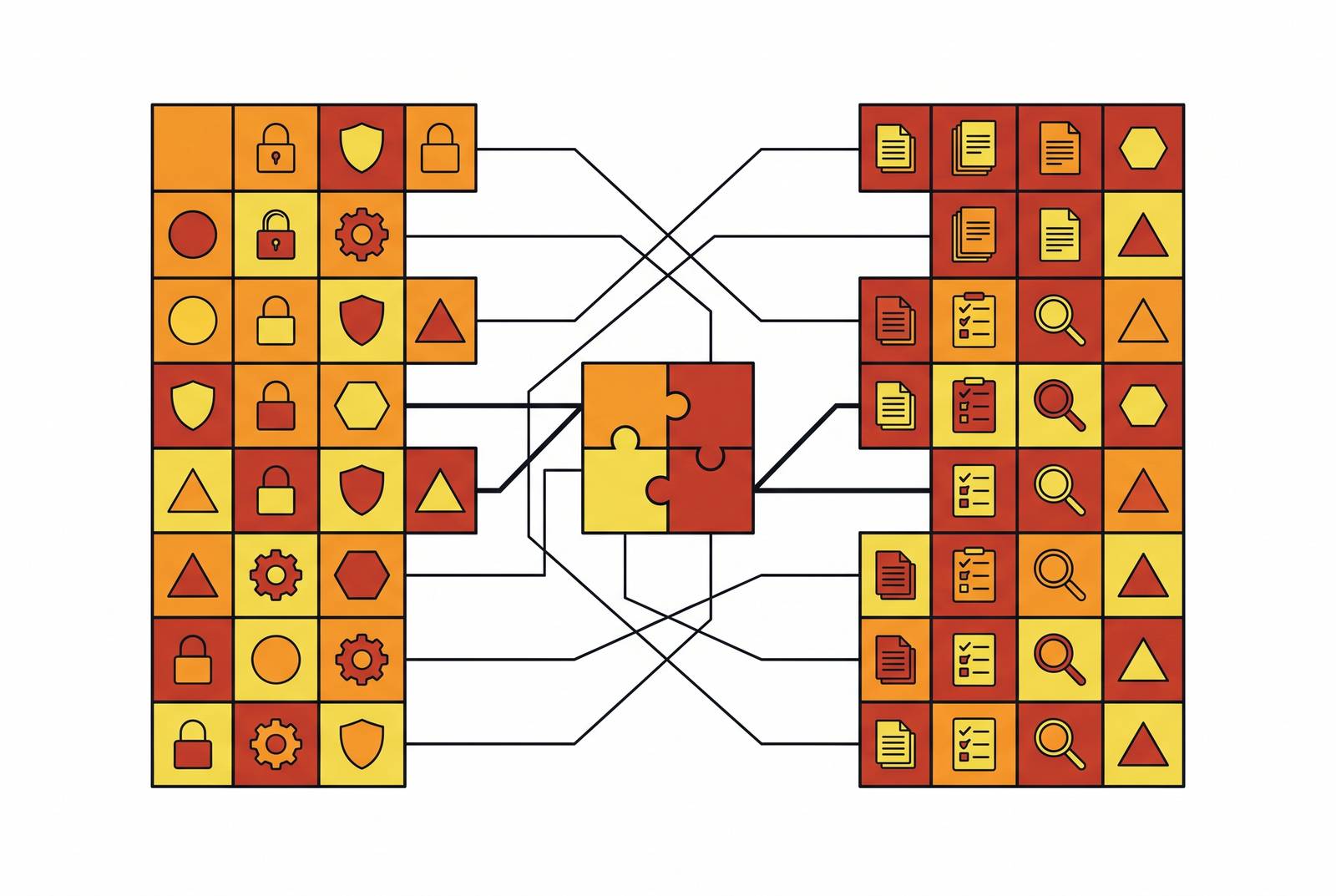
That pile of overlapping requirements contains the actual efficiency play. Many frameworks share nearly identical requirements around access management and encryption. A well-built MFA implementation can satisfy both PCI DSS and HIPAA with the same piece of evidence, but only if that evidence gets mapped to both requirements at the point it's collected, not stitched together retroactively during an audit. Organizations running both SOC 2 and NIS2 programs get the most value from a unified control taxonomy that maps a single piece of evidence to both frameworks' requirements at once, cutting out duplicate collection work entirely.
Why manual evidence collection fails structurally, not just operationally
Manual evidence collection doesn't fail because the people doing it are careless. It fails because the process is built to reconstruct the past instead of capturing the present, and reconstructing the past is exactly the opposite of what an auditor needs. The Konfirmity analysis puts a number on what that costs: organizations without structured evidence collection spend 550 to 600 hours a year managing compliance reactively, scrambling to piece documentation back together during vendor assessments or certification audits. Continuous collection eliminates that scramble.
There's a chain-of-custody problem baked into the manual approach that's easy to miss. Teams that manually export CSVs from an identity provider and paste them into a spreadsheet create a chain of custody problem before the audit even begins, since the auditor cannot verify the data was not altered between export and presentation. And when evidence, control intent, and test method each live in their own separate register instead of one system of record, teams drift into duplicate controls that look equivalent but aren't, leaving gaps during audit, blurring ownership, and turning exception handling into a guessing game.
The consequences reach past compliance and into revenue. Enterprise procurement teams now demand evidence-based security validation before they'll sign a contract. Vendors sitting on organized evidence repositories can answer a security questionnaire in days. Vendors that can't produce the evidence face longer evaluation cycles, weaker negotiating position, and a real chance of getting disqualified outright. A common objection here is that continuous collection costs more than an occasional audit warrants, especially for a small team. That math doesn't hold up: continuous collection carries a front-loaded cost that flattens out afterward, while reactive reconstruction gets more expensive with every audit cycle, every procurement questionnaire, and every regulatory inquiry, and it carries a real chance of producing evidence an auditor simply rejects.
What a structured, continuous evidence collection discipline requires
Closing the gap means building an evidence pipeline that captures, timestamps, and links records to specific control requirements as a matter of routine, running continuously rather than bolted onto the calendar right before an audit. It has to be infrastructure, built into how controls run day to day.
The three-layer chain of requirement, control, and evidence needs to work as a living mapping rather than a document that gets updated once and forgotten. Every control needs an owner, a defined test method, and a specific evidence artifact tied to it, and those three pieces need to live together in the same system of record rather than scattered across separate tools. Because what auditors increasingly reject now is evidence that can't be tied to a timestamp, a system, and an authorized actor, the pipeline has to capture all three of those attributes the moment evidence gets collected, not later when someone's assembling a folder for the auditor.
ISO 27001's Annex A gives a useful structure for organizing the work: controls sorted into four domains, organizational, people, physical, and technological, each needing proof of both implementation and ongoing operational effectiveness. The Statement of Applicability, which documents which controls apply and why any were excluded, counts as a required evidence artifact in its own right.
In practice, a structured program has to instrument several categories at once: access control records covering provisioning, deprovisioning, and quarterly reviews with manager sign-off; configuration change logs tied to specific tickets; monitoring output correlated to actual review activity; training completion records that are timestamped rather than assumed; incident records that show detection-to-resolution timelines rather than a tidy summary written after the fact; vendor risk assessments refreshed on a set schedule for every in-scope third party; and risk assessment records that document the reasoning behind each control choice, which PCI DSS v4.0 requires outright and NIS2 increasingly expects. Version-controlled policies belong on that list too. A policy carrying documented senior management approval, a publication date, a review schedule, and a record of who it was communicated to isn't just paperwork sitting next to the real evidence: it's evidence on its own, provided the version history tracks what changed, why it changed, and who signed off on it.
None of this is exotic.