CIS Benchmark Compliance Evidence Generation in Endpoint Management Platforms
Automating compliance evidence generation across thousands of endpoints.
CIS Benchmark compliance evidence generation is an automation problem dressed up as a security problem. Getting an endpoint configured correctly is the easy part; proving it, continuously, across thousands of machines, is where manual processes fall apart, and where modern endpoint management platforms have quietly become the only workable answer.
What CIS Benchmarks require of an endpoint
The Center for Internet Security is a nonprofit, and its benchmarks are the closest thing the security world has to a shared rulebook. They're built by consensus, drawing on a global community of cybersecurity professionals, and they're accepted across governments, businesses, industries, and academia as a baseline for what "secure configuration" actually means.
People tend to conflate two different things CIS puts out. CIS Controls are 18 prioritized cybersecurity best practices that form a broader organizational roadmap. CIS Benchmarks are something else entirely: technology-specific, prescriptive configuration guidance for individual platforms, whether that's an operating system, a cloud service, a database, a Kubernetes cluster, or a network device. The two aren't competitors. Controls set the governance structure, and Benchmarks supply the technical detail needed to actually implement each control on a real machine.
The coverage is wide. Every benchmark comes in two implementation levels, matched to how much risk an organization can stomach. Level 1 is the practical minimum, something you can deploy without meaningfully hurting system functionality. Level 2 goes further, adding defense-in-depth controls meant for high-risk or heavily regulated environments, though some of those controls can cut into performance or usability, which is why CIS recommends testing them in a non-production environment first. Most organizations start at Level 1 and layer in Level 2 selectively, wherever the added protection is worth the operational trade-off.
There's real regulatory value here too. PCI DSS requirement 2.2 explicitly points to industry-accepted hardening standards, and CIS Benchmarks qualify. HIPAA, ISO 27001, and the NIST Cybersecurity Framework all accept CIS Benchmarks as baseline documentation, while FedRAMP will take them as a substitute for STIGs, but only at Impact Level 2, not above it.
CIS Benchmarks and STIGs get mentioned in the same breath a lot, but the line between them is worth drawing. STIGs are typically a DoD requirement, tied to that supply chain, while CIS Benchmarks serve a much broader commercial audience. Different crowd, similar technical goal.
CIS alignment is one input into a compliance program, not the whole program. An auditor examining your posture will still want access reviews, change management records, incident response procedures, and vendor risk assessments, none of which live inside a device's configuration file. Tanium's documentation states that coverage is broad, spanning over 100 secure-configuration templates across more than 25 vendor product families. There are two implementation levels, matched to risk tolerance.
The volume and variability of benchmark requirements that make manual compliance unworkable
Start with the raw page count. A single benchmark document runs roughly 800 pages and carries more than 300 recommendations, according to ManageEngine's documentation, with some benchmarks running past 1,000 pages of configuration guidance per Dynatrace's knowledge base, for one platform alone. That's one document, for one platform. Now multiply that by every operating system, cloud service, and application in a typical environment, and the idea of a person reading through all of it, let alone applying it by hand, starts to look absurd.
Modern environments don't make this easier. They span cloud platforms, Kubernetes clusters, databases, operating systems, SaaS applications, and identity services, and each of those layers comes with its own set of security recommendations, configuration requirements, and compliance checks. A Windows workstation, a Linux server, an AWS account, and a Kubernetes cluster sitting in the same environment each carry a completely separate benchmark document, with different scored controls and different remediation steps.
Configuring all of that by hand is slow, and it's the kind of task where a single missed checkbox multiplies across every machine it touches. Organizations running large, varied infrastructures struggle to keep configurations consistent across the board, and that inconsistency raises misconfiguration risk.
The failures visible in a scan report are usually symptoms, not root causes. An incomplete asset inventory means a host, a container, or a SaaS tenant never even gets catalogued, so it never gets scanned in the first place, a gap that maps directly to CIS Controls 1 and 2. Patching delays mean a perfectly hardened image starts drifting the moment one unpatched component ships. The scan will flag it eventually, but the real problem is patch cadence, which falls under CIS Control 7. And then there's privilege management: over-permissive roles, missing multi-factor authentication, disabled audit logs. These are what CIS flags, yet almost nobody describes them as "misconfigurations" in casual conversation, even though that's precisely what they are under CIS Controls 5 and 8.
None of this is really a knowledge problem. Security teams generally understand what the benchmarks ask for. What breaks down is the operational discipline needed to enforce hundreds of settings, across thousands of endpoints, every single day, without a machine doing the heavy lifting.
Configuration drift and the false sense of security from a passing audit
A scan is a photograph, not a video feed. Periodic scanning tells you what your compliance posture looked like at one moment; continuous monitoring watches for changes as they happen and flags a setting the instant it drifts from baseline. That distinction sounds subtle. The distinction sounds subtle, yet it carries real weight.
Consider the timeline. A configuration change made on a Monday might not appear in a weekly compliance report until Friday. With continuous monitoring, that same change gets flagged within minutes, according to research from Decryption Digest.
Cloud-native environments make configuration drift worse, not better. Auto-scaling groups, ephemeral containers, and infrastructure-as-code pipelines change configurations constantly, often without a human directly touching a keyboard. Kubernetes pods spin up and shut down within minutes, and cluster configurations shift through GitOps workflows or automated scaling policies that nobody manually reviews line by line. Traditional periodic scanning simply cannot keep pace with that rate of change. It's not a matter of scanning more often; it's an architectural mismatch between how these systems behave and how the scanning tool was built to check them.
Drift isn't a hypothetical edge case. It's structurally guaranteed in any environment where systems get patched, reconfigured, or scaled, and where developers make changes outside a formal hardening process, which is to say, in every real environment. The security consequence is straightforward: the window between when a misconfiguration appears and when someone detects it is exactly the window an attacker gets to exploit it. That's a very real environment. It's an operational one, measured in days or minutes depending on how the monitoring is built.
This changes what a compliance report actually means. A report generated from a periodic scan certifies that systems passed at the moment of the scan, not that they're compliant right now, as the reader reads it. Auditors are catching on to that distinction, and so are insurers pricing cyber risk.
The contents of audit-ready CIS evidence
A passing scan is not evidence. Auditors reviewing CIS alignment as part of a SOC 2, HIPAA, or PCI DSS engagement want documentation that ties specific configuration findings to specific controls.
Complete evidence starts with an asset inventory: a verified list of every in-scope endpoint, its system type, its operating system, and which benchmark version was applied to it. From there, you need a baseline definition, spelling out which CIS Benchmark level (Level 1 or Level 2) was selected and the rationale, along with any controls that were tailored or excluded and their documented compensating controls. Then come the assessment results themselves: pass/fail status for every scored recommendation, timestamped at the moment of assessment, not aggregated into a vague summary. Historical change records matter just as much, showing that drift was caught and fixed, not just that systems happen to pass today. And wherever a control wasn't implemented, exception documentation needs to spell out why, and what's covering that risk instead.
A multiplier effect operates here. For organizations subject to multiple frameworks, evidence that maps a single CIS control to its HIPAA, PCI DSS, FedRAMP, or NIST equivalents eliminates the need to collect separate evidence for each framework. That cross-mapping is where CIS alignment starts paying for itself well beyond the original scan.
SteelCloud's practical guide lays out a seven-step sequence, baseline, gap assessment, prioritize, harden, validate, document, monitor, and each of those steps produces its own distinct category of evidence an auditor will go looking for. Skipping a step leaves a hole in the evidence trail, not just a hole in the hardening.
Assembling all of this by hand, across hundreds of endpoints and several benchmark versions, means collecting, timestamping, cross-referencing, and formatting evidence manually. That's a task that overwhelms spreadsheets and good intentions. It's the specific operational problem that makes automation necessary rather than a nice-to-have.
How endpoint management platforms automate the scan-detect-report cycle
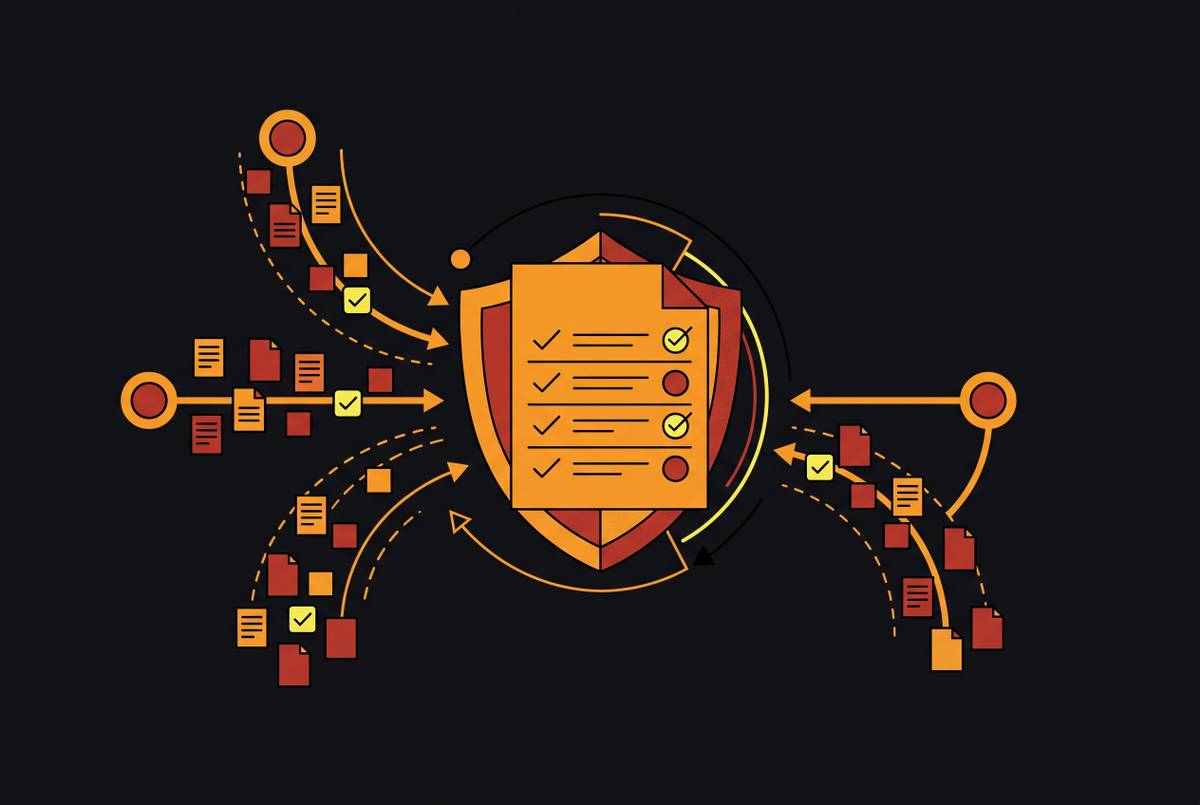
The shift purpose-built platforms bring isn't cosmetic. Instead of the old manual cycle, download the benchmark, run a script, collect the output, format a report by hand, these platforms run a continuous loop: agent-based telemetry, automated comparison against benchmark policy, drift detection, and evidence packaging, all without a human re-triggering each step.
Three layers separate a credible platform from a glorified script runner. Second, drift detection and alerting, flagging a deviation from baseline the moment it happens, with enough context, which control, which system, when it changed, to actually act on it and document it. Third, audit-ready reporting: outputs that map findings to specific CIS controls, carry timestamps, and can be filtered by framework, asset group, or time window.
Remediation separates the platforms from the tools that merely watch. Being able to apply a fix automatically, or with a single approval, closes a loop that scanning alone never closes. The control doesn't just get flagged and left sitting in a dashboard; it gets fixed, and that fix becomes part of the evidence trail itself.
Pre-built policy libraries save a huge amount of the translation work. ManageEngine's Vulnerability Manager Plus, for example, ships with compliance policies derived directly from CIS Benchmarks, so nobody on staff has to manually turn an 800-page document into a set of scannable rules. Integration matters just as much on the output side. Netwrix pushes compliance data into ServiceNow and Splunk through REST API and syslog, meaning that evidence lands directly inside the workflows audit teams already use, instead of sitting in a separate silo somebody has to remember to check.
Container environments need their own answer, since they move faster than anything a scheduled scan can track. Dynatrace's Kubernetes Security Posture Management enables CIS Kubernetes standards by default, assessing cluster configurations against the CIS Kubernetes Benchmark automatically and logging configuration data as compliance events in Dynatrace Grail for close to real-time visibility. That's the clearest illustration of a broader point: ephemeral infrastructure demands an always-on posture rather than a scheduled check-in.
What these platforms ultimately deliver isn't just detection. It's a complete, timestamped evidence trail that holds up when an auditor starts asking pointed questions about a specific control on a specific date.
A practical look at the platforms available for CIS benchmark compliance and evidence generation
The landscape splits fairly cleanly by what a team actually needs: a one-time assessment, continuous compliance, or a broader platform with CIS built in as one module among several.
On the official and open-source side, CIS-CAT Pro is the authoritative tool, available to CIS SecureSuite members, and it produces HTML reports showing pass/fail status for every scored recommendation, along with JSON reports limited to failed checks. It's built for initial assessments and periodic compliance reporting, not for continuous monitoring, real-time drift detection, or remediation automation, those require a different kind of architecture entirely. OpenSCAP is a Linux-focused open-source alternative with SCAP content derived from both CIS and DISA STIGs, making it a solid assessment layer inside a larger stack. Decryption Digest recommends stacking these tools: use CIS-CAT Pro or OpenSCAP for assessment, Ansible or Group Policy for remediation, and layer continuous monitoring on top so hardening doesn't quietly decay over time. These aren't rivals competing for the same job; they're pieces meant to sit together.
Among purpose-built continuous compliance platforms, CISGuard focuses specifically on continuous CIS monitoring with on-premises deployment, covering 22 CIS benchmarks and 3,933 individual security controls, according to a comparison published at cisguard.ae. Remedio, formerly known as GYTPOL before its September 2025 rebrand, takes an AI-driven approach to device security posture management. It integrates with ServiceNow, CrowdStrike, and Microsoft Defender for Endpoint, raised a substantial Series A led by Bessemer Venture Partners in September 2025, and runs across roughly 25,000 devices for Carlsberg on Azure-based infrastructure. Its customer list includes Amazon, Coca-Cola, Kraft Heinz, Eaton, and Colgate-Palmolive, and it landed on Gartner's 2025 Cool Vendors list for Cyber-Physical Systems Security.
Broader vulnerability management platforms fold CIS compliance in as one capability among several. Qualys Policy Audit, formerly called Policy Compliance, is a cloud-native module inside the wider Qualys platform, with wide CIS benchmark support across operating systems and applications, and agent-based continuous assessment is available. Its drift detection, though, needs custom policy configuration to work well and isn't as automatic out of the box as what the purpose-built tools offer.
None of these options is a universal right answer. A Windows workstation, a Linux server, an AWS environment, and a Kubernetes cluster each carry separate benchmark requirements, since the applicable benchmark document differs by asset type and function. Purpose-built CIS compliance platforms are among the platforms available for CIS benchmark compliance and evidence generation. Broader vulnerability and compliance platforms with CIS modules are also among the platforms available for CIS benchmark compliance and evidence generation.
Sources
- What is CIS Benchmarks?
- CIS Benchmarks Explained: A Practical Implementation Guide
- What is CIS compliance? Top controls you can’t ignore | Tanium
- Remedio
- CIS Compliance | Comply with CIS Benchmarks - ManageEngine Vulnerability Manager Plus
- How to Harden Servers and Endpoints Using CIS Benchmarks 2026
- CIS benchmark tool: what it is, how it works, and why continuous monitoring matters
- Best CIS Benchmark Tools 2025 Compared | CISGuard