Operational Overhead Comparison Between Managed and Self-Hosted SIEM Deployments
Self-hosted SIEM costs far more than the software license alone.
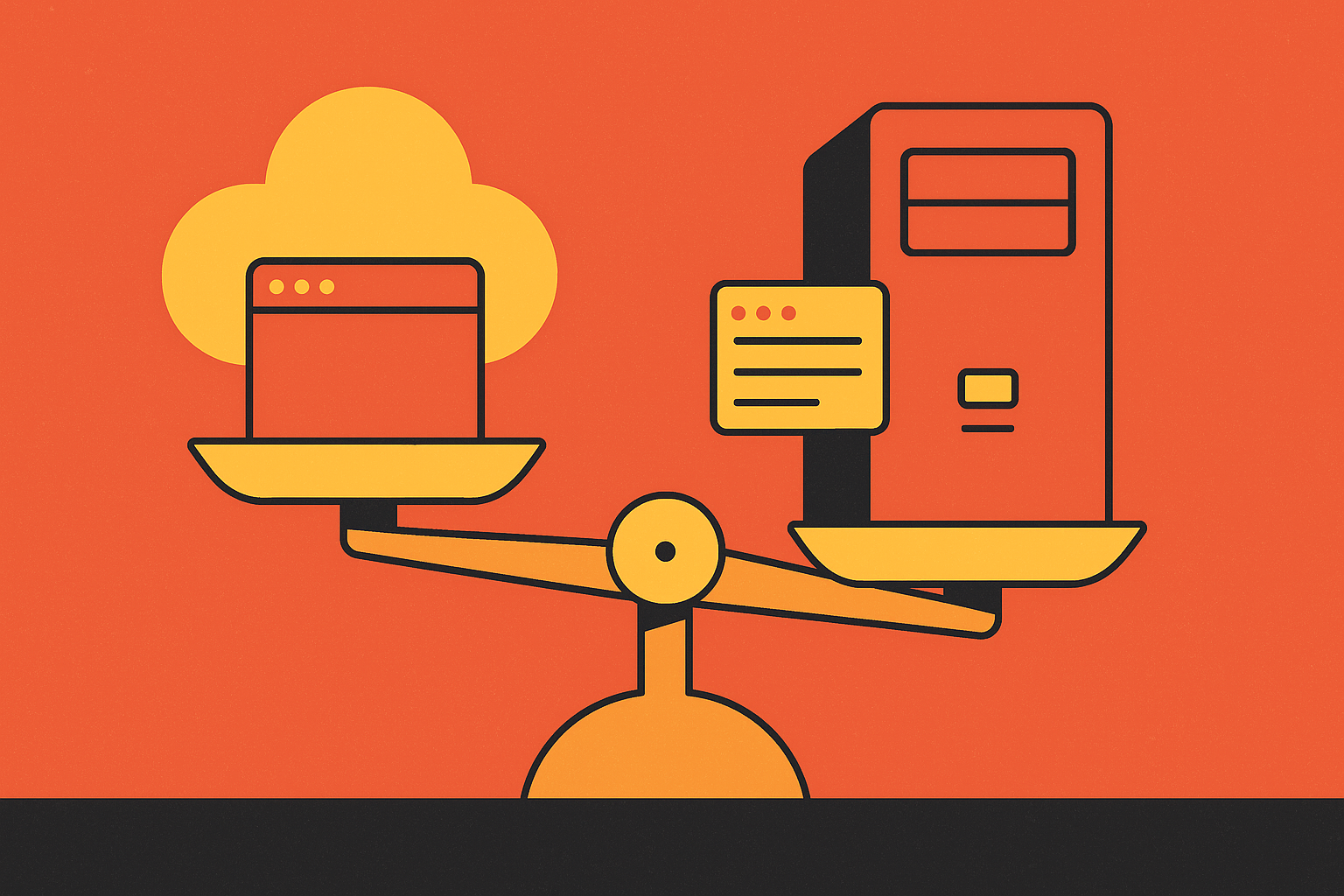
Most organizations evaluating SIEM deployment models compare the wrong number. The platform license is only a fraction of what it costs to run a self-hosted deployment. Managed SIEM is a service that pairs SIEM technology with ongoing expert management: the provider hosts the infrastructure, handles deployment and integration, maintains detection logic, and monitors the environment on the customer's behalf. Self-hosted SIEM gives you the same visibility and detection, but your team has to connect every data source, write and tune the correlation rules, investigate every alert, and keep the system current. A full cost comparison needs six categories, not one: platform licensing, SOC staffing, log storage, false-positive triage, tuning and rule maintenance, and compliance reporting overhead. The gap between the sticker price and what it actually costs to run is what makes self-hosted deployments a poor fit for organizations without a dedicated security team already in place to operate them.
SOC staffing: the cost category that makes self-hosting a staffing problem first
Self-hosted SIEM is mainly a commitment to build and run a security operations function, and that is where the cost concentrates. A SIEM platform does not monitor itself: someone has to watch the console, triage what it flags, and decide what gets escalated. That someone needs training, needs to be available at odd hours, and needs backup when they're out sick or on vacation.
The global cybersecurity workforce shortage makes this harder, not easier. Demand for qualified analysts far outpaces the supply of people who can do the job, which drives up both the difficulty of hiring and the wage an organization has to offer to compete for talent. If you try to build this function from scratch, you compete against every bank, hospital, and tech company that is doing the same thing.
Managed SIEM moves this entire burden onto the provider. The provider's analysts triage, validate, and escalate alerts, so you get confirmed incidents, not a raw feed to sort through. Round-the-clock monitoring comes built into the managed model. With self-hosted SIEM, 24/7 coverage means internal staffing or shift rotations, which is a different proposition entirely for a five-person IT team than it is for a large enterprise security department.
If you don't have a dedicated security team, the staffing requirement is often what decides the whole deployment. That's why platforms like Zip Security sell themselves as a technology-first stand-in for hiring security staff or an MSP, taking on the enforcement and monitoring that would otherwise need internal analysts or shift coverage.
Log storage: where self-hosted volume costs become unpredictable
Log storage costs in a self-hosted deployment scale with the environment in ways that are hard to predict when the budget is first drawn up, and expensive to absorb once the environment grows. The bill tends to surprise people who only priced out the software license.
Cloud workloads, SaaS sprawl, and hybrid infrastructure each generate their own stream of telemetry, and the SIEM has to ingest, normalize, and store all of it. Every new tool you add to the environment adds to that ingestion load. A company that adds a new cloud provider, a new SaaS app, or a new office location is also adding to what the SIEM has to process and keep, whether anyone budgeted for it or not.
A self-hosted SIEM requires the internal team to provision and manage the infrastructure underneath it: compute instances, database hosting with backup capability, storage, and redundancy built for production reliability. Even if you pick an open-source SIEM with no license fee, you still pay for this storage infrastructure. Zero dollars for the license does not mean zero dollars for the deployment.
Managed SIEM providers fold storage infrastructure into a predictable subscription, so you never have to provision, scale, or maintain it yourself. That's the core difference in cost structure between the two models: managed SIEM runs on a predictable subscription, while self-hosted SIEM runs on a variable bill that covers infrastructure and staff both. In contrast to the variable infrastructure costs of self-hosted SIEM, managed solutions absorb storage and compute scaling into a predictable subscription, a structural advantage that extends to any integrated security platform built to handle device, identity, and compliance data together without forcing the organization to provision and scale infrastructure on its own.
False-positive triage: how alert volume becomes a tax on internal analysts
If self-hosted SIEM runs without expert triage, alerts eat analyst time whether or not they turn out to be real threats. For organizations without dedicated security staff, every one of those hours comes out of time that would otherwise go toward running the business.
A self-hosted SIEM generates alerts that internal staff have to work through one by one. If no expert filters the alerts first, the raw volume lands on whoever is watching the system. Behavioral alerts make this worse, because they require context a machine can't supply on its own. A login from a new location could be an employee traveling for a conference, or it could be a compromised credential. The log entry alone doesn't say which. Without someone who can supply that context, staff end up investigating alerts that should have been closed as noise, and that work eats into the time left for the alerts that actually matter.
Managed SIEM answers this with a structural fix: provider analysts handle the filtering as part of the service. Provider analysts review and validate every alert before it reaches you, so you get a prioritized incident, not a pile of raw alerts. That triage and investigation stage, where a human analyst weighs context, severity, and relevance to the organization before escalating anything, is where most providers actually differentiate themselves, and it's the step that cuts the most noise before it ever reaches the customer. Most self-hosted deployments stop at detection: the system generates the alert and leaves the internal team to do the rest. The real difference between the two models lives in that gap between detection and response.
For an organization without a dedicated security function, every hour spent triaging false positives is an hour a founder, an IT generalist, or an operations leader isn't spending on the job they were actually hired to do.
Tuning and rule maintenance: why a SIEM configured once degrades quickly
If you don't keep tuning a self-hosted SIEM, it loses effectiveness over time. Detection quality decays as the environment changes and the threat landscape shifts. The initial deployment cost is only the opening expense.
Correlation rules need updating as threats evolve. Alert thresholds need recalibrating as the environment changes. Data sources need ongoing monitoring to confirm the right logs are flowing in at the right volume. Every tool added to the environment changes what the SIEM has to ingest, normalize, and correlate, so a ruleset that was accurate on day one grows less accurate as the environment grows around it. Threat intelligence updates follow the same pattern: in a self-hosted model they're manual and depend on whoever's on staff to apply them, while in a managed model they happen automatically as part of the provider's job.
This runs into the same scarcity problem as staffing the SOC. The people capable of tuning correlation rules against an evolving threat landscape are the same scarce security engineering talent an organization would need to staff a monitoring function. An organization that can't hire for one usually can't hire for the other either.
The pattern plays out predictably: organizations buy a SIEM, configure it once, and watch detection quality slide within months because nobody is tuning the correlation rules to keep pace with a changing environment. Self-hosted deployments typically take months before they produce reliable output in the first place, since data sources have to be integrated, rules calibrated, and baselines established before the system is worth trusting, and that tuning work doesn't stop once deployment is done. Managed SIEM shifts this responsibility onto the provider, who maintains and updates detection logic, folds in new threat intelligence, and adjusts rule sensitivity as threats change, treating tuning as an ongoing job. A co-managed model splits the difference: the provider handles infrastructure and ongoing maintenance while the customer keeps a hand in rule configuration, distributing the tuning burden across both sides.
Compliance reporting: the overhead that multiplies when the SIEM isn't built for it
In a self-hosted SIEM, you have to configure compliance reporting yourself before an auditor will accept it. Managed SIEM typically ships with pre-built templates and automated evidence collection, so you skip that configuration work and cut the risk of an audit gap opening up unnoticed.
SOC 2, HIPAA, ISO 27001, and PCI DSS each require continuous monitoring evidence that an auditor checks directly. GDPR works a bit differently: it imposes an accountability obligation requiring organizations to document their compliance, but it does not explicitly mandate audits or third-party auditor verification of continuous monitoring the way the other four frameworks do. Either way, the SIEM functions as the audit trail. If it isn't configured to produce output that satisfies whichever framework applies, it becomes a liability.
With self-hosted SIEM, this configuration work falls to your team, because pre-built templates generally aren't part of the package. The team has to build its own reporting against whichever framework it's working toward. Elastic Security is a good illustration: it has limited native compliance reporting and typically needs significant internal configuration to produce audit-ready output. An internal resource spends real hours building and maintaining that reporting layer on top of everything else on their plate.
Managed SIEM usually includes compliance reporting by default, often with pre-built templates already built for common frameworks. Automating evidence collection from the security monitoring reduces or removes your internal configuration burden. None of these five categories, staffing, storage, triage, tuning, or compliance, creates the real cost gap on its own. Counted together, they separate the licensing price tag from what a deployment actually costs to run.
Overhead across both models
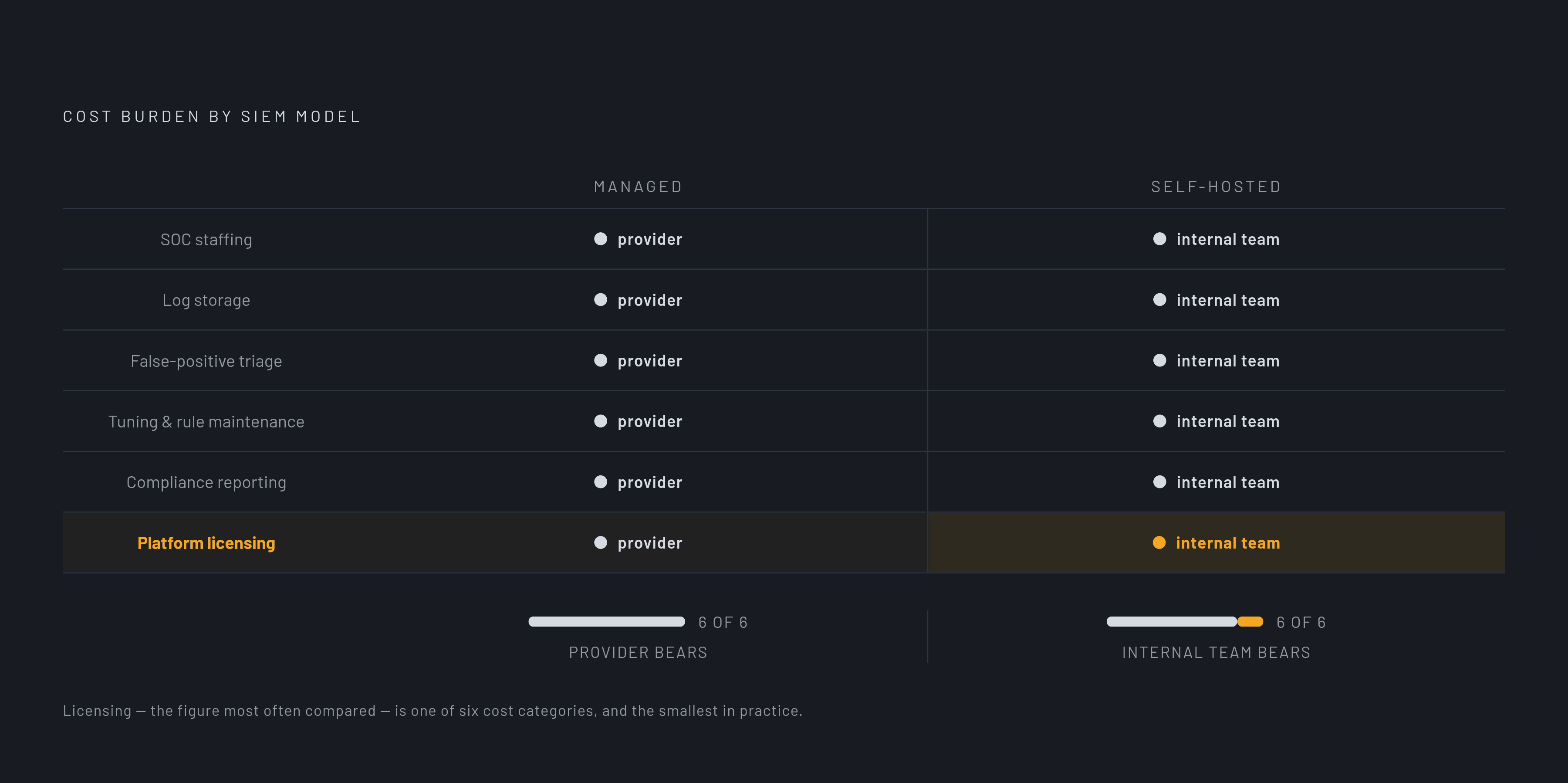
If you count all six cost categories instead of just the license fee, the operational gap between managed and self-hosted SIEM is large enough to change the deployment decision for most organizations that don't already have a dedicated security team.
Laid out side by side, the pattern holds across every category. Deployment is handled by the provider in a managed model, versus requiring an internal project in a self-hosted one. Tuning and maintenance run as an ongoing provider responsibility in one model and an internal team responsibility in the other. Managed SIEM comes with continuous monitoring built in, but if you self-host, you need internal staffing or shift coverage to match it. Alert triage is handled by provider analysts in one case and internal analysts in the other. Compliance reporting comes included, often with pre-built templates, in managed SIEM, while self-hosted SIEM requires configuring that reporting from scratch. Threat intelligence updates are automatic and vendor-managed under a provider, manual and team-dependent without one. Cost structure is a predictable subscription on one side, a variable bill covering infrastructure plus staff on the other.
None of these categories sits in isolation. If a SOC is staffed too thin, tuning gets skipped, so false positives pile up, so whatever internal staff exists spends its hours chasing noise instead of compliance reporting, so that falls behind until an audit finds the gap. Each category compounds the one before it, and the compounding is what a licensing quote leaves out.
Zip Security's approach to this problem is to fold the full security stack, device management, identity protection, and compliance, into one platform, specifically to close the hidden operational costs that self-hosted deployments tend to obscure. By bundling detection, response, and compliance automation instead of asking an organization to build and run each of those as separate functions, it narrows the distance between the number on the quote and what the deployment actually costs to operate.
For an organization without a dedicated security team already staffed and running, the honest comparison was never managed SIEM against self-hosted SIEM's license fee. It's managed SIEM against the full cost of hiring, storing, tuning, triaging, and reporting that a self-hosted deployment demands once all six categories are on the table.