Configuration Complexity of SIEM Onboarding in Mid-Market Managed Security
The months after installation matter more than the install itself in closing the SIEM readiness gap.
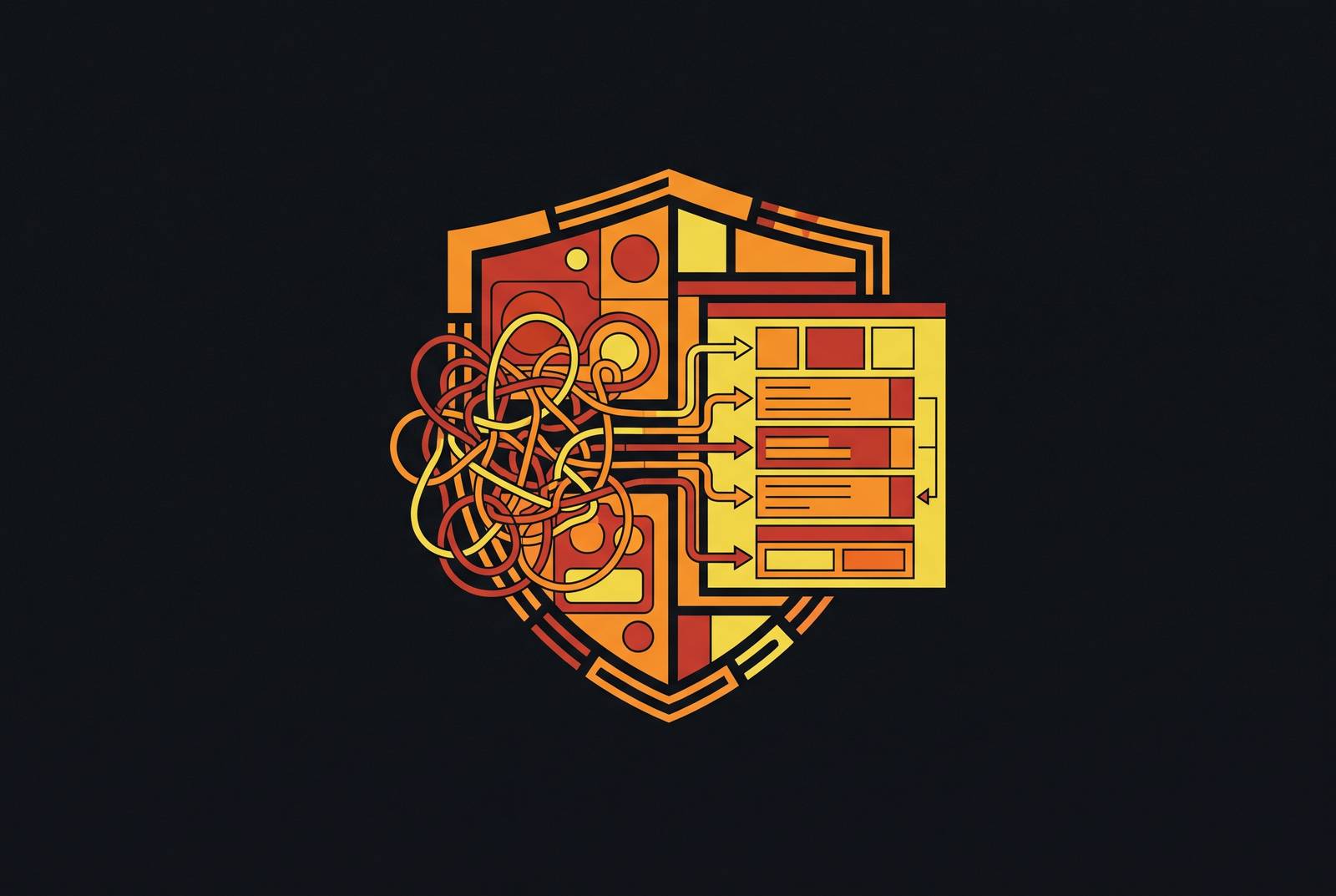
SIEM onboarding doesn't stall because the software is hard to install. It stalls because getting Splunk, Microsoft Sentinel, or QRadar to produce detections anyone can trust in a specific environment takes months of work that starts after the install finishes. For a resource-constrained team weighing a managed security option against a traditional MSP, the real question is who owns the months of tuning that come after turning the platform on.
SIEM onboarding fails at the operationalization stage, not the installation stage
A mid-market security lead can usually point to the moment the SIEM went live: logs flowing, dashboards populated, default rules enabled. Six months later, the same team often still can't answer a basic question: were we breached last week? The platform is running. It just isn't producing anything an analyst can act on with confidence.
Buying Splunk, Microsoft Sentinel, or QRadar gets an organization dashboards and a set of out-of-the-box rules. None of that is the same thing as security. The gap between "the SIEM is installed" and "the SIEM is useful" holds almost all of the real timeline, and most vendor quotes leave it out.
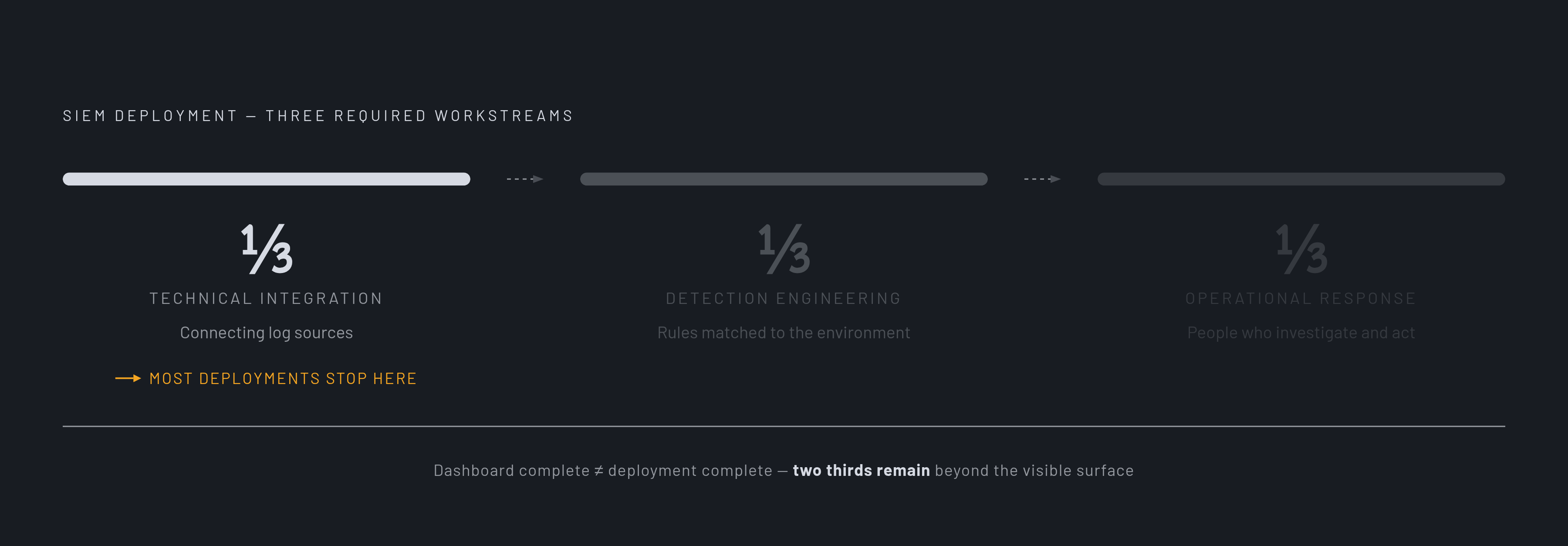
Closing that gap takes three separate workstreams, and none of them finishes on its own. Technical integration connects the log sources. Detection engineering writes rules that actually match the environment generating those logs. Operational response puts people in place who investigate what the rules flag and act on it. A deployment that only completes the first of these three has completed roughly a third of the real project, no matter how finished the dashboard looks.
Where onboarding time concentrates: six friction points
Delay in SIEM onboarding doesn't spread evenly across the project. It piles up in a handful of predictable spots, and a mid-market team that knows where to look can spot most of them before a contract gets signed.
Network and agent access approvals are the first bottleneck. Rolling out collectors and agents across a mid-market environment means crossing organizational lines, security committees, network teams, data owners, and each handoff adds its own delay before a single log source goes live.
Change-control windows create a second, uneven friction point. Organizations with formal change management absorb time at every integration milestone, because every change has to clear a review cycle. Smaller teams with looser processes move faster through this stage, but they often arrive at audit time without the documentation an auditor expects to see.
Data-owner sign-off is a third chokepoint, and it's one engineers can't route around. Regulated data, HR systems, finance systems: routing any of that into a centralized platform requires legal and privacy review before a single log line moves, and that review runs on its own clock.
OT and legacy infrastructure make up a fourth source of delay. Mainframes, proprietary line-of-business applications, and operational technology systems without a usable API all need custom connector work, and that work can run weeks per source rather than hours.
Thin internal staffing is a fifth, quieter problem. A mid-market engineer can usually get log forwarding working and flip on the default rules fairly quickly, often within days. The work that follows, tuning correlation rules, managing false positives, building detections specific to the environment, doesn't have a clear owner once that first sprint wraps and the engineer goes back to their regular job.
Undefined detection priorities round out the list, and this one is organizational rather than technical: if nobody can say what the SIEM needs to catch first, the project stalls in scope debates instead of moving through integration milestones.
The compliance layer adds weeks that most implementation timelines omit
Compliance work sits on top of the technical integration and adds its own calendar time that most vendor-quoted timelines omit, often becoming the largest fixed block of time in the whole project.
HIPAA and PCI-DSS environments each carry their own retention rules, their own control-mapping evidence requirements, and their own audit trail configuration, and all three touch the SIEM's schema, storage setup, and reporting layer at the same time. That's not a task that gets checked off once. Correlation rules have to be reviewed against the actual control requirements. Retention periods have to be enforced at the level of the individual data source. Evidence generation workflows have to be built and tested, not just assumed to work, before an auditor ever looks at them.
Organizations that require security-committee sign-off at each phase of implementation feel this most acutely, because every approval gate pauses the rest of the project while the compliance review runs its course. The gates compound: a delay in one phase pushes the start date of the next.
The failure mode that results is easy to miss until it's too late to fix quietly. A SIEM can be fully "implemented," ingesting logs and generating alerts, while its compliance reporting layer was never configured. The environment looks covered on paper and in the dashboard. It can't actually demonstrate that coverage to an auditor, and that gap only becomes visible when someone is already asking hard questions.
Compliance mapping and evidence generation touch multiple system layers at once. Most vendor timelines underestimate them because they account for only one layer at a time. Platforms that build compliance automation into the core detection and inventory layer, rather than bolting it on after the technical integration is done, cut down on approval cycles and reduce the odds of a configuration gap that only an auditor finds.
Migrating off a legacy SIEM adds its own separate timeline on top of onboarding
Mid-market organizations replacing an existing SIEM carry a second project on top of onboarding the new one, and that second project runs on its own schedule.
A parallel run is usually unavoidable. The legacy platform has to stay operational while the new one gets tuned to the point where its detections can actually be trusted, because shutting down the old system before the new one is ready opens a coverage gap no security team wants to carry, even briefly.
Historical data rehydration adds its own block of work. Compliance and forensic requirements frequently demand that old log data be available in the new platform. That means exporting it, transforming it into a format the new system understands, and re-ingesting it, all before the new SIEM can be considered fully operational.
Detection translation is the heaviest lift of the three. Correlation logic built on the old platform often represents years of tuning specific to that environment, and it rarely carries over cleanly to a new query language or data model. Someone has to rebuild it by hand.
That rebuilding work runs into a skill gap that's easy to underestimate going in. Moving detection logic off Splunk's SPL or IBM QRadar's AQL (Ariel Query Language) and onto a different query language means reconstructing the logic behind each rule, not copying syntax. That's analyst time, and it's exactly the kind of time a lean team rarely has spare. Teams replacing a legacy stack come out ahead when they pick a platform built to compress this dual timeline, one that doesn't require operationalizing detection rules, compliance controls, and device management across several separate vendors at once.
The DIY trap extends timelines even when the internal team is technically capable
A slow, incomplete SIEM deployment doesn't mean the internal team lacks the skill to do the work. It means the deployment model puts ongoing ownership on people who already have a full-time job that isn't SIEM tuning.
Skilled engineers get log forwarding working and turn on the default detection rules during an initial push, then go back to the responsibilities they were hired for. Nobody is left owning the tuning work. By month three, the volume of false alerts has usually worn the team down to the point where alerts get ignored more often than they get investigated.
Default correlation rules aren't built for any particular environment, so they throw off many false positives out of the gate. Bringing that volume down takes sustained, environment-specific tuning, and that's ongoing detection engineering work, not something a one-time deployment sprint can finish.
Even a SIEM that gets tuned correctly doesn't stay that way. The environment keeps changing underneath it: new SaaS tools, new cloud workloads, new identity configurations all generate telemetry the existing rules were never written to handle, and the quality of detection quietly erodes unless someone keeps adjusting the rules to match.
This operationalization gap isn't unique to SIEM. It appears anywhere a resource-constrained team buys powerful software and assumes the software will do the ongoing work on its own. Zip Security sidesteps that specific trap by bundling detection logic, device management, and compliance automation into one stack with defaults set in advance, so a lean team isn't left guessing how to tune a complex system by itself after the deployment call ends.
What separates a managed SIEM arrangement that shortens this timeline from one that doesn't
Not every managed SIEM arrangement actually operationalizes detection and investigation work. Some just move the same unfinished work onto a vendor who performs it at the same slow pace. The real test is whether the provider owns detection engineering and investigation, or only log collection and alert forwarding.
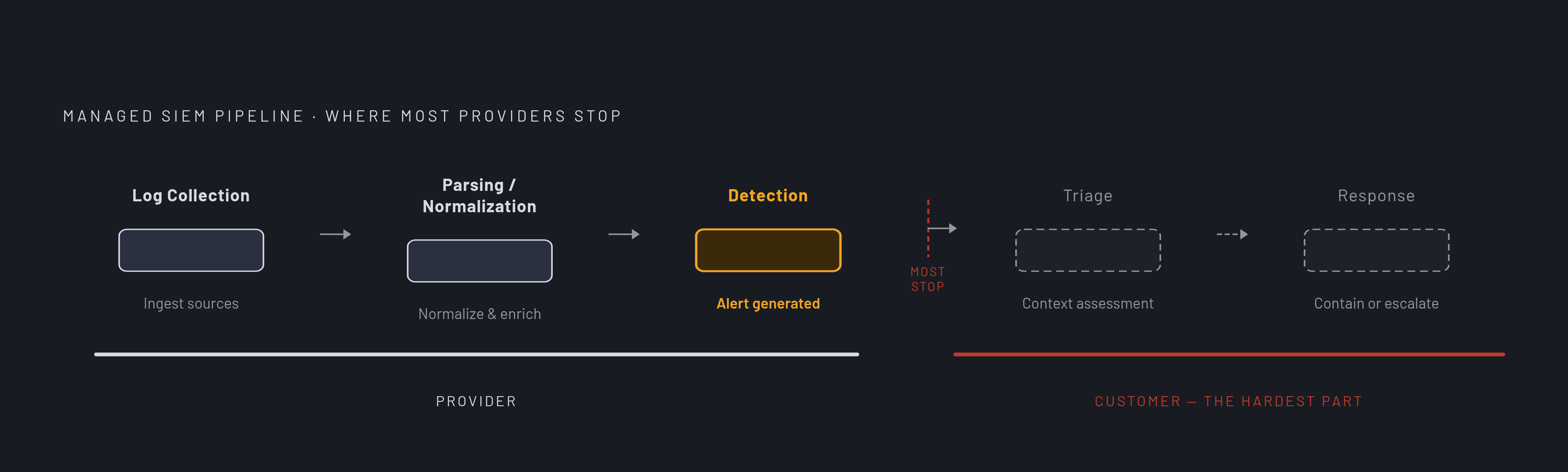
Most managed SIEM providers fall into the second category. They collect logs, apply some detections, and send alerts back to the customer's own team with a request to investigate. That outsources the ingestion work. It does not outsource the triage and investigation work that makes the SIEM worth having.
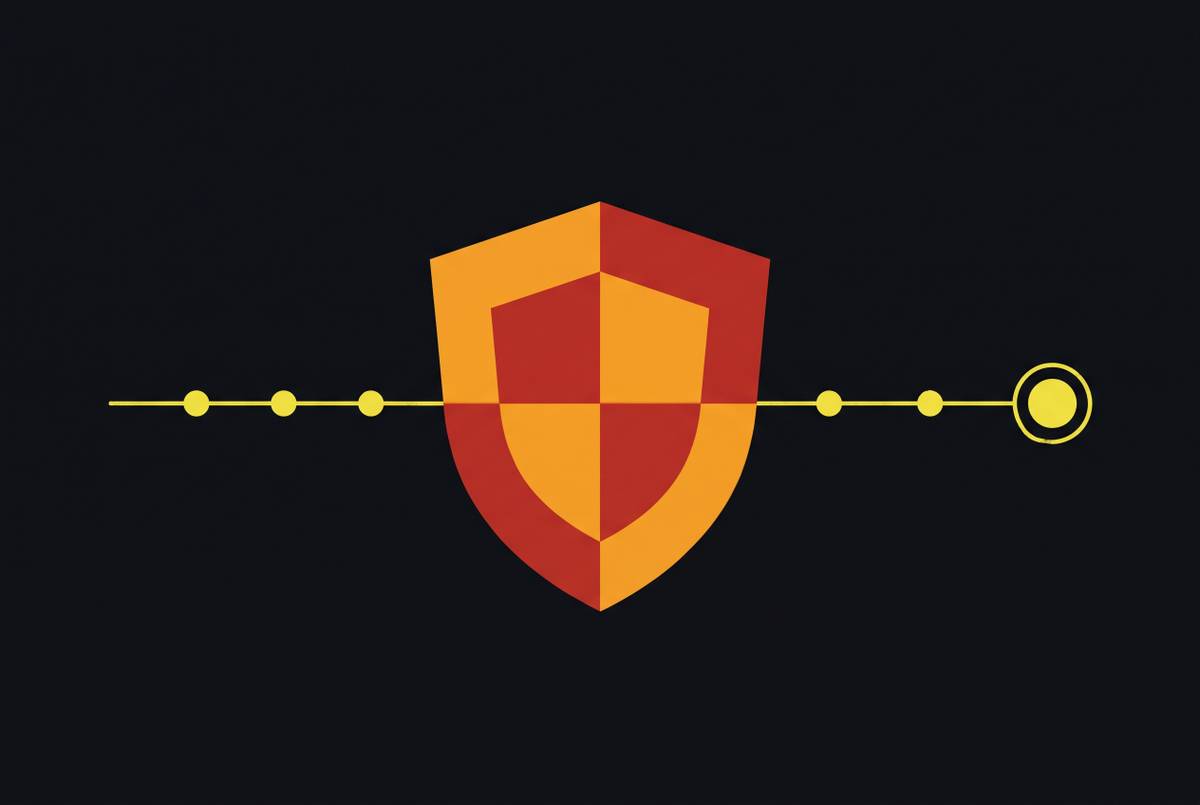
A useful way to picture the managed SIEM pipeline is as a sequence of steps running from log collection through to response. Most providers stop at detection, the point where an alert gets generated, and hand everything after that back to the customer. The arrangement only pays off when the provider also owns triage, assesses the context around each alert, and either escalates it with that context attached or takes direct action to contain it. Anything short of that leaves the customer doing the hardest part alone, just with a vendor's logo on the dashboard.
Architecture affects how fast onboarding actually goes. A provider that connects to data where it already lives, instead of requiring everything to migrate into a proprietary platform first, skips the data-migration workstream entirely, and that alone can cut weeks off the schedule.
A standardized stack compounds that advantage. Organizations already running Microsoft, CrowdStrike, or other widely deployed platforms benefit from connectors that have been built and tested many times over, which shortens the parser-development phase considerably. An organization with CrowdStrike's Falcon sensor already deployed, for example, sees its SIEM data-onboarding phase shrink because the telemetry pipe already exists, and native Falcon telemetry doesn't carry the extra ingestion charges that third-party data would. Zip Security works on a similar principle: it brings device management, identity, and endpoint telemetry together from the start, which cuts down the number of separate, disconnected log sources a SIEM has to be configured to ingest later.
What actually separates a fast managed deployment from a slow one comes down to who owns the correlation rules. A provider that builds and maintains detection logic calibrated to the customer's own environment produces something trustworthy. A provider that doesn't just produces a more expensive alert queue with someone else's name on the invoice.
What mid-market buyers should evaluate before committing to a SIEM deployment model
A buyer who understands where SIEM complexity actually lives can pressure-test a vendor's timeline before signing, instead of finding out about the gaps six months into a contract they're already locked into.
What matters is how long before a detection fires and an analyst can act on it without having to guess what it means. Those are two different dates: the date logs start flowing into the platform, and the date the detections coming out of it can actually be trusted. Vendors quote the first one. Buyers need the second.
A handful of direct questions surface most of the friction points covered above before a contract gets signed. How many of the organization's specific log sources already have a maintained connector, and who builds a custom parser for the ones that don't? Who owns tuning the correlation rules after the initial deployment is done, and is that ownership written into the contract or just assumed? Does the provider's team investigate and contain incidents themselves, or do they escalate and wait for the customer's own staff to act? For any organization carrying a legacy SIEM into the switch, does the quoted timeline separate out the parallel run, the data rehydration, and the detection translation, or does it treat migration as a rounding error? And what compliance frameworks does the onboarding process actually address, with retention policies and audit trail configuration handled as part of that work rather than left for later?
Staffing determines all the other answers, so a lean team should answer it honestly before signing anything. If the honest answer is "nobody yet," the managed arrangement needs to satisfy that requirement from day one, not patch it after go-live.
For an organization without a dedicated security team, reducing the number of disconnected log sources before a SIEM ever gets layered on top does more to shorten the timeline than almost anything else on this list. Bringing device management, identity protection, and endpoint security together first cuts down the parser and normalization work a SIEM would otherwise need. Zip Security is built around that sequence, treating consolidated telemetry as the starting point that makes everything layered on top of it, including SIEM detections, actually workable rather than something bolted on after the fact. Buyers who understand where SIEM complexity really lives are positioned to pick a deployment model that fits the team and the stack they actually have.